Why Keyword and Audience Targeting Break Down Inside AI Conversations
Conversational AI makes keyword and audience profiles obsolete by revealing actual intent directly.
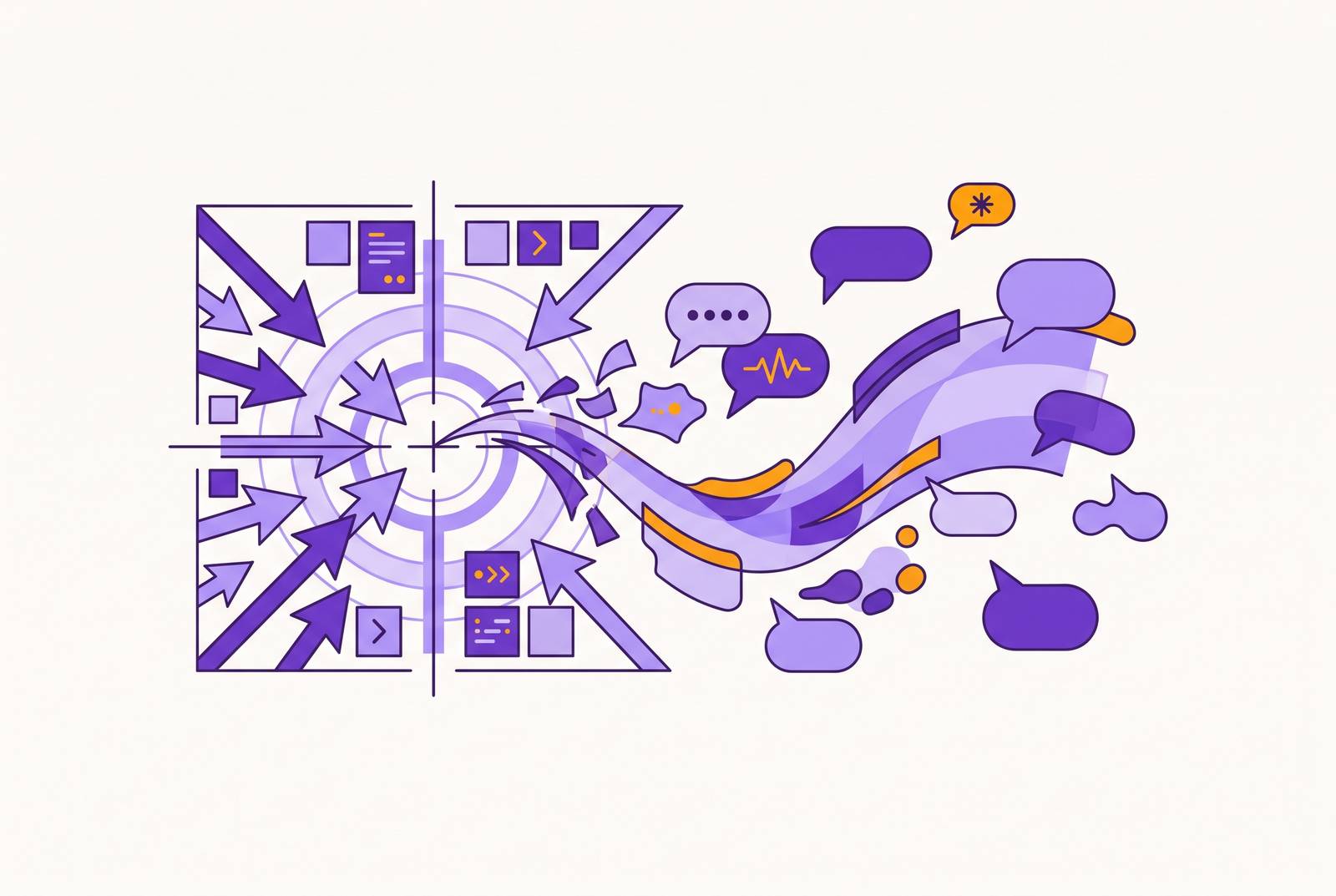
Keyword and audience targeting exist for one reason: advertisers have never had direct access to what a person wants at the moment they want it. Both tools are reconstructions: they get built after the fact, from fragments left behind. A keyword is just a guess at intent, drawn from a few typed words. An audience segment is an inference built from what someone did before: the pages they visited last week, the products they searched for last month. Neither reads the reasoning behind a request. A keyword catches a moment; an audience filter guesses who was behind it, and the two layers stack on each other without ever touching the thought that produced the query. Every refinement built on top of these tools, from match types to negative lists to bid modifiers, sharpens the guess without changing what it is: a workaround for intent that stays hidden until someone builds a system that doesn't need to guess.
How search-era targeting mechanics work
Search and social advertising rest on a specific model of how people behave: a person forms a need, compresses it into a short query or a passive click, and the platform tries to match an ad to that fragment. On the keyword side, advertisers bid on strings of text, sort them by match type, suppress unwanted traffic with negative keyword lists, and read a search term report afterward to see what actually triggered the ad. The entire workflow treats a short typed phrase as the clearest available signal of what someone wants, because for most of the industry's history, it was. On the audience side, platforms build profiles from browsing history, purchase data, demographic records, and inferred interests, all assembled before the ad ever appears, all backward-looking by design. None of it reads what the person is thinking in the moment the ad shows up. Even the search term report, the closest thing practitioners have to a window into real intent, is already one step removed: it shows what someone typed, not what they meant, and it only becomes available after the moment has passed. None of this makes the system irrational. It makes sense as an answer to a hard constraint: intent was never directly observable, so the industry built the best approximation it could out of strings and profiles.
What is different about a conversational AI interface, mechanically
A conversational AI interface changes the basic unit the advertiser is working with. The user isn't submitting a query to be matched against an index. They work through a problem out loud, in their own words, across several turns, and each message builds on what came before it. What someone said three exchanges ago shapes what their next message means, so the targeting surface becomes a moving target: a context that keeps evolving, not a static page or a single point-in-time search. The systems behind these interfaces, built on transformer architecture, keep a running representation of the whole dialogue, supporting what linguists call discourse coherence. That means the full conversation is the meaningful unit, not any single line within it. Someone who asks "what about vegetarian options?" can't be understood without the earlier exchange about restaurants or meal planning: the intent lives across the conversation, not inside any one sentence. A single exchange might start as a restaurant recommendation, shift into trip planning, move into budget questions, then land on transportation logistics, four distinct intent contexts that a page-based or query-based system would record as four unrelated events.
The ChatGPT surface shows this shift in concrete form. Ads there appear in visually distinct, clearly labeled sponsored cards, and they stay separate from the AI's actual answer by design. OpenAI's "Answer Independence" principle commits to never letting advertising shape what the model says in response, so the ad sits beside an answer that was never influenced by who paid for the placement. Targeting here runs on a natural-language context hint set at the ad group level, not a keyword list and not a demographic selector, so if your bid is well-matched but modest, it can beat a poorly matched large one in a relevance-weighted auction. ChatGPT is the most developed public example of this shift, but the structural change it represents, conversation as the unit of targeting, isn't limited to one company's interface.
Why keywords specifically break down in this environment
Keywords don't fail in conversational AI because the users are harder to reach. Someone might never type "project management software" into anything, yet spend several turns describing team coordination problems, missed deadlines, and the friction of remote collaboration. A keyword-matching system sees nothing there. A system reading the conversation can spot a high-intent pattern for that exact product category. Ordinary words like "team," "deadlines," or "track" trigger a keyword match in a legacy system, but those same words appear across completely different conversations carrying completely different intent, and a keyword has no way to tell them apart without the dialogue around them.
The tools built to sharpen keyword precision, match types and negative keyword lists, don't carry over to a conversational surface. Most conversational AI platforms give you no search term report, no negative keyword field, and no match type selector, though Microsoft Copilot is an exception, offering search term reporting and term exclusions through AI Max. On most surfaces, the only lever an advertiser has is how narrowly or broadly the natural-language context hint gets written. The whole keyword refinement cycle, audit search terms, expand the negative list, tighten match types, depends on a query that can be pulled out, inspected, and categorized after the fact. In a multi-turn conversation, there is no isolated query to pull out. The "query" is the entire dialogue, and a dialogue can't be reduced to a string match.
Demographic and behavioral audience segments have no direct analog in conversation
Audience segments are profiles assembled from what someone did in the past. A conversation reveals what someone wants right now, and those are two different kinds of signal that don't substitute for one another. On the ChatGPT surface, there's no way to target by age, gender, industry, job title, or interest category, though advertisers can upload their own first-party customer lists as custom audiences for inclusion, exclusion, or bid adjustments. That's not a missing feature waiting to be patched in. It follows because the system is built around conversational context instead of a stored profile of the user. The historical-profile model assumes past behavior predicts future need. A conversation skips that inference entirely, because the person is already stating what they want in plain language.
Picture someone who asks to compare enterprise project management software for a team of 50 with Salesforce integration, next to someone who just asks what's a good app to track tasks. A demographic segment would likely file both under the same label, project management prospects, but they're separated by budget, purchasing authority, and how close they are to making a decision, and the conversation makes that separation visible immediately. A single conversation can carry the budget, the constraint, the shortlist of options already considered, what got rejected and why, and the rough timeline for deciding, all information that behavioral targeting systems spend enormous effort trying to approximate from scattered browsing patterns. In this environment you target the conversational intent cluster: a group of people defined by the problem they're working through, not by the demographic traits they happen to share. The privacy architecture follows from the same structural shift, not the other way around: because relevance comes from the current conversation rather than cross-site tracking history, persistent user identifiers aren't required for contextual relevance, though platforms like ChatGPT Ads still support identifier-based custom audiences for targeting and suppression where advertisers supply their own lists. Context has replaced the profile as the foundation, and the privacy benefit is a consequence of that design, not its justification.
What conversational intent signals reveal beyond keywords and segments
A single prompt inside a multi-turn AI conversation carries qualitative information, purchase readiness, budget, decision-making authority, competitive context, that keywords and audience segments were never built to surface. Funnel stage appears directly in how a question gets phrased. Exploratory prompts like "how does X work" or "help me understand my options" mark early research. Comparative prompts like "best X for Y" or "X versus Y" mark active evaluation. Transactional prompts like "X pricing" or "how do I sign up for X" mark someone close to a purchase, and each of these stages calls for different creative and a different offer.
Budget and authority signals come through without anyone having to ask for them. If someone mentions procurement processes, RFP requirements, or a decision involving multiple stakeholders, that points toward larger deals and longer sales cycles. Someone describing a need as "affordable" or "cost-effective" versus someone asking about an "enterprise" or "comprehensive platform" tells an advertiser more about buyer type than a demographic filter can, because the conversation states the buyer type while the demographic filter only guesses at it. Competitive context arrives the same way, unprompted: a user who names what they already evaluated and why they rejected it has handed over a qualification profile that a sales development rep might spend weeks extracting through calls and emails, and the conversation delivers it before any ad has even been served.
A query like "I'm leading a remote team of 12 people across three time zones, and we're constantly missing deadlines because communication is scattered across email, Slack, and text messages, what should I do?" packs in team size, the specific workflow, the exact pain points, and a clear decision context, all in one message. A three-word search query can't approach that density of signal. The conversation also keeps updating itself: as the user adds detail across turns, the signal gets sharper, so an advertiser reading that conversation is watching a funnel narrow in real time rather than waiting days for the same person to come back with a more specific search. The real-time prompt analysis approach inverts the old problem directly: rather than reconstructing intent from fragments after the conversation has ended, it reads the full conversational context as the user is expressing it, so the proxy becomes unnecessary.
What advertisers need to rebuild
Moving from keywords and audience segments to conversational intent targeting takes more than flipping a setting inside an existing campaign. You have to rebuild the basic unit of strategy, replacing search terms and audience personas with conversational territories and intent clusters. So instead of auditing keyword lists and building out negative keyword sets, advertisers need to map the problem states their best customers are actually in when they first engage: not their job title or industry, but the specific situation that makes a given solution relevant to them right now. Some advertisers are already building what amount to conversational personas, recognizable patterns in how a conversation unfolds that signal a specific need or decision stage. Instead of targeting "small business owners," the target becomes conversations that show signs of cash flow concerns, or dialogues where someone is actively exploring automation options for their business.
Without a search term report, the optimization loop changes shape too. Instead of mining query data for new negative keywords or tighter match types, you analyze which conversational territories produce genuine engagement and adjust the context descriptions accordingly. Creative has to adjust along the same lines: an ad that fits the research stage of a conversation will miss badly if it shows up during evaluation or at the point of decision, and the conversation itself tells an advertiser which stage they're actually looking at. Platforms built specifically for this environment, including programmatic infrastructure built for large language model interfaces, are built to take in multi-turn dialogue as a whole and act on it, treating the conversation itself as the matching signal rather than trying to extract a single query or a demographic label from it. That's a genuine shift in skill, not a new coat of paint on an old one. Conversational AI ad platforms work on semantic intent spread across a dialogue rather than isolated terms, so a brand's ad can match against the actual reasoning behind a person's request, not a keyword list that was only ever a guess at what that reasoning might have been.