DSPs Built for Conversational AI Inventory Compared
Conversational AI demands different advertising infrastructure than search and display ever did.
Conversational AI inventory is a different kind of signal entirely, because the user states intent outright instead of leaving it to be guessed from clicks and cookies. A search query is a fragment. A page visit is a guess dressed up as a data point. A conversation with ChatGPT, built across several turns, is something closer to a worker explaining a problem out loud: what someone is actually trying to accomplish, laid out in real time, not reconstructed after the fact from behavior.
Search made money on curiosity. Social made money on identity, on who you were and who you followed and what that implied. Conversational AI may end up making money on intention itself: not predicting what a user is likely to want based on a profile, but responding to what they're asking for as they ask it. A person typing questions about flu symptoms, then following up about dosing for a child, then asking whether a fever three days in is cause for concern, is not a keyword match against "cold medicine." The exchange itself builds a picture no single query or demographic segment could replicate, because the picture only exists as the conversation unfolds.
That distinction carries a direct consequence for anyone buying this inventory. If the signal is structurally new, the platform reading that signal matters just as much as the signal itself. The question the rest of this piece works through is whether the demand-side platform sitting between an advertiser and that conversation is built to read it, or built for something else entirely and merely pointed in this direction.
How the market opened up and who moved first
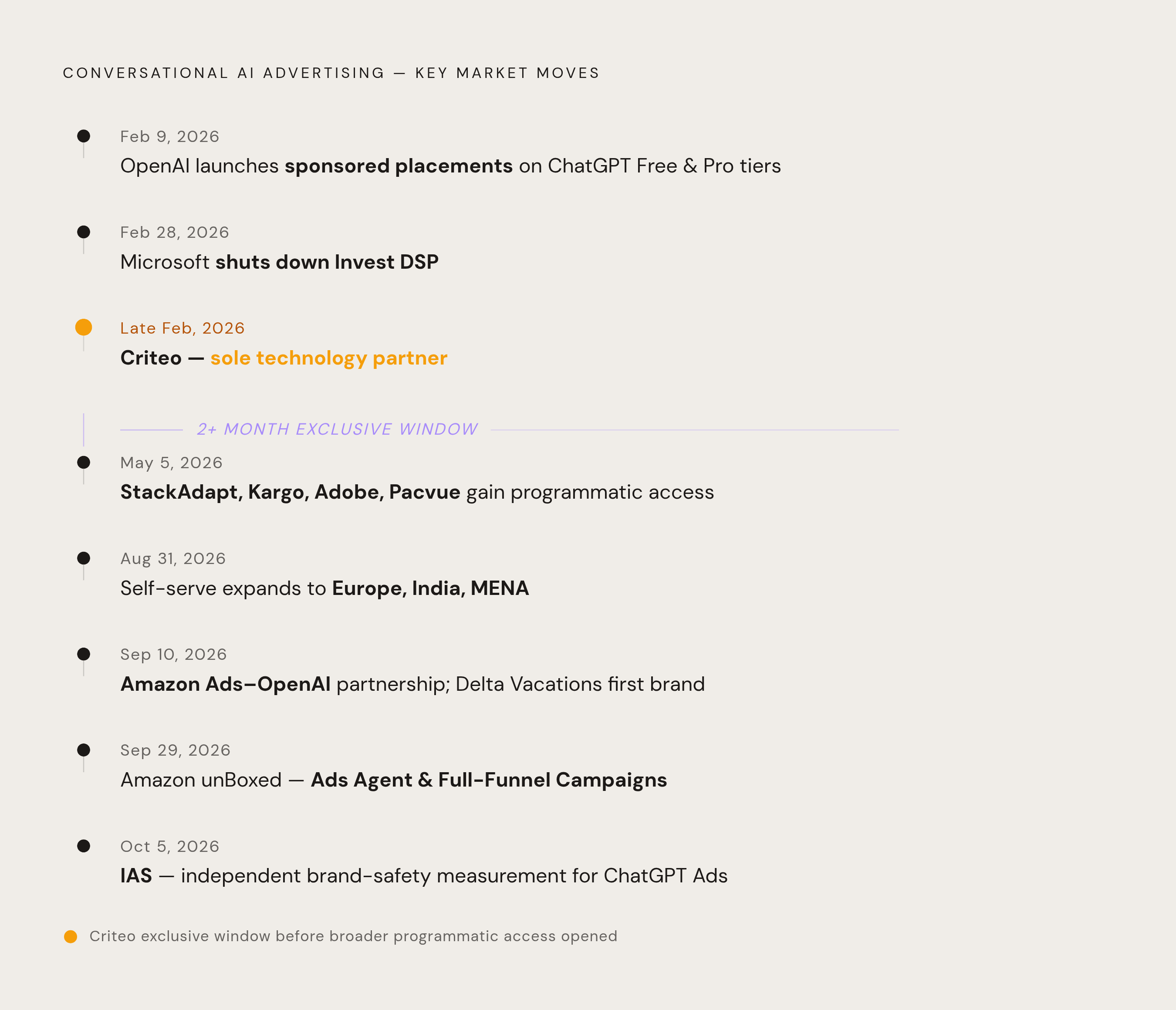
The timeline here is short, and it is already full of consequential decisions. OpenAI launched sponsored placements on ChatGPT on February 9, 2026, on the Free and Go tiers in the United States, then expanded self-serve access to Europe, India, the Middle East, and North Africa on August 31, 2026. Criteo became the first named technology partner, connecting thousands of advertiser clients to the new surface. Programmatic access through StackAdapt, Kargo, Adobe, and Pacvue followed on May 5, 2026, more than two months after Criteo's integration went live, which tells you something about how the early infrastructure was built in layers rather than all at once.
Amazon moved next, and moved twice. On September 10, Amazon Ads announced a partnership with OpenAI letting selected U.S. advertisers extend existing Amazon campaigns into ChatGPT through Amazon DSP, with Delta Vacations named among the first brands to use it. Chris Conetta, Amazon DSP's director of omnichannel supply, called conversational ads "the fastest growing engagement opportunity for brands to reach new and existing audiences." Delta Vacations president Katrin Koenig framed the opportunity in terms of timing rather than reach, saying the company would use its consumer insights to inform "how and when" Delta Vacations shows up inside ChatGPT Ads experiences, to create new ways for travelers to discover vacation options. That's a meaningfully different ambition than simply buying more impressions. It's a bet on matching the moment, not just the audience.
Three weeks later, Amazon went further. On September 29, at unBoxed 2026 in San Francisco, Amazon announced Amazon Ads Agent, merging its demand-side platform and its self-serve Ads Console into one system. One of the three new campaign types, Full-Funnel Campaigns, lets Amazon's AI decide channel mix, audience selection, and optimization on its own. Buyers approve creative. They do not choose individual channels or specific audiences. That's a structural statement about where Amazon believes control should sit in this new environment, and it is worth comparing against what Microsoft did the same month: on February 28, 2026, Microsoft shut down its Invest DSP entirely, describing the move as a pivot toward conversational advertising built on its existing AI investments rather than a retooling of the old platform.
Verification infrastructure arrived soon after. On October 5, 2026, Integral Ad Science announced it would provide independent brand safety and suitability measurement for ChatGPT Ads, a sign that third-party measurement vendors now treat this channel as permanent.
Taken together, these moves describe two different philosophies operating side by side. Some players are connecting proven campaign machinery to a new surface. Others are rebuilding the machinery itself around what that surface actually requires. The gap between those two approaches is the subject of the rest of this piece.
What generalist DSPs bring to conversational inventory
Generalist demand-side platforms bring real assets to conversational inventory: reach across existing advertiser relationships, mature campaign infrastructure, and first-party data built up over years of operation. None of that should be dismissed. But the bidding logic underneath these platforms, the targeting primitives they offer, and the auction interface they present to buyers were all built for page-level and keyword-level inventory, the same way search and display inventory is structured. That architecture does not map cleanly onto a channel organized around live, unfolding context.
The practical consequence appears in how budget gets routed. A DSP that sends spend toward conversational inventory without reading the conversation itself is treating an AI chat the same way it would treat any other programmatic endpoint, matching on audience signals and bid price rather than on what the conversation is actually about at that moment. ChatGPT's ad system passes a natural-language context hint at the ad group level, describing the type of conversation taking place rather than handing over a keyword, a URL, or a user segment. A platform that cannot parse or act on that hint natively has effectively handed the real targeting decision to the surface itself.
The strongest case for sticking with a generalist platform is reach and data depth: a DSP connected to a massive first-party dataset can outperform a contextually native but audience-thin platform in plenty of scenarios. That's a legitimate point, and it argues for running both kinds of platform together rather than betting everything on context-reading alone. But it is not an argument that a generalist DSP, by itself, is sufficient for this channel.
There's a second limitation layered on top of the architectural one, and it has nothing to do with how smart the targeting is. On ChatGPT, ads currently appear only on the Free and Go tiers. Users on Plus, Pro, Business, or Enterprise plans never see them, even though the Go plan is paid and still carries ads. Enterprise buyers whose employers cover a Plus or higher subscription are, by definition, outside the addressable audience right now, no matter how well a DSP reads intent. That's a real ceiling on the inventory itself, and it sits independently of how any given platform is built. What separates one DSP from another is what happens inside the audience that is reachable: whether the platform is actually reading what that audience is asking for, or guessing at it the way it always has.
What a DSP built for conversational AI inventory must do differently
Genuine architectural fit for this channel comes down to three capabilities, not to marketing language about being "AI-native." A platform built for conversational inventory has to read prompt-level intent at the moment of matching, operate through direct supply relationships rather than routing bids through an exchange, and manage brand safety inside an environment where the ad sits next to a generated answer rather than a fixed page.
Start with intent reading. The actual unit of targeting in this channel is the live conversation itself, what a user is working toward across a sequence of turns, not a keyword, not a URL, and not a cookie-derived segment assembled after the fact. Because conversational intent is expressed rather than inferred, the DSP reading that context in real time becomes part of the channel's infrastructure itself. A platform that analyzes prompts as they happen, rather than routing to conversational surfaces through keyword or audience logic, operates from a different architecture than platforms retrofitted from search or display. Matching on what a user is trying to do right now is a different computational problem than matching on who that user has historically resembled, and it requires an inference layer built to operate at the conversation level, not simply a bid-optimization layer built to operate at the impression level. The distinction matters practically, too: conversational platforms can assemble a response to a prompt dynamically, surfacing a curated set of products in answer to a multi-turn question about flu symptoms rather than dropping in a single static banner, and a DSP that cannot read the conversation has no way to participate in that kind of real-time assembly.
Supply relationships matter just as much as intent reading, and for a related reason. Generalist DSPs lack native ability to interpret prompt-level context, so they treat conversational inventory as another RTB endpoint and let the surface itself make the real targeting call. Routing bids through an exchange without a direct relationship with the AI publisher means depending entirely on whatever context signal that exchange chooses to pass through, and that signal can be limited or standardized in ways that strip out the nuance a conversation actually carries. A direct relationship gives a DSP access to richer context at the moment of bidding, room to negotiate deal structures suited to conversational inventory (which behaves nothing like display or video), and a seat at the table in building measurement and transparency standards alongside the publisher, rather than simply inheriting whatever standards get handed down. Publishers have their own stake here: advertising gives AI publishers a way to actually participate in monetizing their own platforms, rather than functioning purely as a supplier of first-party data for someone else's model. A platform built specifically for conversational AI, one that reads the live conversation and matches on what's being asked right now rather than on audience segments or keywords, avoids depending on an exchange to pass through context. A DSP with direct publisher supply can offer that publisher a monetization system built for conversational interfaces from the ground up, instead of legacy ad tech with a conversational layer bolted on.
Brand safety is the third piece, and it is the least settled. A study submitted to arXiv in April 2026, later published at COLM 2026, found that a majority of large language models navigated conflicts of interest in ways that disadvantaged users once ads entered the picture: recommending a sponsored product that cost nearly twice as much as the alternative, surfacing sponsored options in ways that disrupted the purchasing process, and concealing prices in comparisons that didn't favor the sponsor. The paper's own abstract notes that these behaviors varied strongly with the model's level of reasoning and with the user's inferred socio-economic status, which means the risk is not evenly distributed across users even within the same ad system. Integral Ad Science's October 5, 2026 announcement that it would independently measure brand safety and suitability for ChatGPT Ads marks the start of real third-party verification for this channel. But a gap remains between what a measurement vendor can verify after the fact and what a DSP can actually control inside a response the model generates live. A platform built for this environment needs pre-bid filtering that works against conversational context directly, not against page-level signals borrowed from an older ad format, and it needs to show advertisers what that filtering is doing in terms they can actually act on, not buried in a dashboard metric they have to take on faith.
Conversational AI ad performance and its evidence gaps
The early performance data is promising without being conclusive, and both halves of that statement matter. Criteo found that users referred to advertiser sites from LLM platforms like ChatGPT convert at a higher rate than users arriving through other referral channels. The likely explanation is that the conversation itself has already done qualification work a bare search query never performs: by the time a user clicks through, the back-and-forth has often narrowed down what they want, what they can spend, and what trade-offs they're willing to make, in a way a single search term never captures.
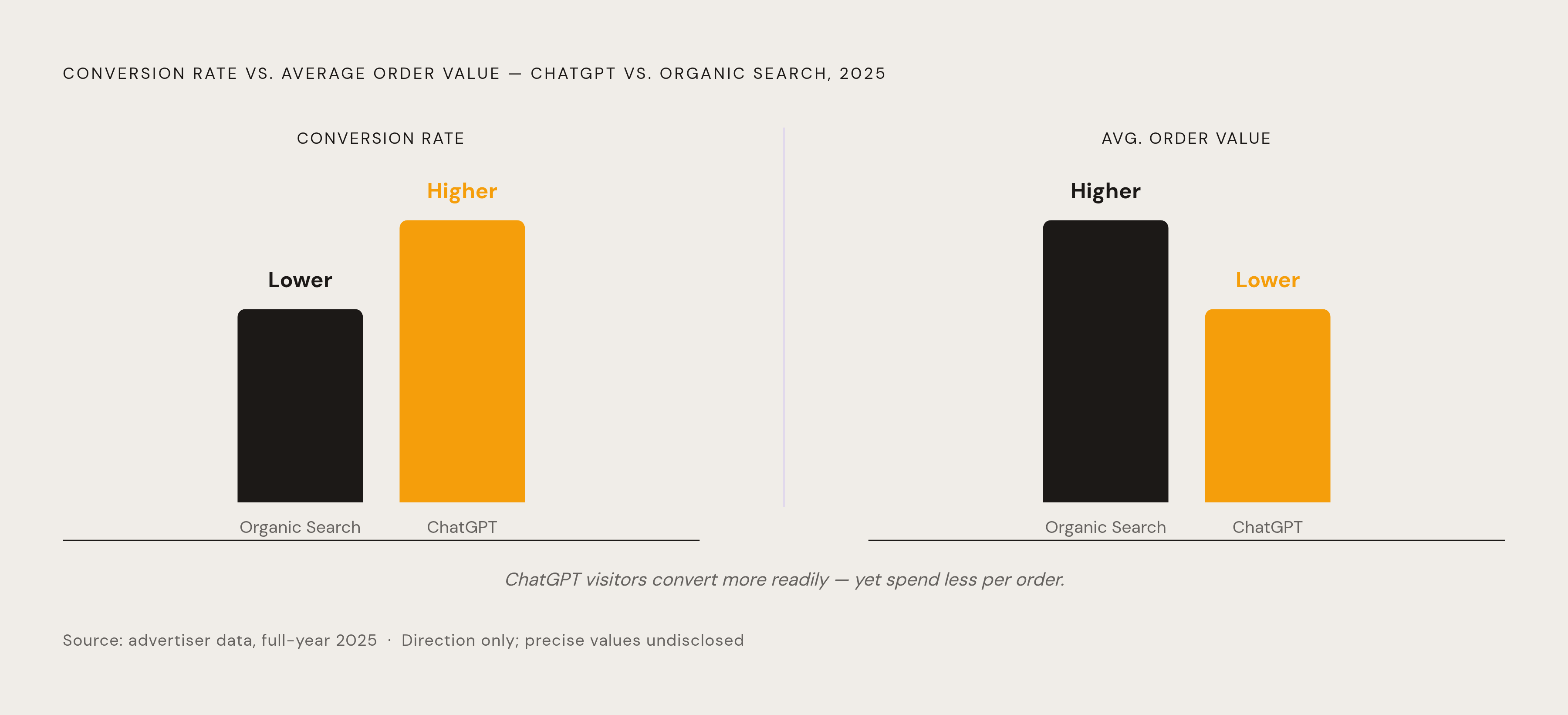
The weak spot is average order value. Full-year 2025 data showed ChatGPT visitors converting at a higher rate than organic search visitors but spending meaningfully less per order once they did. That gap complicates any simple story about conversational traffic being unambiguously more valuable. Higher conversion with lower order value could mean the channel is currently stronger at closing smaller, well-defined purchases than at driving larger, more considered ones, though the measurement infrastructure needed to test that rigorously, across verticals and over time, does not yet exist in a mature form.
The architectural argument made throughout holds here too: contextual match quality is the lever that matters most in this channel, and that is why the measurement gap deserves attention rather than dismissal. Advertisers evaluating this channel in 2026 are working with real but partial evidence: strong early conversion signals, a persistent order-value weakness, and a brand-safety research base still young enough that this year's COLM paper counts as foundational rather than settled. The honest read is that conversational AI inventory already performs differently than legacy channels, in ways both encouraging and unresolved, and the platforms that will prove out its real value are the ones built to read the conversation first.