How AI Chat Ad Placement Matching Actually Works
Advertisers must match ads to live conversation context, not keywords.
A demand-side platform for AI chat ads has to read a live conversation and decide, in real time, whether a given ad belongs inside it. That is a different job from matching keywords to a query or matching a segment to a cookie, and it is why buying this channel well requires a new mental model, not a new UI skin on an old one. Thrad, a programmatic ad platform built for AI chat interfaces that reads the live prompt to determine which ad belongs in a conversation, is one infrastructure layer designed around exactly that distinction. ChatGPT launched ads on February 9, 2026. Google confirmed new ad formats for AI Mode at Google Marketing Live 2026. Microsoft Copilot auto-enrolls eligible campaigns by default. All three are live at once, and none of them work the way a search campaign does.
Why AI Chat Ads Require a Different Mental Model
In search, the advertiser picks the keywords that trigger an ad. In a conversational interface, the advertiser writes a description of the kind of conversation the ad belongs in, and the platform's own language model decides, turn by turn, whether a live exchange matches that description closely enough to earn the slot. That handoff of control is not a cosmetic difference. That handoff changes what skill a media buyer needs, what data is actually useful for targeting, and how the system decides an ad is relevant. A keyword list is a set of strings to match against a query. A context hint is a description of a situation, read by a model that is already tracking the meaning of an entire conversation. Those are different crafts, built on different inputs, judged by different mechanisms.
The speed at which this has gone live across the industry is itself part of the argument for taking the shift seriously. ChatGPT's ad launch, Google's AI Mode formats, and Microsoft Copilot's auto-enrollment did not arrive one at a time with room to adjust between them. They landed close together, on surfaces that between them cover a large share of how people now ask questions online. A marketer who treats any of these as a smaller version of a search campaign will misconfigure it from the first flight, because the targeting logic simply is not the same logic.
The major AI platforms disagree about whether this channel should exist. OpenAI, Google, and Microsoft have each gone the other direction, but with different architectures and different levels of advertiser control. That split is not noise. It tells a buyer that the economics and the trust questions around advertising inside a conversation are still unsettled, and that each platform has made its own bet about how to resolve them.
Where the ad physically sits inside a conversation, and why that placement decision is load-bearing
Before any targeting mechanism matters, the physical location of the ad relative to the answer has to be understood, because that location is what sets the trust rules and the inventory rules everything else operates under.
On ChatGPT, the ad renders as a labeled sponsored card that sits below the assistant's answer. It is not woven into the answer text, and the model's response itself is not for sale. With more than 50 million paying subscribers by February 2026, that is a large, specific slice of the user base that sits entirely outside the ad inventory, regardless of budget or bid.
Google's approach places the ad inside the conversational search experience itself. New formats confirmed at Google Marketing Live 2026, including Conversational Discovery ads and Highlighted Answers, run through Gemini, which reads the conversation and decides what's relevant and whether, and which version of, an ad belongs in the response. The advertiser supplies the raw materials but doesn't control that placement decision directly. Any team running Microsoft Advertising or Bing campaigns is likely already running Copilot ads without having made an active decision to do so.
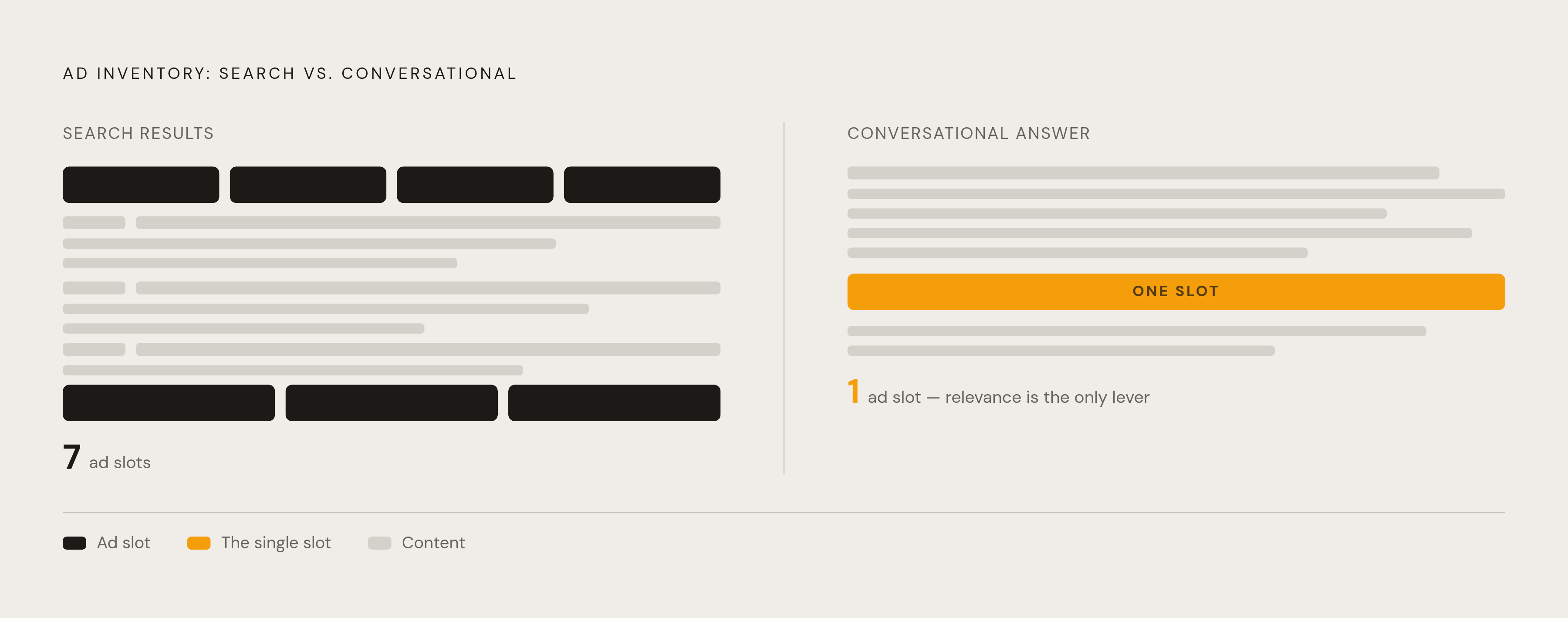
A constraint shapes the entire channel across all three approaches: a search results page can hold many ads side by side, but a single conversational answer can realistically hold one, maybe two. That scarcity is a structural property of the format, and it's what makes relevance the main lever a buyer has, since there's no volume play that compensates for a mismatch when only one slot exists per exchange. Platforms building the supply side of this market, the exchanges and infrastructure vendors that sit behind these surfaces, have had to rethink inventory scarcity itself for exactly this reason: a conversational answer accommodates far fewer placements than a results page, so relevance becomes the only lever that scales.
How the Context-Matching Mechanism Reads a Conversation
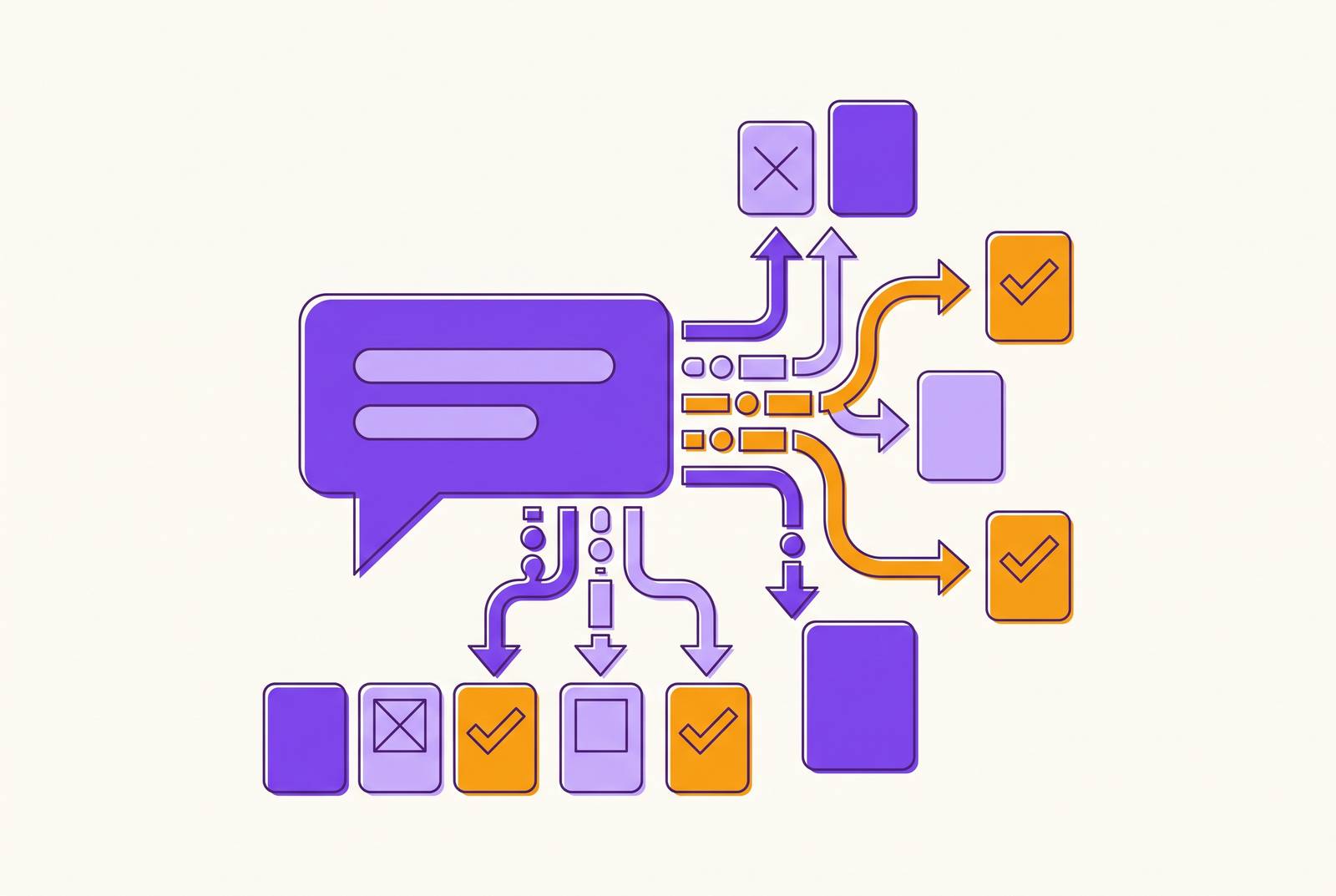
The mechanism at the center of all this doesn't match an ad to a query. It matches an ad to the full semantic state of a conversation that's still in progress, and that's a different problem that needs a different kind of solution than keyword matching ever did.
The system reads the entire thread, not just the last message a user typed. A user who asks "what about vegetarian options?" partway through a conversation about restaurant picks isn't producing an isolated query. The system reads that question against everything said before it, including the dietary preferences and the restaurant context that came earlier in the thread.
That has a direct consequence for how little a keyword can actually tell an advertiser. Someone might never type the name of a product category and still spend several messages describing, in detail, the exact problem a product is built to solve. The practical shift this demands is that advertisers need to think in terms of problem narratives and conversational journeys, not keyword lists, because the system is built to recognize the former and mostly blind to the latter.
There's also a personalization layer for users who've opted in. In practice, a user whose chat history is full of conversations about starting a business may see a different ad than someone whose history is mostly about travel planning, even inside a conversation that looks superficially similar on the surface.
The privacy shape of all this runs opposite to how most ad targeting has worked for the last fifteen years. Relevance here comes from what's being discussed in the conversation happening right now, not from a browsing history or a persistent identifier tracking a person across sites. Each conversation functions as its own discrete targeting context, evaluated on its own content. The system doesn't depend on the cross-site tracking infrastructure that the rest of digital advertising has spent a decade building and is now spending a decade dismantling.
How the Auction Prices Conversational Relevance
Once the system has decided which ads are plausible candidates for a given moment in a conversation, it still has to pick a winner and set a price, and that auction works on relevance. A small advertiser with a precisely written hint can out-compete a much larger advertiser running something generic. That is a genuinely different dynamic from a search auction, where scale and Quality Score both matter but raw budget still tends to win out once volume gets competitive.
Pricing relevance this way sounds straightforward until the auction actually has to do it, because establishing genuine click-through intent without historical log data is a hard problem. The same research builds a way around this gap, constructing a psychologically grounded simulation that uses Big Five personality priors to generate synthetic agents with plausible click behavior, using that synthetic data to train a continuous, differentiable evaluator, and deriving a truthful auction pricing rule from the resulting signal.
None of this is cause to sit the channel out. A buying platform built for this surface has to solve a version of this same problem on an ongoing basis, because the auctions it's bidding into are pricing a signal that the industry is still learning how to measure well.
On the buying side, ChatGPT currently offers three ways to pay: CPM for a Reach objective, CPC for a Clicks objective, and oCPC for a Conversions objective, with custom max bids available on both the CPC and oCPC options. Self-serve access through the OpenAI Ads Manager opened in May 2026, and after the pilot phase there's no minimum spend requirement, which puts the channel within reach of advertisers well below the scale that used to be required to get early access to a new ad surface.
Why intent stated in a conversation is structurally richer than intent inferred from a query
A search query is a compressed signal that a marketer has to reconstruct backward into something like a buying stage. A conversation often just states the budget, the constraint, the shortlist, and what the person has already ruled out, in the person's own words, without any reconstruction needed. That makes a conversation a richer and more honest record of where a buyer actually stands than a handful of keywords ever could be.
Intent gets stated rather than inferred, so a marketer working from a three-word search query has to guess whether that query represents someone just starting to look or someone ready to buy. A marketer working from a conversation doesn't have to guess, because the user has already said which product attributes matter to them, named an actual budget range, or asked directly which of two options to rule out. A single exchange like that can carry more targeting information than an entire keyword-driven session would.
Conversations also move. What starts as a general question can pass through research, comparison, objection-handling, and a decision, often inside one sitting, and each of those phases is a different commercial moment that calls for a different message. Most contextual ad systems built for other formats analyze a piece of content once and treat that judgment as fixed. A system built for conversation has to keep reassessing relevance as the dialogue develops, because the moment that matters for an advertiser might be the fourth message in, not the first.
That dynamic is also what makes multi-turn conversation retargeting, a newer idea in this channel, worth paying attention to. Rather than retargeting someone because they visited a website, the system retargets someone who had an extended conversation about the exact problem a product solves but didn't convert in that conversation. That is a different category of signal than a site visit: it reflects demonstrated engagement with the problem itself. Multi-turn conversation retargeting is targeting Q4 2026 availability. Because the whole targeting approach is built on what's happening in the live conversation rather than on tracking a person across sites and sessions, the signal holds up well as privacy rules keep tightening elsewhere in the industry, without needing the cross-site identifiers that are becoming harder to rely on everywhere else.
What the Matching Logic Means for Writing Context Hints
Of everything a media buyer controls in this channel, the context hint is the highest-leverage piece of craft; treating it like a keyword list produces consistently bad matches, because the system reading it is parsing meaning, not matching strings.
A context hint needs to describe a conversational situation in plain language, not list the topic categories an ad supposedly covers. It should describe what the person in that conversation is trying to get done and why the offer is useful to them at that specific moment, not which product category the advertiser sits in. A hint built like a comma-separated list of topics, the kind of thing that would have worked fine as a keyword set, reliably produces weak matches. A hint written like a short account of the situation a buyer is in right when the product becomes relevant to them matches far more accurately, because it's giving the model the same kind of information it's already using to track the rest of the conversation.
The copy and the landing page aren't separate creative decisions sitting downstream of the hint. They are matching signals in their own right. Copy written to answer a question someone might actually be asking in the moment tends to match better than copy built around a sale or a list of product features, and the auction reads the hint, the copy, and the landing page together as one combined relevance signal. If those three pieces point in different directions, the mismatch between them drags match quality down even if any one piece looks strong on its own.
The 280-character limit on the hint itself forces specificity. A vague hint burns through that limit without adding anything the model can actually use to discriminate one conversation from another. A specific hint, one that names the actual situation an advertiser wants to reach, uses that same character budget to say something the matching system can act on.
On Google's AI Mode and on Microsoft Copilot, this craft looks different, because the advertiser has less direct say in the matter. The system builds the ad creative out of existing campaign assets, and the platform's own relevance logic decides where and whether it shows up. That means the quality and specificity already built into a campaign's existing assets is what determines performance on those surfaces, since there's no separate hint to compensate for a weak underlying campaign.
Where the measurement infrastructure has not yet caught up with the targeting mechanics
The sources checked for this guide are listed below.