Linguistic Markers of Purchase Readiness in User Prompts
How conversational AI reveals when buyers are ready to purchase.

A marketer looking at the query "project management software" has almost nothing to work with: three words, no context, no sense of whether the searcher has a budget or a boss waiting on a decision. A user typing into a chat interface, by contrast, often writes a paragraph that contains the budget, the constraint, the tool already tried and abandoned, and the shortlist of what's left. That difference, between a query a marketer must guess at and a prompt that states its own intent, is the subject of this piece: the specific language inside conversational prompts that signals a person is close to buying, and how that language can be classified, ranked, and acted on.
Conversational prompts reveal purchase readiness in ways search queries cannot
Search advertising has spent two decades building inference on top of scarcity. A two- or three-word query carries so little information that entire industries, keyword match types, audience modeling, retargeting pixels, exist to fill in what the searcher actually meant. A conversational prompt removes much of that guesswork because people type in sentences, and sentences carry qualifiers a keyword never could. They describe what's going wrong, what they've already tried, and what they need to happen next, and all of that arrives in one turn rather than being reconstructed from a session history.
Because this kind of relevance comes from the conversation itself, not from a profile built over months of browsing, the targeting built on top of it doesn't need persistent identifiers or cross-site tracking to work, a structural feature of how the signal is generated rather than a compromise made for privacy's sake.
Adventure Media's 2026 analysis offers a clean illustration. A user never types the phrase "project management software," but the conversation, centered on team coordination, deadline tracking, and remote collaboration, amounts to a high-intent signal for that exact category. Explicit product-category language is not a precondition for purchase intent. The category is present in the problem description, even when the category name never appears.
The working unit stops being the search term or the match type and becomes the problem narrative, the shape of the conversation a person is having before they ever name the thing they're looking for.
A working taxonomy of linguistic markers that signal purchase readiness
Purchase-ready language clusters into recognizable types, and each type points to a different stage of decision-making, so each deserves a different advertising response rather than a single generic one.
Switching language, phrases like "alternative to X" or "migrating from X," carries the highest intent of any marker, because the person asking has already committed money to a competitor and has already decided to leave. The spending decision is made. Only the destination is still open.
Budget language, questions like "under $X" or "what does X cost" or "pricing for," marks someone who has already decided to spend and is now sizing up the number. Price comparison belongs late in the funnel, not early. It's a buyer's question, not a researcher's question.
Comparison language, "best X for Y," "X vs Y," "which of these," marks a buyer who already knows the product category and is narrowing a shortlist. The consideration set is visible directly inside the prompt. An advertiser doesn't need to infer who else is being considered: the person just said so.
Readiness cues, "sign up," "free trial," "get started," "how do I buy," are about as explicit as commercial language gets. The person is asking for the transaction itself, not background information about it.
Urgency and timing cues, "this week," "before our Q2 deadline," "our budget just got approved," shrink the window in which a conversion is possible and call for messaging built around that shrinking window.
Local cues, "near me," "in [city]," "available in," do two jobs in one phrase: they confirm commercial intent and they confirm geography at the same time.
Frustration statements ("I've tried three different tools and they're all too complicated") and timing disclosures ("our Q2 budget just got approved") function as upstream intent even when the person never names a product category. They arrive earlier in the conversation than category language does.
Negative exclusions matter just as much as the positive matches above. Phrases like "what is X," "how does X work," "DIY," or "free way to" mark a researcher rather than a buyer, and a targeting system that doesn't filter these out will waste spend on people who have no intention of purchasing anything soon.
The five-rung intent ladder
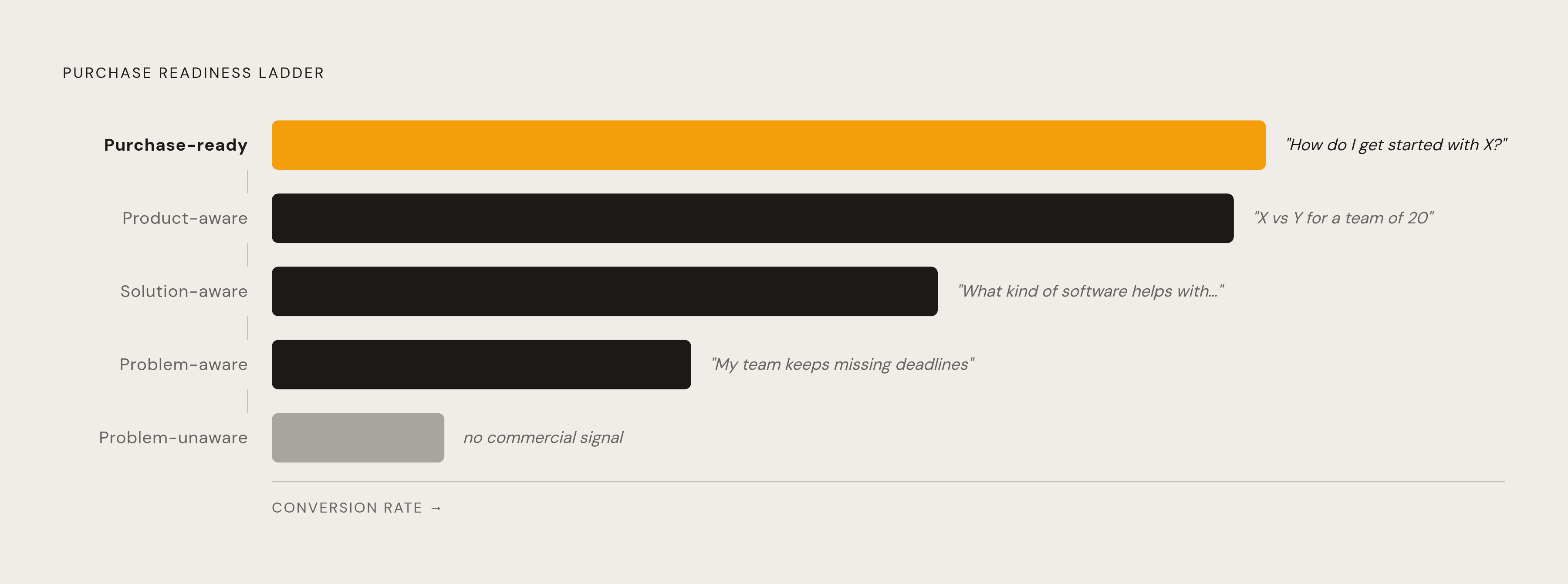
Purchase readiness isn't a yes-or-no state. It sits on a ladder of awareness, and each rung calls for a different ad angle and converts at a different rate.
Problem-unaware sits at the bottom of the ladder: the person doesn't yet know anything is wrong, and there's no commercial signal to act on. One rung up is problem-aware, where the person describes a pain, "my team keeps missing deadlines," without yet searching for a solution category. This is upstream signal, present before anything commercial has formed. Next comes solution-aware, where the person starts exploring categories, "what kind of software helps with...", language that's still informational but beginning to lean commercial.
Product-aware sits a rung higher still: the user names actual vendors and compares them directly, "X vs Y for a team of 20," which is shortlist language and carries high commercial intent. At the top of the ladder is purchase-ready, where the decision is made and the person just needs pricing, a trial link, or a final nudge, "how do I get started with X," "is there a discount for annual billing." This rung converts at the highest rate of the five.
What makes the ladder useful in practice is that a single conversation rarely stays on one rung. Adventure Media's analysis traces a dialogue that opens on "home improvement ideas" and moves toward "contractor selection" and then "project budgeting" as the questions get more concrete and more implementation-focused. A targeting system has to track that movement as it happens, reassessing where the conversation sits on the ladder continuously, instead of scoring the opening message and calling the job done.
Prompt rarity makes its ratio an advantage
Most conversations with an AI assistant carry no commercial intent at all, which is precisely what makes the signals that do appear trustworthy.
Practitioner analysis of large-scale prompt data puts the number directly: fewer than one in six ChatGPT prompts carry commercial or transactional intent, with the rest spent on curiosity, research, and ordinary task completion. In display advertising, commercial intent gets assumed from the start and relevance gets approximated after the fact. In a conversational setting, intent has to be earned before it can be confirmed, and an advertiser who reaches a person at that point is reaching someone who has already stepped into a decision-making frame of mind on their own.
That scarcity changes the economics of the auction, too. The ChatGPT Ads system prices placement through a relevance-weighted second-price auction, where a precisely targeted ad with a modest budget can beat a vague, high-spending one. That's not how most paid media works, where scale tends to buy its way past precision.
The obvious objection is that low commercial density makes the inventory too thin to build a real campaign on. No single AI interface produces enough high-intent commercial moments on its own to sustain a campaign, which is the argument for buying across several at once rather than treating any one of them as sufficient. Some programmatic infrastructure built specifically for AI chat environments addresses exactly that cross-surface buying problem by connecting advertisers to inventory across a broad range of LLM-powered apps, because a position on both the buy and sell side lets such platforms read conversational context that generalist buying platforms cannot access.
Semantic clustering tracks intent as it migrates across a conversation
Intent is a trajectory rather than a fixed property attached to one message, and the systems built to detect it have to track that trajectory across the full arc of a conversation rather than scoring any single turn in isolation.
The transformer architecture behind conversational AI keeps discourse coherent across turns: it can only make sense of a follow-up like "What about vegetarian options?" by referring back to earlier turns about restaurants, and advertising systems built on the same architecture use that same contextual memory to judge whether an ad fits the moment.
The Tsinghua / BIGAI framework for evaluating LLM-native advertising scores ads on four dimensions at once: how relevant the response is, how coherent the expression is, how effective the advertising is, and how likely a click actually is. None of those four can be judged from a single message pulled out of context.
Click-through intent is the hardest of the four to pin down. There's no historical log of clicks on ads embedded inside LLM responses to train from, human annotators don't agree with each other well enough to produce a reliable label, and frontier models used as judges tend to mistake how fluent a sentence sounds for how close its author actually is to buying something.
The same research framework works around that gap by generating synthetic labels from simulated personas built on Big Five personality traits, then training a shared evaluator on those labels. The result decomposes click intent into measurable features shaped by personality, so it produces a continuous signal that a pricing auction can actually use.
Fine-tuned smaller models outperform large generalist LLMs at detecting purchase intent
A model's ability to generate fluent text and its ability to detect purchase intent are two different skills, and treating them as the same thing produces worse targeting rather than better.
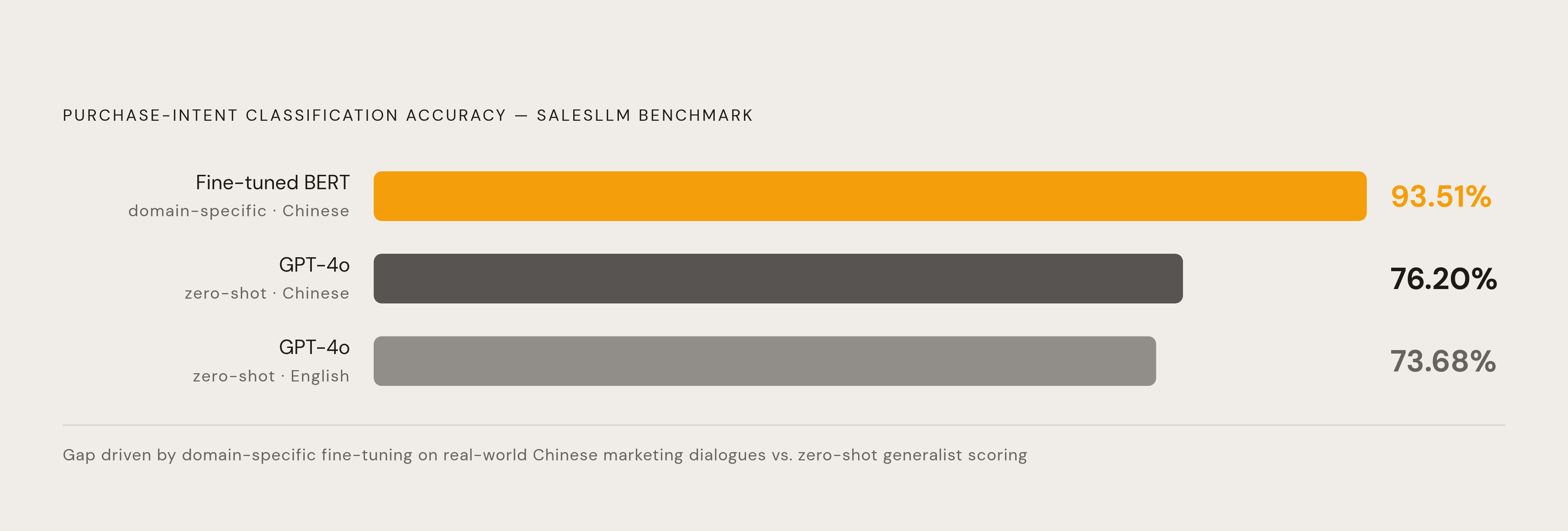
The SalesLLM benchmark research, produced jointly by Bairong Inc. and collaborating academic institutions, tested real-world marketing dialogues and found that fine-tuned BERT classifiers, not large generative models, did the better job of estimating buying intent at the end of a conversation. The reason given is straightforward: models trained specifically on domain data pick up explicit intent markers that generalist LLMs miss.
The gap between the two isn't marginal: fine-tuned BERT-like models reached 93.51% accuracy on intent classification in Chinese marketing dialogues per the SalesLLM benchmark research, substantially higher than GPT-4o in both Chinese and English test conditions, the advantage of domain-specific fine-tuning over raw model scale.
The explanation offered for this gap is that a frontier model asked to judge intent in a zero-shot setting ends up scoring how well-constructed a sentence is rather than how close the person behind it is to buying something. Fluency and intent get conflated, and the result looks like a judgment about purchase readiness without actually measuring it.
For advertisers and the platforms serving them, the lesson is that intent classification is a specialized engineering task that benefits from dedicated fine-tuning on real conversational purchase data. It isn't a capability that shows up automatically just because a bigger model gets deployed. The CMU / Tsinghua evaluator framework makes the identical architectural choice: a smaller, parameter-efficient shared-bottleneck model trained on psychologically grounded synthetic labels, instead of a prompt fed to the largest available frontier model.
What the Prompt Signal Reveals
A prompt at the purchase-ready rung of the ladder often discloses the budget, the rejected alternative, the constraint, and the timeline in one conversational turn, information that keyword targeting and demographic targeting can only approach gradually, through inference built up over repeated exposure.
A keyword like "project management software" carries no information about whether the person typing it is a first-time researcher, a frustrated veteran ready to abandon a current vendor, or a procurement manager with budget already signed off. A prompt, in the great majority of cases, answers that question directly rather than leaving it to be inferred.
Demographic data, age, location, income bracket, works at the level of the population rather than the individual. A prompt that reads "our Q2 budget just got approved and we need to migrate our team off our current tool" discloses timing, scale, urgency, and the intent to switch, all at once, for one specific person.
That disclosure runs in one direction. The advertiser gains a depth of signal no earlier channel offered, but the person typing the prompt often has no idea how precisely they've described themselves as a target.
How the pre-purchase journey beginning in AI chat changes where purchase-ready signals appear
Purchase-ready language increasingly appears inside AI chat before a user ever opens a search engine. A brand waiting to catch that intent on the open web arrives after the decision has already started forming.
A meaningful share of pre-purchase research now begins inside AI chat rather than a search bar. In travel specifically, practitioner data from Verve puts the figure at 37% of queries starting inside an LLM before the person moves to the open internet to actually complete a purchase.
Users tend to go several prompts deep into a conversation before they ever open a browser tab. The entire arc described by the intent ladder, problem-aware through purchase-ready, can play out inside the chat interface itself, with no browsable session for conventional attribution tools to follow.
Microsoft Copilot's choice to weigh an entire session's context rather than just the most recent message reflects that same behavior: the signal worth measuring is the arc of the conversation, not its final line, and Microsoft reports that this approach produces stronger click-through and conversion results than traditional search placements, a claim worth treating as the vendor's own but one with a plausible structural basis behind it.
The attribution consequence follows directly. A last-click model undercounts a channel where the deciding moment happened several turns into a conversation that never left the chat window, with no clicks in between for the model to credit.