Prompt Structure as a Proxy for Decision Stage
AI chat conversations reveal decision stages through prompt structure, not just keywords.

Per eMarketer's June 2026 research, users run about six prompts deep before they leave a chat interface and head to the open internet to buy something. That number matters more than it looks, because the decision journey used to hide behind a single search query but now unfolds turn by turn, in a conversation a platform can watch happen in real time.
The arc isn't random. Early prompts stay broad, naming a problem or poking at a category, while later ones narrow: testing specifics, comparing named options, asking about logistics. At every turn the user chooses to dig deeper into the same thread or pivot to a new angle, and both moves carry information. A pivot away from price and toward implementation timeline isn't noise; it's a buyer moving from "can I afford this" to "can I actually roll this out by the deadline."
Search never offered this. A typical search session runs only a handful of queries, often disconnected from one another, filtered through whatever autocomplete happened to surface. The AI conversation is cumulative instead. Each prompt builds on the last, and the platform hosting it has access to the whole thread, not just the final query.
That access reaches what search structurally cannot. It shows how a buyer frames a problem before learning the vendor's word for it, and it shows which constraints get volunteered unprompted: budget language, team size, a deadline. It shows where hesitation sits, usually visible as a follow-up circling back to a concern raised three turns earlier. And it shows the exact moment a conversation stops being about evaluation and starts being about logistics: the cancellation-policy question, the onboarding question, the kind of thing only gets asked once someone has basically decided.
For advertisers, the implication is blunt. Relevance at prompt one means something different than relevance at prompt five, even when the topic hasn't moved an inch. For publishers and ad platforms building inventory around this channel, the unit that matters is the arc itself, not any single impression yanked out of context.
A working taxonomy of prompt types mapped to funnel position
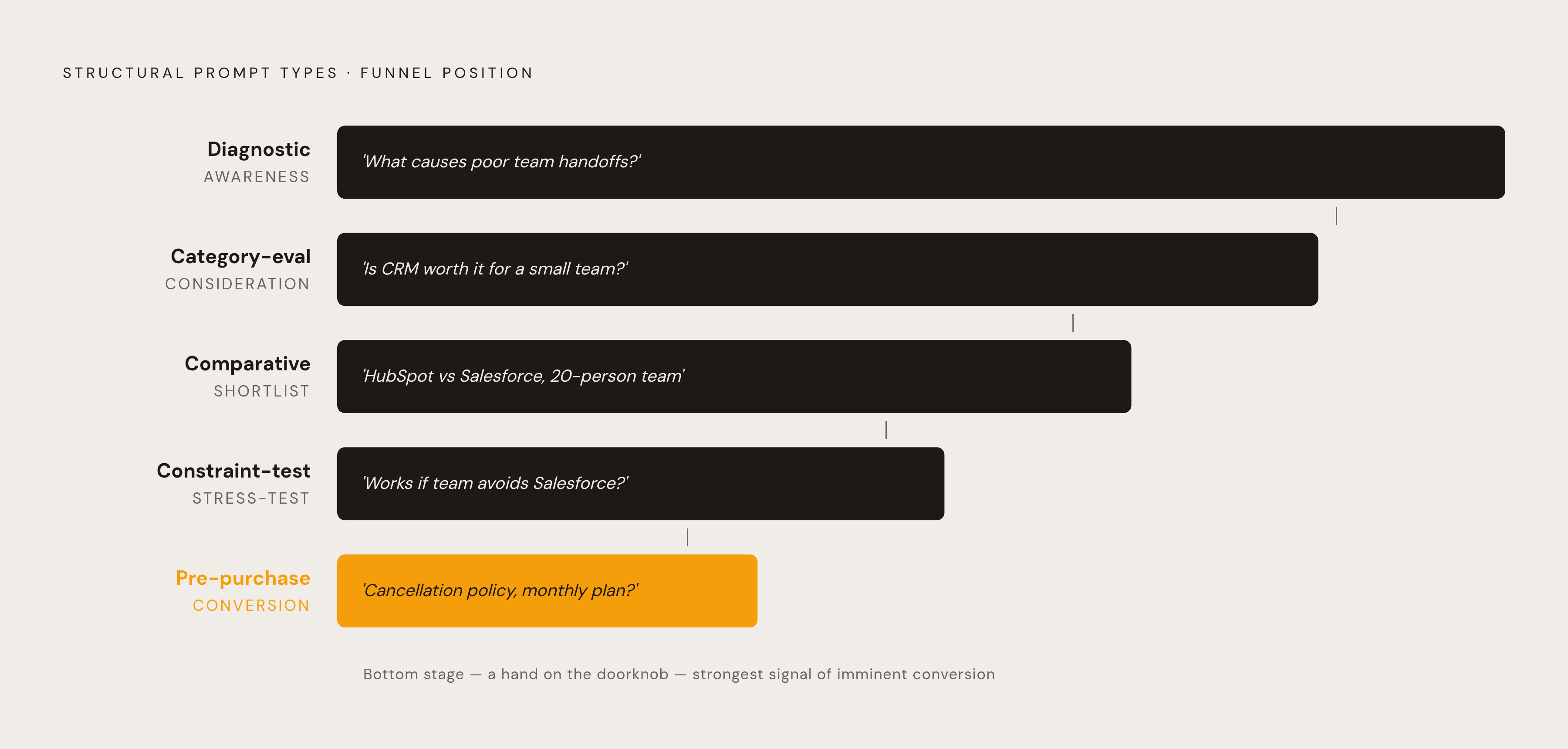
Sorting real chat transcripts into the usual "top/mid/bottom of funnel" buckets doesn't work; the categories are too coarse to hold what's happening turn to turn. Splitting by the grammar of the question, not its topic, works better. Five structural categories cover most of what shows up in a buying conversation, and each carries its own logic.
Diagnostic prompts ask "what causes X" or "why does Y happen." These sit at the very top of the funnel. The user is naming a problem, not shopping for a fix, and there's no vendor vocabulary in the prompt at all.
Category-evaluation prompts ask something like "is CRM software worth it for a small team" or "what do people use to solve X." Still upper funnel, but the user has moved from naming a problem to deciding whether an entire category deserves the effort.
Comparative prompts name alternatives directly: "compare HubSpot and Salesforce for a 20-person sales team." This is mid-funnel territory, where evaluation criteria start to solidify and a shortlist forms even if the user hasn't said so out loud.
Constraint-testing prompts push on a specific candidate: "does this work if my team doesn't use Salesforce," "can it handle this edge case." Someone is already in mind here; the user is stress-testing fit, not casting a wide net.
Pre-purchase procedural prompts are the closest thing to a hand on the doorknob: "how do I set this up," "what's the cancellation policy if I start on the monthly plan." Commitment logic, not discovery logic.
The category alone doesn't tell the whole story. Modifiers inside the prompt shift the read regardless of type. A named team size or budget range pulls a prompt further down the funnel no matter what question form it takes, and first-person possessives, "my team," "our workflow," signal more purchase intent than the same question asked hypothetically. Temporal markers like "before we renew" or "by Q4" compress the timeline and flag urgency. Negation and exclusion, "not enterprise," "without a long contract," mean a shortlist is already active and the user is in elimination mode.
None of this is academic. It maps directly onto a bid decision: which signal justifies which ad format, and at what price.
Why the informational prompt is the most undervalued buying signal
The standard assumption among practitioners, carried over almost intact from search, treats an informational query as research, research as no near-term purchase, and no near-term purchase as low commercial value. That logic made sense when an informational search was usually a one-off lookup, severed from whatever happened next. It's wrong here, and most of the industry keeps pricing it as though it isn't. That's the mistake worth naming directly: informational prompts are getting bid on like leftover inventory when they're often the highest-leverage placement in the whole arc.
Inside AI chat, an informational prompt is frequently the opening line of a much longer conversation, not a dead end.
Per eMarketer's June 2026 findings, 39% of prompts in the sportswear category reflected upper-funnel informational activity. Tracked across their full length, those same sessions surfaced granular product preferences, purchase timing, and specific constraints, the kind of detail a bare "Nike sneakers" search would never expose. eMarketer's own comparison makes the point concrete: a search for "Nike sneakers" tells an advertiser someone is in-market and almost nothing else. A ten-prompt conversation about marathon training tells the advertiser what the buyer actually needs, what they value in a shoe, and roughly when they intend to buy, all before a single transactional word shows up.
This isn't a delayed version of the same value a mid-funnel comparison prompt carries. It's a different kind of value entirely: a brand present at the informational stage helps set the frame before evaluation even starts, shaping the criteria later applied to every competitor on the eventual shortlist. That's upstream influence over the shortlist itself, not a late bid for a spot on it.
Calling this content marketing undersells what it actually is, since content marketing is organic and untargeted by definition while this is paid placement, matched in real time to a problem the user is describing in their own words, in the exact session where they're describing it. Pricing it like low-value top-funnel inventory misreads what's actually happening in that conversation, and it's leaving money on the table for whoever figures that out first.
How the transactional end of the prompt spectrum is already being monetized
The other end of the spectrum isn't being ignored, and it's moving fast. Per the same eMarketer research, 37% of sportswear prompts were transactional, nearly matching the informational share. Both ends of the funnel show up in meaningful volume, in the same channel, often in the same session.
Transactional prompts look like what anyone would expect: named product requests, price comparisons, availability checks, "where to buy" questions. This is the vocabulary of someone ready to act, and it's the segment platforms moved fastest to monetize, for the obvious reason that it looks the most like search.
OpenAI's ad formats, launched in May 2026 according to reporting from New Public Media, build around exactly these moments. Sponsored Answers sit inside the response to a transactional or comparative prompt, Sponsored Follow-ups are paid suggested next-questions built to pull the user deeper into commercial territory, and Sponsored Shopping cards are product-level placements timed to high-intent moments.
The pilot moved fast. Per DigitalApplied's June 2026 reporting, OpenAI's ad program launched in February 2026 and reached $100 million in annualized revenue within two months, at a reported $60 CPM. OpenAI has held to what Adventure Media described in April 2026 as "answer independence," ads shown in visually distinct tinted boxes rather than blended into the organic response. That's a design choice made today, not a structural limit on the format going forward.
Google is scaling in the same direction. AI Overviews carried ads alongside 25.5% of responses as of mid-2026, per DigitalApplied, up from just 5.17% in early 2025. A steep ramp for a short window.
Going after the transactional end first was the easy call, the safe bet that reuses search logic on a new surface. The harder, more durable opportunity sits upstream of it: matching ad delivery to the entire arc, not just its last turn. Platforms that stop at transactional monetization are leaving the more defensible position sitting right there on the table.
The signal gap between what prompt structure reveals and what legacy targeting can read
Search targeting runs on the keyword: a word or phrase matched against a query, with zero access to what came before it in a session and zero read on funnel position. Social targeting runs on the audience profile: a bundle of past behavioral and demographic signals, blind to whatever intent a person happens to be expressing live, right now, mid-conversation. Neither primitive was built for what's happening inside an LLM interface, and neither one bends to fit it.
Per Lapis's August 2026 analysis, there's no SERP inside a chat window and no feed either, just a single conversation, rendered one turn at a time. Keyword matching has nothing to grab onto there, and neither does an audience profile assembled from six months of browsing history.
The gaps are specific. Keyword systems can't parse constraint language like "for a 20-person team without a Salesforce budget"; they see individual words, not the meaning built between them. Audience profiles reflect past behavior, not the live deliberation happening in the current session. Neither approach reads funnel position from sentence structure at all: a keyword match fires exactly the same way whether it hits on prompt one or prompt five of the same conversation.
Reading context at the prompt level takes something else entirely. It needs semantic understanding of the full prompt rather than token-level matching, awareness of what's already been said earlier in that same session, classification against a structural taxonomy to infer where in the funnel the prompt sits, and extraction of the signals buried in the language itself: the first-person possessive, the temporal marker, the negation.
Generalist demand-side platforms have reach across many surfaces but no way to read conversational context, while ad networks built for a single AI surface can read that context but can't offer reach beyond it, Thrad, which runs its own exchange alongside direct AI publisher supply, is one infrastructure built to close that specific gap. Neither one solves the problem alone, and no incremental patch to legacy ad tech gets there either. This is a structural gap, not a feature gap, and it won't close by bolting a classifier onto an old bidding engine.
What prompt-level signal reading looks like in practice: from classification to bid
The pipeline, in its basic form, runs like this: a prompt arrives, a context layer classifies its intent type and funnel position, bid logic adjusts on the basis of that classification, and the ad format and message get selected to match.
The auction mechanics behind this are still an active research question, and the papers diverge more than their headline claims suggest. Dubey et al., in a 2025 arXiv paper, studied frameworks meant to ensure higher bidders get proportionally better placement inside LLM-generated output. Hajiaghayi et al., also 2025, examined retrieval-augmented ad allocation, weighing both retrieval relevance and bid amount when deciding where an ad lands inside a generated response. LLM-Auction, published by Zhao et al. in December 2025, goes further, folding the auction directly into the generation process through reinforcement learning and jointly optimizing for response quality and ad revenue at once. Of the three, it's the closest preview of where production systems likely land.
Format selection should follow funnel position, not topic alone, and getting this backward is where a lot of campaigns quietly fail. A diagnostic prompt calls for framing content and category education, since an aggressive, high-intrusion ad format at that stage does active damage to trust before a relationship even starts. A comparative prompt calls for structured product information and differentiator-forward messaging. A pre-purchase procedural prompt calls for friction-reducing content and a direct path to conversion, nothing more elaborate than that.
Meta offers a useful point of contrast, and arguably the more cautious path. Per Subhadip Mitra's reporting from April 2026, Meta reads conversational signal and uses it to retarget users with ads off-platform, rather than placing ads inside the conversation itself. The signal gets read, but the placement happens somewhere else entirely. That preserves the integrity of the chat experience; it also means giving up the moment of peak relevance, the instant when the user is actually asking the question an advertiser could answer.
The bid implication follows from all this: funnel position should move bid value independently of topic. A late-stage constraint-testing prompt in a category with little competition can be worth more than a top-of-funnel prompt in a crowded one, even though the crowded category sounds more valuable on paper. Advertisers building a targeting brief for this channel need to specify which prompt types and funnel stages they intend to cover. A brief weighted entirely toward one stage leaves the brand blind everywhere else, and blind spots in this channel are expensive.
Why the parallel intent stream matters for how brands allocate attention now
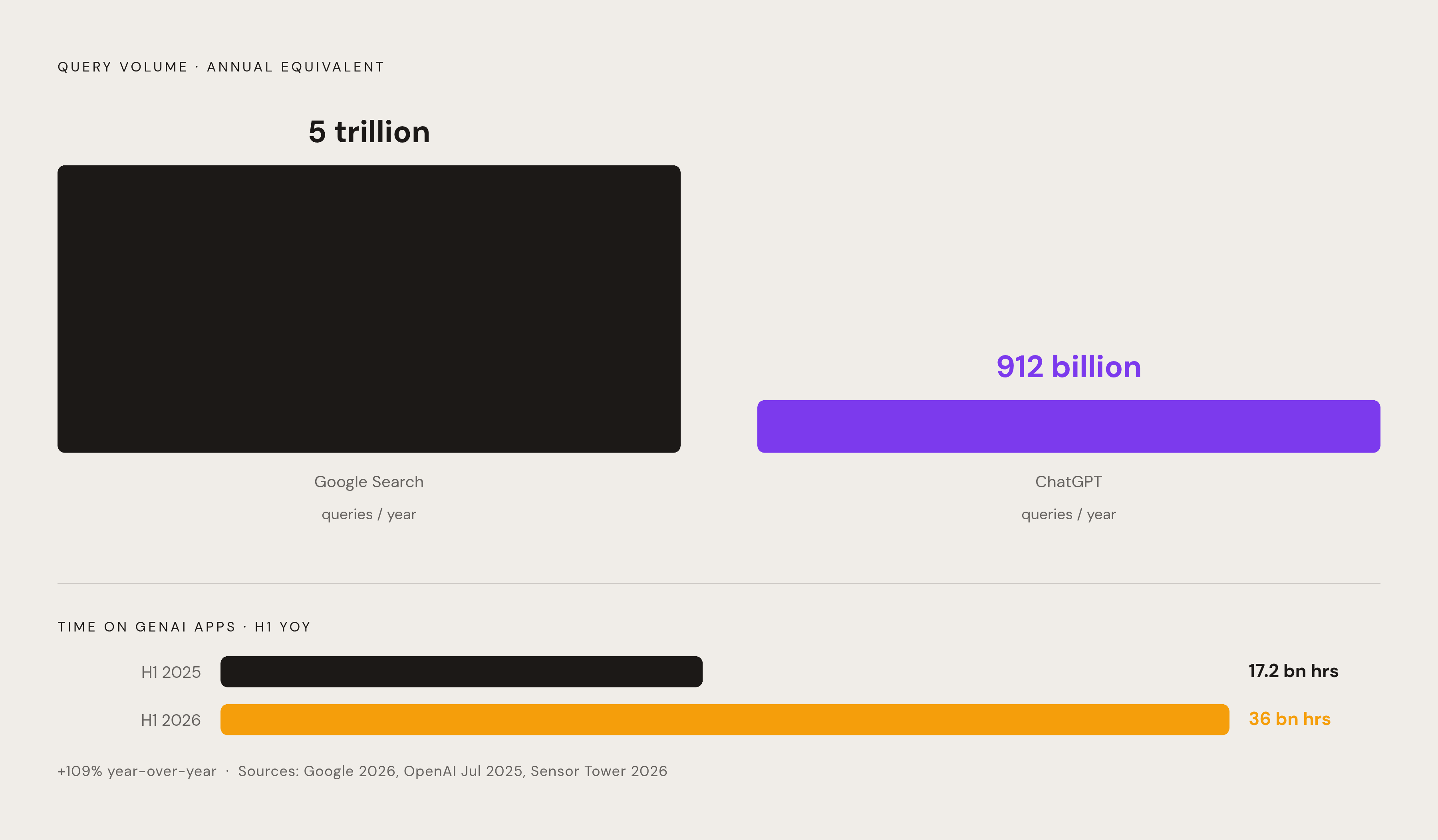
Two intent streams now run side by side, and both are large. Per Verve's 2026 report, Google confirmed it processes more than 5 trillion queries a year, and as of July 2025 ChatGPT was already handling 2.5 billion queries a day. The AI stream isn't a rounding error next to search. It's a parallel channel operating at real scale, and treating it as a side experiment misreads the numbers.
The upstream dynamic is the part worth sitting with. Per eMarketer's June 2026 research, AI chat is increasingly where intent forms before it ever reaches a search bar: six prompts deep, then out to the open internet to convert. A brand absent for those six prompts doesn't just miss an impression. It loses the chance to help set the frame the buyer carries into everything that follows.
The audience underneath all this keeps growing. Sensor Tower's June 2026 figures put global time spent on GenAI apps at a projected 36 billion hours in the first half of 2026, up from 17.2 billion hours in the same period the year before. The generational shift is already visible too: 31% of Gen Z users now start queries directly in AI or chat tools instead of a search engine, according to HubSpot's 2025 AI Trends for Marketers report, as cited by Amsive in June 2026. Budget is following the audience. AI search-adjacent advertising is forecast to grow 152% to $26.42 billion in 2026, per a Beet.TV and Sonata Insights presentation at Cannes Lions 2026.
None of this argues for abandoning search, and nobody credible is making that case. Verve's 2026 analysis frames the two channels as coexisting and layering on top of each other: the conversational signal explains how and why a buyer arrived at a decision, while search shows where they stand at this exact moment. Both views matter, and neither replaces the other.
Prompt structure as a proxy for decision stage isn't a clever targeting trick sitting on the margins of the industry. It's the mechanism by which a brand finds the right conversation, at the right moment, before a shortlist ever closes. Advertisers waiting for this channel to settle into familiar, comfortable primitives will find, when they finally arrive, that the frame was already set by whoever showed up earlier in the arc.