How Conversational Context Changes Intent Interpretation
Conversational AI reveals buyer intent directly through dialogue, not inferred behavior.

A single search query is a fossil: the last visible trace of a thought process the platform never saw. "Best running shoe" could come from someone buying their first pair, a marathoner replacing a worn-out favorite, a son shopping for his father's birthday, or someone whose podiatrist just told them their gait is wrecking their knees. The keyword is identical in all four cases. The intent behind it is not, and nothing in the string of text discloses which situation produced it.
A conversation has memory. Every message a user sends in a session gets read against everything that came before it, not in isolation. Large language models don't score turn four as a fresh query; they read it as a continuation of turns one through three, and that continuation reframes what those earlier turns meant.
Take a sequence like: "Tell me about CRM tools," then "which ones handle nonprofit compliance," then "we're a team of four." Each new message rewrites the meaning of the first one. By the third turn, "Tell me about CRM tools" reveals itself as a small nonprofit with a four-person team asking about compliance-capable software, and the system only knows that because it held the thread.
What accumulates across a session includes the constraints a user volunteers (budget, timeline, team size), the options they've already considered and rejected, the vocabulary they reach for (technical versus lay language, which signals expertise), and the emotional register of the exchange: anxious, decisive, or still comparison-shopping. Behavioral tracking aggregates clicks, with no mechanism for understanding how one action changes the meaning of the action before it. A conversation carries that meaning natively, and flattening it into a tag or a category destroys the very thing that made it interpretable in the first place.
How intent shifts, narrows, and sometimes reverses across a dialogue
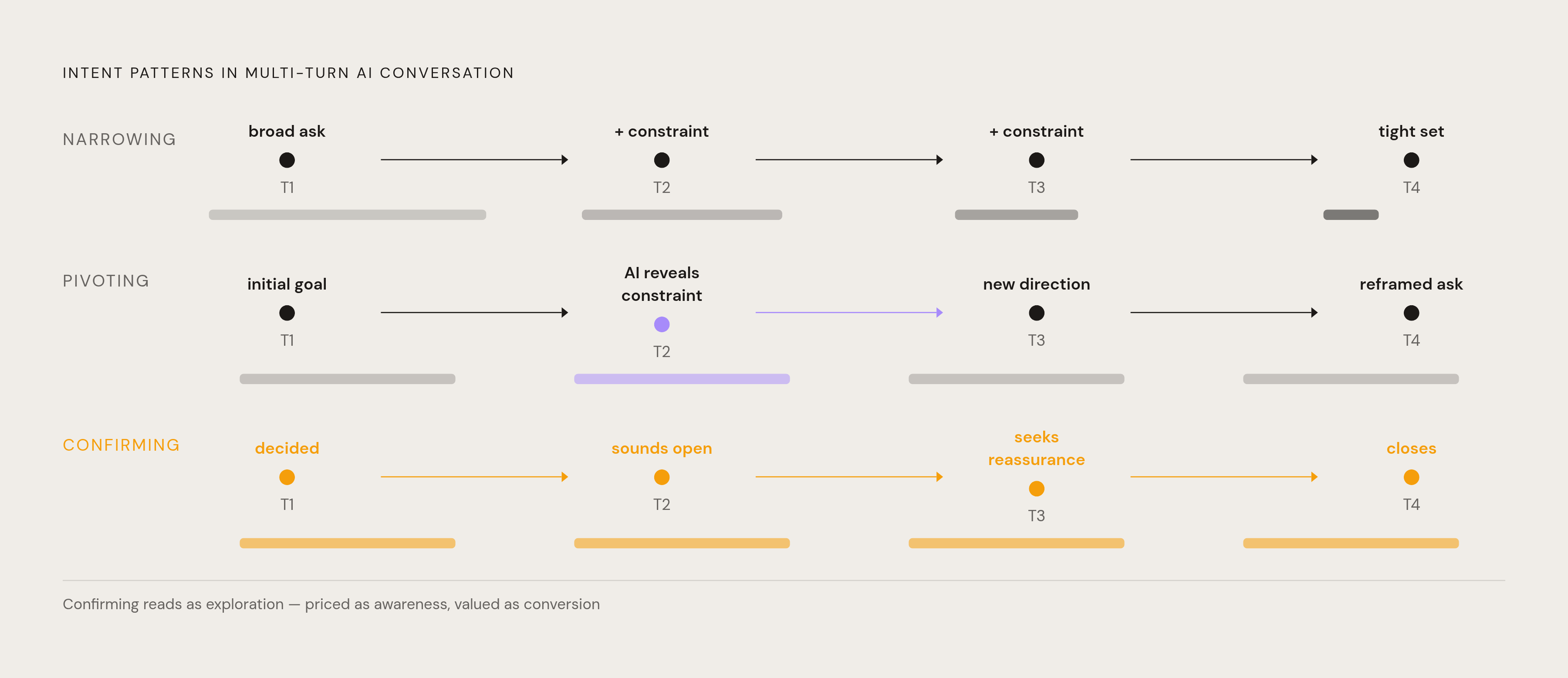
Turn one is usually exploratory. There's a category in view, but no strong commitment signal yet. By turn three or four, something else has taken shape: the questions get narrower, more specific, closer to a decision. The funnel metaphor, borrowed from decades of marketing theory, has outlived its usefulness here, because users don't move down a single axis from awareness to purchase. They jump. A session can move from broad awareness to near-purchase and then back to comparison, all inside the same exchange.
Three patterns show up often enough to name. Narrowing happens when a user starts with a category-level question and progressively adds constraints, shrinking the consideration set turn by turn. Pivoting happens when the AI's own answer introduces a constraint the user hadn't considered, and that answer changes what they want next; they didn't know to ask about it until the system surfaced it. Confirming happens when a user has effectively already decided and is using the conversation to validate that choice, so the question sounds exploratory even though the intent is closure.
That third pattern is the one the industry keeps getting backwards. The default instinct is to treat every unbranded, category-level prompt as top-of-funnel and price it like awareness inventory. That instinct undercounts intent far more often than the current playbook admits. Emerging signal data suggests over a fifth of pre-purchase digital journeys now start with AI chat, and in travel that figure climbs past a third. Early prompts in these sessions tend to read as unbranded and category-level, even when the downstream intent is already transactional. A prompt that sounds informational may sit one or two turns from a purchase decision. Intent at message one is not intent at message five, and pricing the two the same misprices the entire session by a wide margin — the difference between selling awareness inventory and selling a closing moment for the price of a browse.
Why prompt-level signals reveal more about a buyer than any behavioral proxy
Behavioral targeting is built on inference. A user visits three mattress review pages, so the system infers they're probably shopping for a mattress: a reasonable guess, built at a distance, from a trail of clicks the user never explained.
Conversational intent starts from direct explanation: the user states the problem themselves. Someone typing "What marketing automation platform handles complex multi-division consent requirements best" has just stated, in one sentence, a problem that would take dozens of page visits to approximate from behavioral data alone, and even a well-built model doing that reconstruction would only ever land on an approximation. The prompt already contains the user's own framing of the problem, the vocabulary that signals their expertise and industry, constraints offered without being asked (budget, team size, compliance needs), and often the alternatives already ruled out.
The scale of this shift shows up in how people actually use these tools. Over half of ChatGPT queries are informational in nature, a notably higher share than the informational portion of Google search traffic, which means a large slice of assistant traffic is people actively working through a decision rather than navigating toward a destination they already know. Behavioral proxies were always a workaround for not having direct access to that reasoning. The direct signal exists now, sitting in plain text, and building an entire targeting stack around the old workaround anyway leaves real signal on the table, unused, in data the platform already holds.
How multi-turn context changes what a relevant ad even means
Search relevance happens at one instant: a query matches a keyword, an auction fires, an ad appears. Nothing about that transaction has history behind it. Relevance in a conversation carries direction; it's a position inside a dialogue, and an ad that fits at one point can miss badly a few turns later.
An ad for "explore hiking boots" might land well at turn one. By turn five, when the same user has written "which sole holds up in wet granite, already blown two pairs of Salomon," that same ad reads as tone-deaf, because it ignores everything the conversation has since established. Relevance at that point depends on reading the full prior exchange, locating where the user currently sits in their decision process, and matching the ad to the constraint set built up over the session, not to the surface-level topic of the latest message.
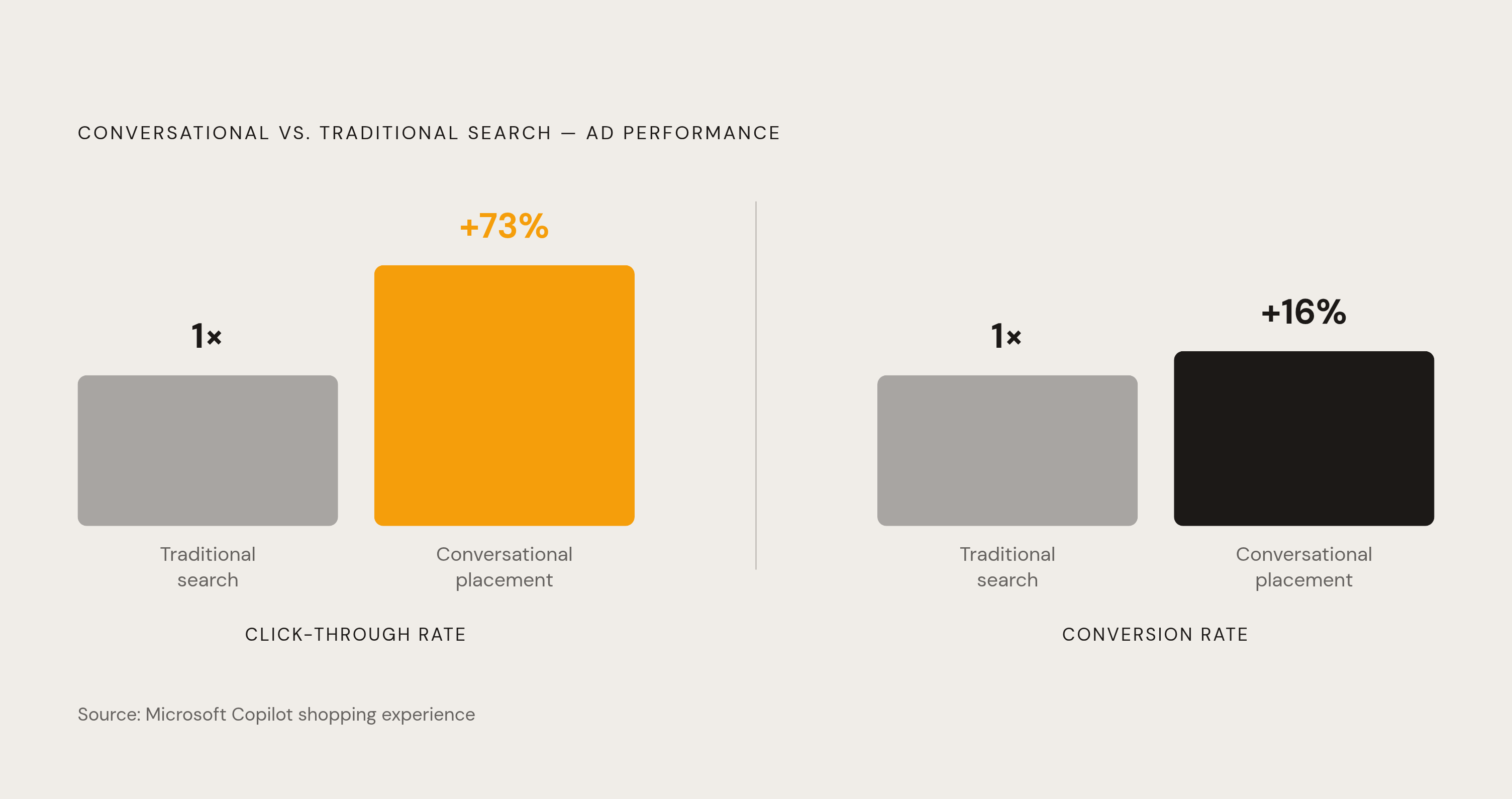
This is exactly where keyword targeting and page-level contextual targeting both fail, and no amount of tuning fixes it, because the failure is structural, not a matter of degree. Both read the surface of a moment; neither reads the state of a conversation. Native ad placement inside an AI response, matched to that state, functions as a fundamentally different product from an ad placed next to an article or above a set of search results. Microsoft's Copilot shopping experience, built on this kind of contextual matching, reported 73% higher click-through rates and 16% stronger conversion rates against traditional search: an early but concrete signal of what intent-matched placement delivers relative to the old baseline.
Where the current models for reading conversational intent fall short
Most intent classification systems in use today were built for single-query environments. They score a message on its own, and applying that scoring to multi-turn dialogue means reading the latest line while missing everything the prior turns did to reshape its meaning. Porting single-query models into a multi-turn world isn't a minor mismatch; it throws away most of the signal the conversation actually contains.
What gets lost is specific: the constraints a user established three turns earlier, the pivot that happened mid-session when an AI answer changed what the user actually wanted, the gap between someone still exploring and someone confirming a decision they've effectively already made. Strip the context and all three collapse into the same flat signal, indistinguishable from one another.
Auction mechanics haven't caught up either, and this is where the gap gets expensive. Early research into LLM ad auctions has focused mostly on making sure higher bidders get better placement, without asking whether that placement fits where the conversation currently stands. That's a different problem than CPC bidding on a keyword, and copying the old auction logic over doesn't solve it; it just moves the old mismatch into a new venue.
Attribution is the deeper unsolved piece, and it's the one that should worry the industry most. If someone asks an assistant about travel insurance, gets a contextual ad, closes the session, and buys three days later on a different device, the chain of credit breaks by design; nothing connects the two events. Intent modeling needs to treat the whole dialogue as the unit of analysis, not the individual message. That remains an open engineering problem, and nobody selling ad tech today has fully solved it.
What it means to buy against conversational intent rather than against keywords or audiences
Search advertising bids on a keyword, a string of text standing in for a user's likely intent. Audience-based buying bids on a profile, a cluster of inferred attributes meant to approximate the same thing. Both are compromises, built because the systems buying against them never had access to the user's actual reasoning, and neither deserves treatment as a best practice going forward, no matter how entrenched either one is in current media plans.
Conversational AI narrows that gap: the intent sits right there in the exchange, richer and more specific than any keyword or profile could encode. Buying against it means reading a conversation's topic, its accumulated constraints, and its current decision stage, not just the words in the latest message. It means bidding on moments, specific states inside a dialogue, rather than on static keywords or pre-built audience segments. It means matching ad content to constraints a user has actually stated, instead of running creative that got mapped to a keyword months earlier. None of it requires a cookie, because the conversation itself supplies the context.
Not every platform can do this, and most currently can't. Generalist demand-side platforms buying across many surfaces lack the signal to bid on conversation state at all; they were built for keywords and profiles, and conversational context doesn't fit that pipe. Single-surface AI ad networks can read context within one assistant, but users don't confine their decision-making to one surface anymore, and a network that only sees one conversation thread can't aggregate intent across the rest.
The unit of targeting has shifted. Where it once centered on the user, or on the keyword or the page beneath the ad, it now centers on the conversation in progress, and on where inside its arc that conversation currently sits. Advertisers who build their buying strategy around that fact catch intent at the exact moment it's most precisely stated, before it dissolves back into the anonymous behavior the industry has spent twenty years trying, imperfectly, to reconstruct.