Constraint Language as Audience Qualifier
Conversational AI reveals purchase intent more directly than keywords or demographics ever could.

A user tells a chatbot they need a hotel that's dog-friendly, and the entire conversation reorganizes around that one fact. That single sentence is worth more to an advertiser than a decade of demographic modeling, because it states, in the user's own words, the exact boundary of a real decision. This is the shift constraint language forces on advertising: buyers who learn to read and bid on these statements will out-target everyone still working from keywords and audience proxies.
Keyword targeting matches a word. Demographic targeting guesses at a person based on where they live or how old they are. Constraint language is neither a match nor a guess; it's a person stating, mid-thought, what they need and what they're working within. Nothing in advertising history has captured that moment directly, because no prior channel put the user's reasoning process on display. Search only sees the query after someone has already compressed their need into a phrase. Social infers from what someone did last week or last year. Conversational AI is different by design: the multi-turn format asks the user to keep talking, and constraints fall out of that conversation the way sediment falls out of moving water.
What constraint language actually looks like in conversation, and why it concentrates purchase intent
Constraints tend to cluster into a handful of recognizable shapes. Budget ceilings: "under $500," "the cheapest one that still does the job." Dietary and health limits: "no gluten," "nut-free, it's for a school event," "has to work with a low-sodium diet." Location and logistics: "within 10 miles," "ships to Canada," "no car, so it has to be on a bus line." And situational or relational limits: "for a 7-year-old," "needs to look fine in an office," "has to plug into the system we're already running."
What matters more than the category is where the constraint shows up. It almost never opens the conversation. Users start broad and narrow as they go, and the constraint is the narrowing event itself. Once it lands, everything said before it gets read differently. A trip-planning chat that starts as "best beach towns in Florida" becomes, the moment someone adds "but it has to be dog-friendly, we can't leave our golden retriever," a conversation about traveling with a pet. The hotel options shift, sure, but so does the whole frame: restaurant picks, drive time, even the kind of neighborhood that makes sense.
AI chat carries the richest intent signal marketers currently have access to, because each turn adds detail that a single search query can't hold. By the time a constraint shows up, often well into the exchange, the user has already handed over category, use case, and rough preference. An advertiser reading that turn knows more about how close someone is to buying than any click history could tell them. Compare that to knowing someone is 35 and lives in a high-income zip code. That tells an advertiser nothing about whether this particular person needs a nut-free cake for Saturday.
How the platforms currently read and act on conversational context — and where they differ
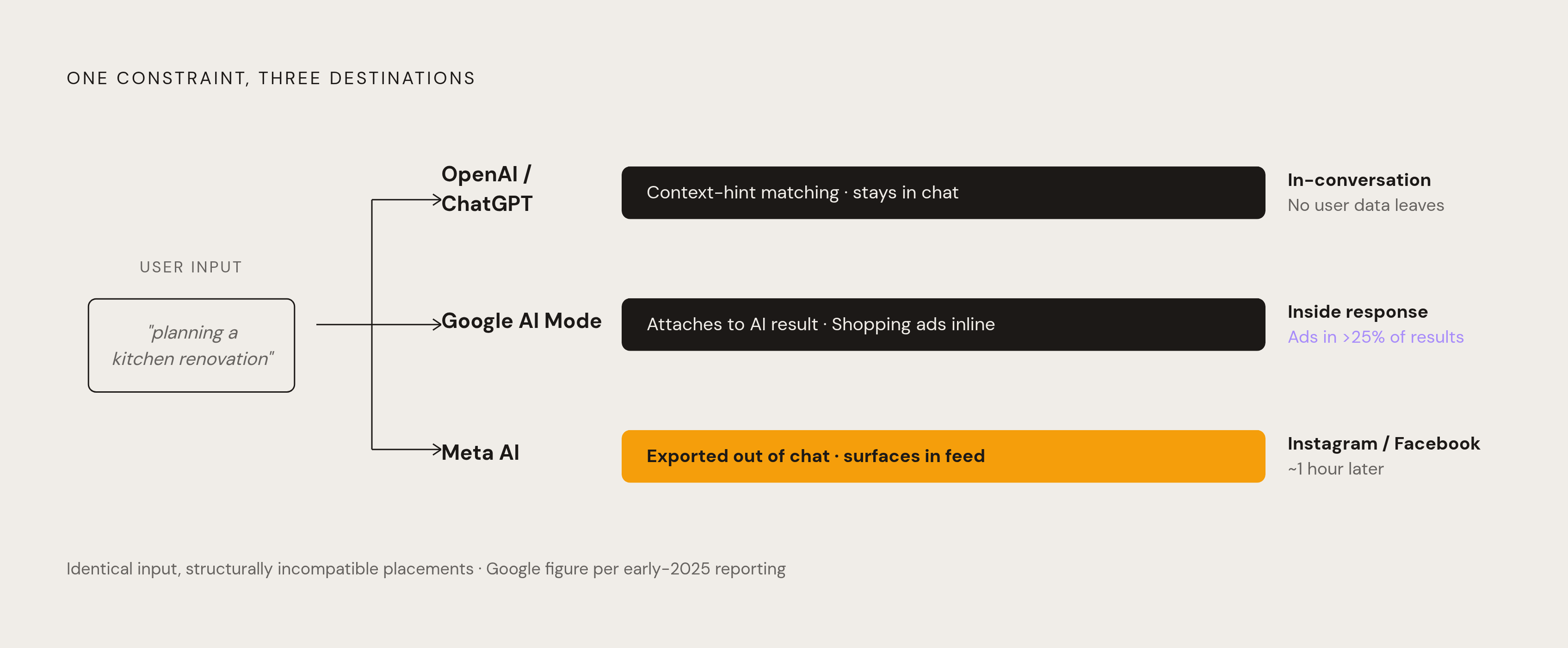
The three major AI platforms running ads have landed on three different answers to where constraint signals should live, and the differences are structural, not cosmetic.
OpenAI's system for ChatGPT ads runs on what it calls context hints. Advertisers write plain-language descriptions of the conversations where their product fits, rather than picking keywords or audience segments, and a relevance-weighted system decides when to serve. That means the unit an advertiser is bidding on is itself a description of a scenario, not a token match. OpenAI says directly that hints "help guide matching but do not guarantee delivery in specific conversation types." There's no user-level tracking behind this, no demographic layer, no behavioral profile pulled from other sites. Chats, names, locations: none of it reaches the advertiser. That's not an incidental design choice. It's the reason constraint signals carry so much value on the platform in the first place. Strip away user-level data and contextual precision becomes the only lever left to pull.
Google's approach through AI Mode looks different. Ads now show up in a large and growing share of AI Mode results (up from roughly 5% in early 2025 to over a quarter of results more recently), and shopping ads with Direct Offers appear inside the AI-generated response itself. This reads less like a new targeting system built for conversation and more like search advertising logic extended into a conversational wrapper.
Meta's approach breaks from both. It doesn't put ads inside the AI chat at all. Instead, the conversation becomes a signal that gets exported to feed advertising elsewhere. Someone tells Meta AI they're planning a kitchen renovation, and an hour later a home-improvement retailer's ad shows up in their Instagram feed. Three platforms, three theories of where a constraint belongs: inside the conversation itself, attached to an AI-adjacent result, or shipped out to a legacy feed. For anyone buying media across these systems, "AI advertising" isn't one surface to learn. It's at least three separate signal-to-placement architectures, and the same constraint statement behaves completely differently depending on which one it lands in.
The bidding problem: how auctions need to change when relevance is conversational, not positional
Old CPM logic prices an impression against a page or a user profile that doesn't move. A conversational impression moves. The constraint might appear on turn one or turn five, and the value of the impression changes depending on when it lands, which means the auction has to price a moment, not a slot. An ad shown right after someone states a $200 budget ceiling is not the same unit as an ad shown on the opening prompt of a generic conversation, even if both technically occurred inside the same chat session.
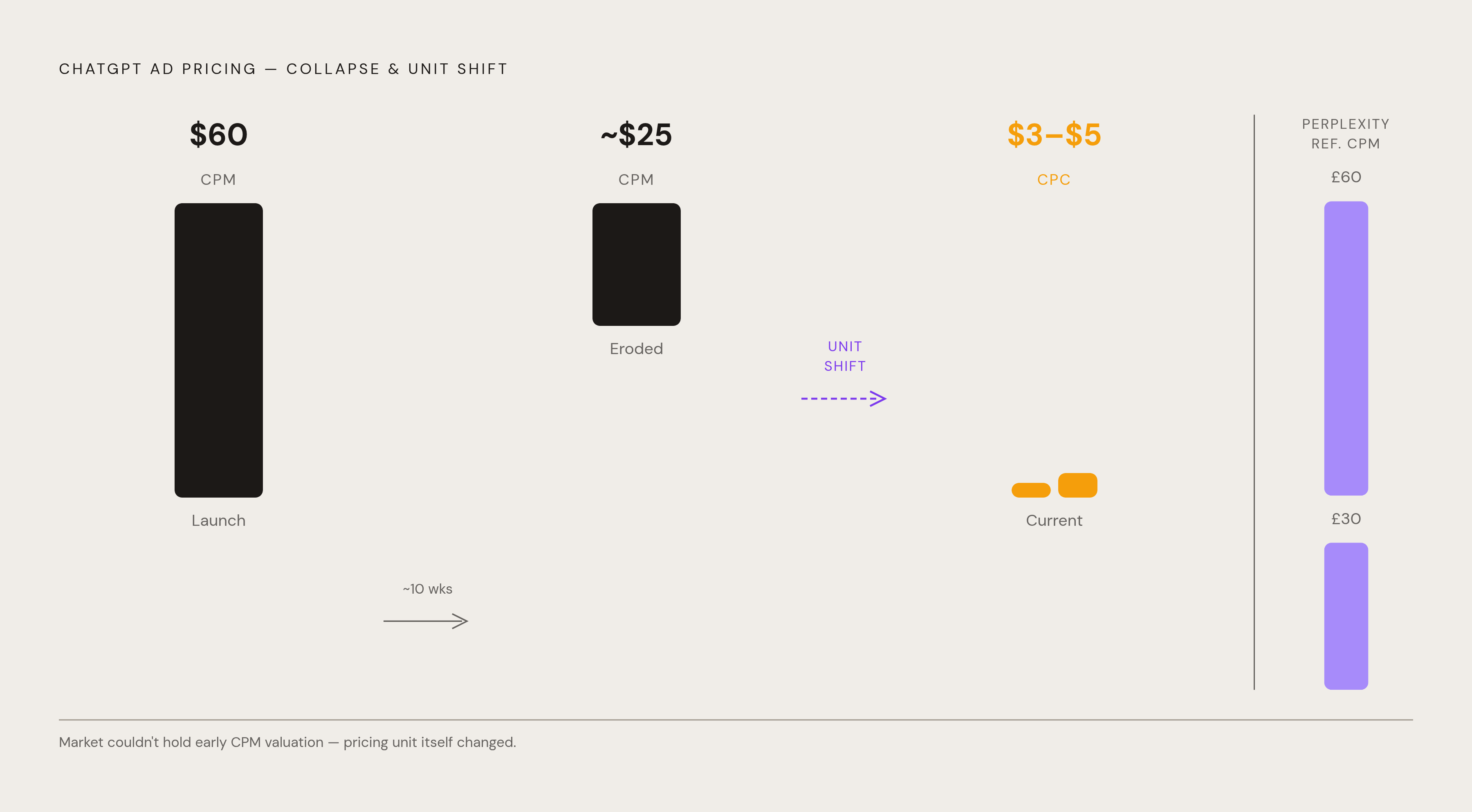
Pricing in the market today reflects how early this all still is. OpenAI moved its ChatGPT ad pricing from CPM to CPC, with bids running between $3 and $5, after the $60 CPM it launched with eroded down to around $25 within about ten weeks. Perplexity, back when it ran ads, priced on CPM between roughly £30 and £60. The shift to CPC is telling: a click is an action that follows a specific, contextually matched response, and that's proven to be a more defensible unit of value than paying for the conversation-level impression on its own.
Academic research on auction design for large language models is starting to grapple with the same tension: how to keep response quality high while still letting higher bidders win more placement. A framework published in December 2025 (Zhao et al., referred to as LLM-Auction) tries to solve this by folding auction logic straight into the model's generation process through reinforcement learning, training the system to optimize response quality and ad revenue at the same time, rather than treating them as separate problems bolted together after the fact.
None of this answers the harder question yet: how should a platform price a turn where a constraint just appeared, versus a general conversational impression, when the exact same ad slot can serve either one? The bidding infrastructure available to buyers today doesn't expose that distinction at all. Whichever platform builds the first auction that lets buyers bid specifically on constraint-emergence moments, rather than broad conversation categories, will be able to charge structurally higher CPCs and justify every cent of it.
Why publishers who expose constraint-rich inventory are sitting on monetization they haven't collected
The IAB Tech Lab has documented roughly $2 billion in publisher revenue lost to AI-driven search traffic displacement. That number alone says the existing model is broken: publishers are feeding content into AI responses and getting nothing back for it.
But there's a second, quieter loss sitting underneath that headline number. A recipe site running its own AI assistant, where a user asks "can you adapt this for someone with a tree nut allergy," is sitting on something far more valuable than a page view. That's a disclosed dietary constraint attached to a purchase-adjacent moment, and there's currently no clean way for most publishers to sell it as such. Legacy ad networks built for search or display simply weren't designed to read this kind of signal. Those networks were built for the surfaces they originally served, not for chatbot turns, and the mismatch leaves constraint-rich conversational inventory effectively unmonetized, which is the gap Thrad's programmatic infrastructure for AI chat interfaces was built around.
The IAB Tech Lab's CoMP Working Group, made up of roughly 80 executives from publishers, cloud providers, and AI monetization companies, is currently building standards like Cost per Crawl pricing, LLM Ingest APIs, and llms.txt files. None of that touches constraint-level pricing yet; it's still an open problem nobody has solved. PubMatic's partnership to open programmatic access to AI conversational inventory is an early sign the supply side is starting to organize around this, but the specific value of a constraint-rich turn still isn't priced into any of these frameworks.
A publisher who can walk into a sales conversation and say "this ad ran in a turn where the user had already stated a $200 ceiling and was comparing two named product categories" is selling something categorically different from a flat CPM on a chatbot session. And the surface available to sell keeps expanding. A 2025 global survey found 97% of businesses plan to use AI in customer communications, with 43% naming AI-driven chatbots as a top area of investment. That adoption curve means constraint-rich inventory keeps growing every quarter, and the gap between what's collectible and what's actually being collected only gets more expensive to ignore.
What brands need to unlearn about audience definition before they can bid on constraint signals
Demographic targeting is a hypothesis about who might want something. Constraint targeting is a live statement of what one specific person needs right now. These pull on opposite muscles, and most media teams are only trained for one of them.
Writing a context hint for a system like ChatGPT's ads manager has more in common with writing a short scene than filling out a targeting form. "Someone planning a family road trip who just mentioned needing a roof rack" is a different kind of brief than "adults 25 to 45, household income above a certain threshold." The first requires imagining a decision moment in detail. The second requires filling in boxes. Campaign planning has to shift accordingly: instead of one broad audience definition, a brand needs a library of hint descriptions mapped to real decision points, closer to a decision tree than a media plan.
Creative has to follow the same logic. An ad served right after a user states a budget ceiling should acknowledge that ceiling somehow; an ad that ignores the constraint and runs generic brand messaging is wasting the exact signal that made the placement valuable in the first place. Most programmatic teams are still optimized for scale and reach efficiency, chasing lower CPMs across bigger audiences. Constraint targeting optimizes for something else entirely: precision at a specific moment, and willingness to pay right then. Those are different KPIs, and they require a different pitch internally before a client will sign off on the budget shift.
No case study exists yet to prove a performance lift from this approach, and none should be claimed without one. The argument here is structural, not a promise of returns: brands building the internal habit of thinking in constraint scenarios now are building a skill that has no shortcut once every platform makes this point-and-click. By then, the early movers will already have the playbook.
The measurement gap that constraint targeting exposes — and why solving it matters more than the targeting itself
Constraint targeting creates a precision problem that existing attribution simply can't handle. Someone states a budget ceiling mid-conversation on Monday and buys the product Thursday through a completely different channel. No attribution model currently in wide use connects those two events, because the platform's own privacy architecture makes the connection invisible by design.
That's the trade-off worth sitting with. OpenAI's refusal to track users at the individual level, share demographic data, or build cross-platform behavioral profiles is exactly what makes constraint signals so trustworthy and valuable in the first place; it's also exactly why closed-loop measurement doesn't exist on the platform today. What can be measured right now is narrower: CPC and click-through at the conversation level, brand lift studies run outside the platform entirely, and post-purchase surveys that ask customers where they first ran into the product. What still has no answer: how to credit a multi-session AI research journey with an eventual conversion, how to weigh a constraint-stage engagement against a plain category-awareness engagement, or how to measure lift when a constraint stated in one AI interface leads to a purchase through a totally different channel.
The economics push urgency into this. Running ChatGPT alone is estimated to cost roughly $700,000 a day in infrastructure, and that number alone explains why these platforms can't sustain advertising as a business line without proving advertiser return in a way procurement teams can actually defend. Measurement credibility isn't a bonus feature here. It's the difference between AI ad budgets consolidating around a few platforms or scattering everywhere while marketers wait for proof.
For programmatic teams and adtech buyers, the move now is to build measurement scaffolding alongside the targeting work itself, not after it. That means server-side event tracking, post-purchase attribution surveys, and incrementality tests run independently of whatever the platform provides. Teams that build this instrumentation early, on their own, will be the ones able to defend AI ad spend the moment finance asks for proof it worked. That measurement infrastructure will end up just as proprietary, and just as valuable, as the targeting skill it's built to justify.