What DSP Access to ChatGPT and Perplexity Inventory Actually Requires Right Now
ChatGPT ads are buyable through three paths; Perplexity's are not.
A buyer asking whether ChatGPT or Perplexity inventory can be bought through a DSP needs two separate answers, because the two surfaces are no longer comparable. Perplexity sold no ads at all as of February 2026. ChatGPT inventory is growing and reachable through three distinct access paths, each with its own eligibility gate, its own split of operational control, and its own measurement limits. A DSP purpose-built for conversational AI inventory matches ads to live prompt context rather than adapting a display or search stack to a chat window, and such platforms sit alongside Amazon DSP, The Trade Desk, StackAdapt, Google DV360, PubMatic, and Dappier as the field a buyer actually has to weigh.
Why this question needs a precise answer right now
A search for "buy ads on ChatGPT or Perplexity through a DSP" returns guidance that was accurate eighteen months ago and is wrong today on at least one half of the claim. Perplexity stopped selling advertising entirely, so if an instruction tells you how to buy its Sponsored Questions unit, it describes a product that no longer exists. ChatGPT, meanwhile, has moved fast enough that a guide written in March 2026 would miss the Amazon DSP pilot that followed in September, the targeting features layered in after the May self-serve launch, and the agency holdco integrations that built out in between. Getting the answer right means treating each surface and each access path on its own terms, not folding them into a single generic claim that a DSP can "get you into AI chat."
Perplexity inventory no longer exists
Perplexity ran an experimental advertising program into early 2026, placing sponsored units called Sponsored Questions in front of users, and brands including Whole Foods and Indeed were onboarded during that window. In February 2026, Perplexity confirmed it would not pursue advertising as a revenue stream going forward and moved to a subscription-only model. The Sponsored Questions program is discontinued, and nothing has replaced it as a paid unit. Perplexity's subscription revenue grew after the exit, a detail that matters because it shows the company walked away from advertising on its own terms. For a brand today, that leaves exactly one route into a Perplexity answer: earning it. Appearing in Perplexity's results now depends on producing the clearest, most credible answer to the question a user actually asked, a discipline often called answer engine optimization, and no media budget, DSP relationship, or agency contact changes that.
How ChatGPT advertising is structured
ChatGPT's ad business started with a narrow and specific rollout. On February 9, 2026, OpenAI began showing ads to logged-in adult users on the Free and ChatGPT Go tiers in the United States. Every paid tier, Plus, Pro, Business, Enterprise, and Education, stays ad-free, so the entire advertising opportunity sits within the free and low-cost consumer base, not the paying user base enterprises tend to picture when they think about ChatGPT's reach.
Buying access followed a few months later. OpenAI opened a self-serve ChatGPT Ads Manager to US businesses on May 5, 2026, and you get CPC and CPM bidding with no minimum spend required, a change from an earlier version of the product that had required one. Since that launch, OpenAI has added a conversion-optimized bidding objective (oCPC), custom audiences built from email and phone lists, geographic targeting down to the state, DMA, and ZIP level, platform targeting, automatic advanced matching, and one-day view-through reporting. Amazon has layered in a format of its own on top of this foundation: product feed ads that build creative automatically from a brand's existing product catalogue, a different unit from the standard text-and-image ad most ChatGPT Ads Manager buyers run today.
How ChatGPT targeting works
ChatGPT does not sell keyword targeting, and it does not let advertisers target by age, gender, or income. Instead, OpenAI built what it calls "context hints": advertisers describe, in broad terms, the kinds of scenarios or intents they want to reach, and OpenAI's own system matches those descriptions to live conversations using the current thread, historical personalization signals, and how users have engaged with similar ads in the past.
That design has one consequence every buyer needs to internalize before choosing a path: nobody can handpick the exact prompt or conversational moment where an ad appears. Placement authority sits with OpenAI's matching system no matter which path a buyer uses to get in. Run a campaign through Amazon DSP, through a holdco's ad tech stack, or directly through OpenAI's own Ads Manager, and the result is the same on this point: the buying platform manages setup, budget, and optimization, while OpenAI decides when and where the ad surfaces inside a conversation. A DSP can get a campaign into the queue. None of the three paths lets a DSP extend its usual targeting controls into that decision.
The three paths to buying ChatGPT inventory
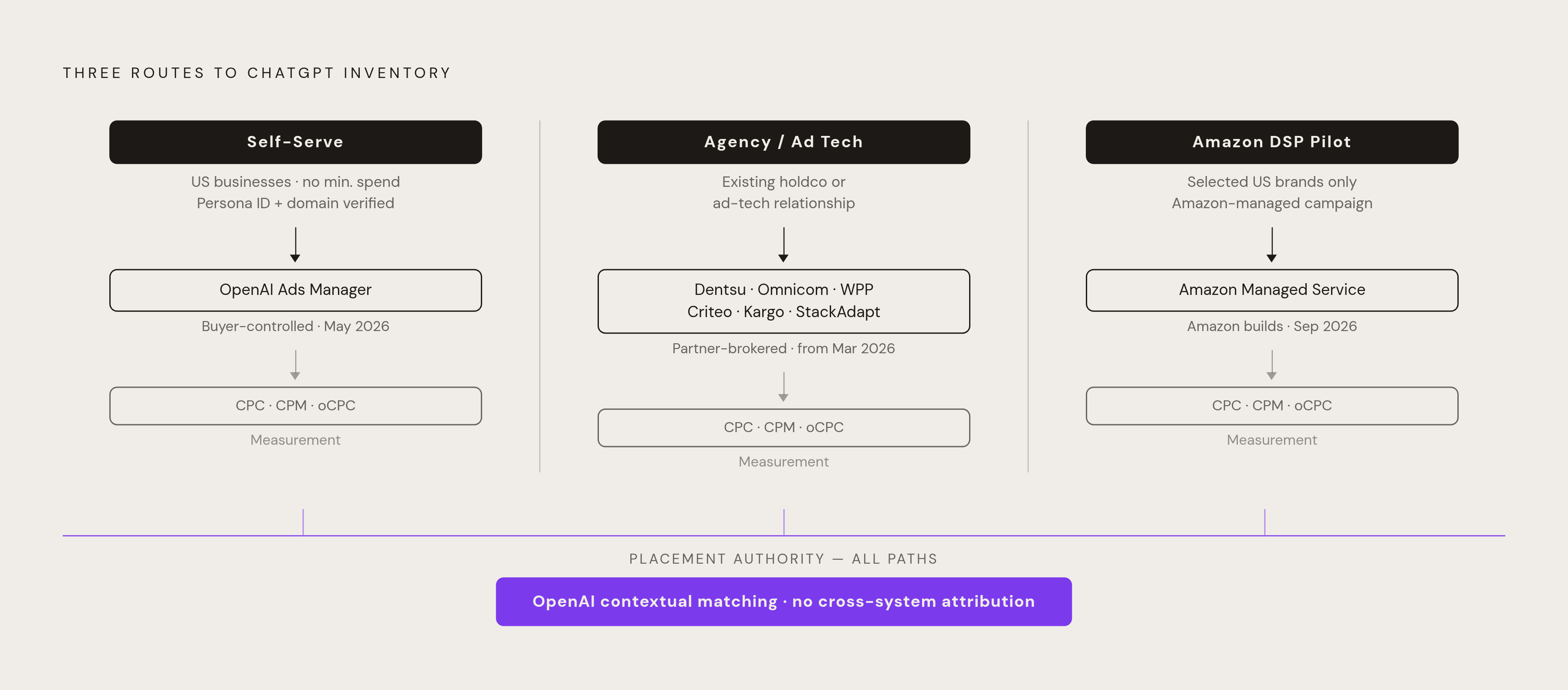
Three distinct routes into ChatGPT advertising exist today, and they differ in who qualifies, how much control a buyer keeps, and what they can measure, not just in how convenient the workflow feels.
The first is direct self-serve through OpenAI's own Ads Manager, open to US businesses since May 5, 2026, with no minimum spend required. You need identity verification through Persona and domain verification through either a DNS TXT record or an HTML meta tag, standard steps when a platform wants to keep bad actors out of a new ad product. Once verified, a buyer gets CPC and CPM bidding, the oCPC optimization objective, custom audiences, geographic targeting down to the ZIP code, platform targeting, and one-day view-through reporting. This path puts a buyer closest to OpenAI's own reporting dashboard and first in line for new features as they ship, but it offers no programmatic automation and no way to manage a ChatGPT campaign alongside other channels from a single cross-platform interface.
The second path runs through agency holdcos and established ad tech partners. OpenAI has built formal integrations with Adobe's GenStudio, Criteo, Kargo, Pacvue, and StackAdapt on the ad tech side, and with Dentsu, Omnicom, Publicis, and WPP on the holdco side. Criteo was the first ad tech partner to join, in March 2026. OpenAI is also working with LiveRamp on measurement, so advertisers can have more confidence in attribution than raw platform reporting currently gives them. This path fits a buyer who already has a holdco relationship or an existing ad tech stack and wants ChatGPT inventory folded into workflows that already exist, rather than standing up a new direct relationship with OpenAI. Before Amazon entered the picture, if a brand either didn't qualify for direct self-serve access or didn't want the operational overhead of managing it, it would default to the holdco route.
The third path, the newest and the one generating the most attention, is the Amazon DSP managed service pilot that launched September 10, 2026. Delta Vacations is among the first named US brands testing the integration. The arrangement is a managed service in the strict sense: Amazon's team builds and optimizes the campaign, but OpenAI's advertising system still decides when and where an eligible ad appears inside a ChatGPT conversation. Placement authority does not move to Amazon just because Amazon is running the buy. Testers get aggregated performance numbers, impressions, clicks, cost per result, CPM, and CPC, but deeper attribution tracing a user from an Amazon-sourced signal through a ChatGPT impression to a conversion on the advertiser's own site remains unresolved. The pilot is limited to a selected group of US brands; it is not a general self-serve launch, and being an Amazon DSP advertiser today does not guarantee a seat in it. OpenAI had already built retail media partnerships with Target and Albertsons before this, with Albertsons, Target, and Williams-Sonoma all announced as early pilot participants in February 2026, but Amazon brings inventory reach and advertiser volume neither of those partnerships matched. OpenAI had reportedly discussed a deal with The Trade Desk earlier in the year before it settled on Amazon as its largest DSP partner to date, and that matters because Amazon DSP isn't an independent, third-party DSP the way Criteo or StackAdapt are.
What DSP access through Amazon transfers
The Amazon partnership genuinely opens a door. A large class of advertisers who had no way into ChatGPT inventory without either a direct OpenAI relationship or a holdco arrangement can now reach it through a DSP many of them already use for everything else. That is a real expansion of access, and it should be counted as one.
It is also a narrower expansion than it might first appear. Targeting control does not move to Amazon: OpenAI's contextual matching system governs where an ad lands regardless of how Amazon's campaign settings are configured. Placement transparency does not move either, so you cannot see or choose which conversational contexts will trigger your ad. Cross-system attribution stays unresolved, because nobody has yet built a reliable way to measure whether a click inside a ChatGPT conversation leads to a purchase on Amazon, a purchase on the advertiser's own site, or nothing. Amazon's shopping and browsing data genuinely strengthens the case that a given audience is relevant, but inside ChatGPT, that strength feeds eligibility, not placement. OpenAI's system still makes the final call on where the ad actually runs.
Delta Vacations' participation puts the real test in plain view: can Amazon's consumer data help a travel brand surface at the right moment inside a multi-turn vacation-planning conversation, without the ad reading as an interruption dropped into a thread that has nothing to do with it? That bar sits well above the one a display network clears when it reaches a travel-interested audience somewhere on the open web. As the roster of partners touching a single campaign grows, so does the operational question of who owns what. A buyer running spend across Amazon DSP and ChatGPT needs a clear answer, in writing, for who governs targeting decisions, who signs off on brand suitability, who controls pacing, who delivers reporting, and who resolves a dispute when the numbers from two systems don't match. More partners in the chain means more of these lines need to be drawn, not fewer.
What measurement looks like across all three paths today
Every path into ChatGPT advertising shares the same measurement ceiling right now. OpenAI's own help center states that ChatGPT Ads does not yet have performance benchmarks across advertisers, industries, or campaign types, so a buyer comparing a CPM or CTR against some assumed "normal" is comparing against a number that doesn't exist yet. What is available, consistently, across the self-serve, holdco, and Amazon paths, is aggregated reporting: impressions, clicks, CPM, CPC, and cost per result. None of it comes down to the individual user level.
OpenAI's work with LiveRamp, still ongoing, is aimed directly at this gap, with the goal of giving advertisers more confidence in attribution than current reporting supports. The Amazon path adds its own specific wrinkle on top of the shared limitation: Amazon manages the campaign, OpenAI decides where it runs, and the conversion event the advertiser actually cares about might happen on a third domain. Nobody has stitched that full journey into a single closed-loop measurement picture at this stage of the pilot. The practical posture for a buyer, across all three paths, is to track the aggregated numbers that are available, resist drawing firm conclusions from them until benchmarks exist, and build in time before treating any single campaign's results as representative of what the channel can do.
Fitting a purpose-built conversational AI DSP into this landscape
Both the Amazon DSP path and the holdco path route ChatGPT inventory through platforms that were built to transact on display ads, search ads, or retail media. They can handle the mechanics of buying conversational inventory, but they were not designed from the ground up to read what is happening inside a conversation. A DSP built specifically for AI assistant and large language model interfaces starts from a different premise entirely: match the ad to the intent of the conversation as it is actually unfolding, rather than to a page, a keyword, a demographic bucket, or a user profile carried over from some other channel.
So platforms built specifically for conversational AI advertising behave differently from generalist DSPs adapted to a new surface. A real-time prompt analysis engine matches ads to what a conversation is actually about as it happens, but even when you work through a self-serve or managed-service ChatGPT path, you are still operating inside OpenAI's own contextual matching logic, not extending a traditional DSP's targeting controls into the chat itself. For a brand whose customers move through research, comparison, and decision-making across more than one AI interface, not ChatGPT alone, a platform that treats the conversation itself as the unit of targeting addresses something neither the Amazon path nor the holdco path is built to solve, since both were designed around inventory types that predate conversational AI.
The fragmentation across ChatGPT's three access paths, each with its own eligibility gate, its own measurement access, and its own split of control, is why DSPs purpose-built for AI publisher inventory have become necessary. A DSP built specifically for this landscape, running both a buy-side platform and direct publisher supply, can absorb some of that complexity on behalf of a buyer working across several AI surfaces at once, though ChatGPT's own structural limits on placement control, context hints, and measurement stay fixed no matter which buying interface sits on top of them.
What a buyer should do
Three questions determine which path makes sense for a given brand: whether an Amazon DSP relationship already exists, whether the goal is reach across multiple conversational AI surfaces or ChatGPT specifically, and whether the organization can work within a managed-service structure or needs full programmatic, self-serve control.
A brand already spending through Amazon DSP, with budget set aside to test a new channel, gets the lowest-friction way in through the Amazon-ChatGPT managed service pilot, provided that brand lands in the eligible US group OpenAI and Amazon have selected. A brand with an existing relationship at Dentsu, Omnicom, Publicis, or WPP, or an active account with Criteo, StackAdapt, Kargo, or Pacvue, can reach ChatGPT inventory through that existing relationship rather than building a new one from scratch with OpenAI directly. A US business that wants a direct line to OpenAI, no minimum spend, and the newest features as they ship can go straight to the self-serve Ads Manager, subject to the Persona identity check and domain verification. Several other legacy platforms extend into AI-adjacent or publisher inventory, marking other points on this same spectrum, even where they are not yet the specific route into ChatGPT itself.
Conversational AI is adding new inventory surfaces and new buying paths faster than most media plans get updated to reflect them. The buyer who takes the time to map what each path actually requires today, rather than waiting for a single unified on-ramp that does not yet exist, is the one positioned to move when the next surface opens up.