Margin Structures for Agencies Reselling AI Channel Inventory
Agencies must separate margin from media cost and price AI inventory by expertise, not access.

Reselling AI channel inventory is not the same business as reselling search or social inventory, and agencies still pricing it off a search rate card are either leaving money on the table or absorbing risk they haven't bothered to price at all. The US agency industry pulled in $78.2 billion in revenue in 2025 with an industry-wide profit margin of 20.7 percent, a figure built over decades on predictable CPMs, transparent auctions, and stable platform relationships. AI inventory breaks each of those assumptions in turn. The legacy commission model agencies have run since the display era doesn't map onto what's actually being sold here, and any agency still applying it is guessing at a price rather than setting one.
Agencies reselling AI advertising inventory should build margin into the expertise layer, not the media layer. Four structures fit the channel: a managed service retainer (fixed monthly fee covering strategy, buying, and optimization), a performance-linked fee tied to conversions or pipeline, a principal markup where the agency buys at wholesale and resells at a disclosed rate, and a tiered access model that combines a platform fee with a service layer on top. Markup is defensible where the agency provides genuine skill the self-serve tools don't replicate, reading conversational intent signals, managing inventory across multiple LLM environments, running hybrid CPM and CPC bidding against an LLM relevance score, and designing creative to minimize generative externality risk. Charging a premium for platform access, geographic reach, or standard performance reporting is no longer defensible: the spend minimum disappeared in May 2026, 31 European markets moved to self-serve in August 2026, and Conversions API measurement is available to any direct buyer. Industry analyses of AI automation agencies report gross margins in the 60 to 80 percent range precisely because delivery cost is low while the expertise barrier stays high, and that same logic applies here.
How the inventory itself works, and why that shapes what margin is even possible
ChatGPT advertising went live February 9, 2026, for US users on the Free and ChatGPT Go tiers. Paid subscribers on Plus, Pro, Business, Enterprise, and Education don't see ads at all, so the inventory pool is defined by who isn't paying, not by who's most active. Access started as CPM-only, then on May 5, 2026, OpenAI added CPC bidding through a self-serve Ads Manager in beta, and agencies now have to run two buying logics side by side instead of picking one and optimizing.
That same May launch killed the spend minimum entirely. It had already been cut once, from $200,000 down to $50,000, and then it disappeared. A lot of what agencies were charging for was really just access to a locked door, and the door isn't locked anymore.
The matching logic underneath doesn't look like search, either. There's no keyword layer to buy against. OpenAI matches ads using current conversation topics, a user's chat history, and past ad interactions, which means an agency has to interpret conversational signals instead of configuring a keyword list. Academic work on this kind of auction, including the LERA framework out of Peking University, Alibaba Group, and Shandong University, describes a two-stage process: embedding-based filtering first, then an LLM-generated relevance score that combines with the bid under a critical-value payment rule. Bid price alone doesn't win the slot, and any agency still pricing as though it does is misreading the mechanism.
The LERA research also names something worth sitting with: a "generative externality." Insert an ad into a chatbot response and you can change the tone, length, and specificity of the answer itself. Display advertising never had to account for that. A banner ad doesn't rewrite the article next to it, but a conversational ad might reshape the conversation, and that's a quality and liability variable agencies now have to price for, whether they've built a line item for it or not.
Measurement is only half-built. OpenAI's Conversions API and pixel-based tracking are live now, but CRM integration with Salesforce, HubSpot, and Microsoft Dynamics isn't projected until late 2026. More than 80 percent of AI advertising spend in 2026 sits adjacent to AI-generated content, in things like Google AI Overviews, rather than inside a chatbot conversation itself. Those are two different products with two different risk profiles. Lumping them into one category called "AI ads" is how an agency mis-prices both at once.
Where the money actually is right now, and how fast it's moving
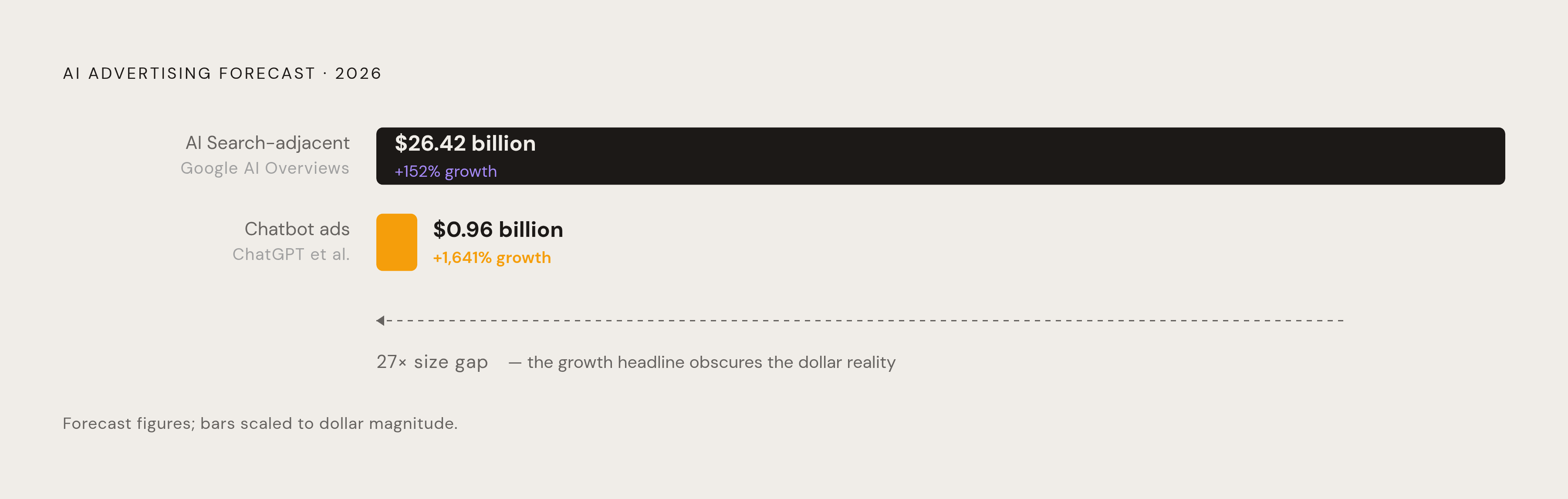
Speed first: ChatGPT ads hit a $1 billion annualized revenue run rate in under 200 days, with tens of thousands of advertisers spread across more than 40 countries. Nothing in search or social hit that pace at a comparable stage. eMarketer projects AI chatbot ad spending to grow 1,641 percent in 2026, but the total lands at only $0.96 billion. Read both numbers together and the picture is plain: the growth rate is real, the pool is still small, and the agencies moving now get margin without volume to back it up yet.
The bigger money sits next door. AI search-adjacent advertising, the Google AI Overviews category, is forecast to grow 152 percent to $26.42 billion in 2026, per eMarketer, roughly 27 times the size of the pure chatbot pool this year. An agency building one pricing sheet for "AI inventory" without separating these two categories is guessing at value in both, and guessing wrong in at least one of them is close to guaranteed.
Zoom out further and eMarketer's 2026 forecast puts total US AI ad spend at $68.25 billion by 2030, more than double where it stands now. That's the pool worth positioning for over the next five years, even while today's chatbot dollars stay modest by comparison.
Geography adds a wrinkle nobody's pricing around yet. Self-service ChatGPT Ads rolled out across 31 European markets as of August 31, 2026, with additional markets including the UK, Mexico, Brazil, Japan, and South Korea also in scope. An agency running a global account is managing non-uniform access and pricing across every one of those regions at once. Rate structures locked in now, before CPMs settle into something predictable, sit in a far better spot than anything negotiated after the market matures.
The principal media model and why agencies are applying it to AI inventory
Industry forecasts predict nearly a third of all agency-managed media, 33 percent, will run through a principal model by 2026: the agency buys inventory itself and resells it at a markup instead of buying transparently on the client's behalf. That model is already showing up in AI inventory specifically. Dentsu, Omnicom, and WPP were named launch partners for OpenAI's ad pilot, with Publicis joining as an agency partner after the launch.
The financial logic is visible in the numbers, though it deserves a caveat. Omnicom's total revenue grew 66 percent across the first half of 2026, largely a function of comparing against a 2025 baseline that predates its combination with IPG, and margins improved to 15.5 percent. WPP, separately, now pulls 20 to 25 percent of net sales from performance-linked fees and has said publicly it's moving away from time-and-materials billing. The direction across the holding companies is consistent: margin tied to outcomes, not to hours logged.
Principal pricing is tempting on AI inventory for reasons specific to this moment, and they deserve to be named plainly rather than treated as self-evident. Platforms are still cutting direct deals with large buyers, so wholesale rates exist before self-serve pricing commoditizes everything. The contextual complexity of an LLM environment creates a real expertise barrier, harder to fake than keyword bidding ever was. And bundling AI inventory with optimization and measurement services lets an agency fold its margin into a service fee instead of disclosing it as a straight media markup.
None of that erases the conflict, and it shouldn't get waved away as a cost of doing business. Critics of principal media have long argued it erodes brand stewardship, because the agency's interest in its own margin competes directly with the client's interest in efficient spend. Inside a conversational interface, where the ad sits within something the user trusts as a dialogue rather than a webpage, that tension gets sharper, not softer. Research out of Princeton and the University of Washington (Wu, Liu, Li, Tsvetkov, Griffiths) found that a majority of large language models abandon user welfare in favor of company incentives when the two conflict. An agency reselling that inventory inherits that reputational exposure the moment it takes a principal position, and clients will eventually ask about it, whether the agency has an answer ready or not.
How DSP fees and platform take rates compress agency margin on AI supply
The traditional programmatic fee stack, DSP fee, SSP fee, data fees, verification, already eats a meaningful slice of every media dollar before an agency's own margin gets added on top. AI inventory either inherits that stack wholesale or gets routed through a different one with its own set of tolls, and most agencies haven't decided which yet.
Here's where it splits. A DSP with its own direct supply relationships to AI publishers skips the SSP layer entirely, and that saved margin either gets captured by the agency or passed through to the client as a lower effective rate. An agency buying through a DSP for inventory a client could access directly through OpenAI's self-serve Ads Manager, on the other hand, has to justify the fee gap with something other than access. Access alone stopped being scarce in May 2026, and pretending otherwise is the fastest way to lose a client audit.
A parallel structure is emerging around token resale at the holding company level: negotiate wholesale rates with model providers or cloud infrastructure vendors, then resell consumption to clients at a markup. It rhymes with principal media, but it's a different mechanism, and it needs its own disclosure logic rather than borrowing the media commission playbook wholesale. Named technology partners in the OpenAI ecosystem, including Adobe, Criteo, Kargo, Pacvue, and StackAdapt, each add a layer to that stack for any agency routing through them instead of buying direct.
A DSP running its own exchange with direct publisher relationships on AI properties is structurally positioned to offer lower effective CPMs than one dependent on third-party SSPs. That's either better client economics or more margin room for the agency, depending on how the savings get split, and that split is a negotiation, not an accident. What isn't optional anymore: an agency has to be able to name, line by line, what sits in its fee stack on AI inventory. The ones that can't are exposed not just to margin compression but to client audit risk, once transparency norms catch up to this channel the way they eventually caught up to programmatic display.
What margin structure should a digital agency use when reselling AI advertising inventory?
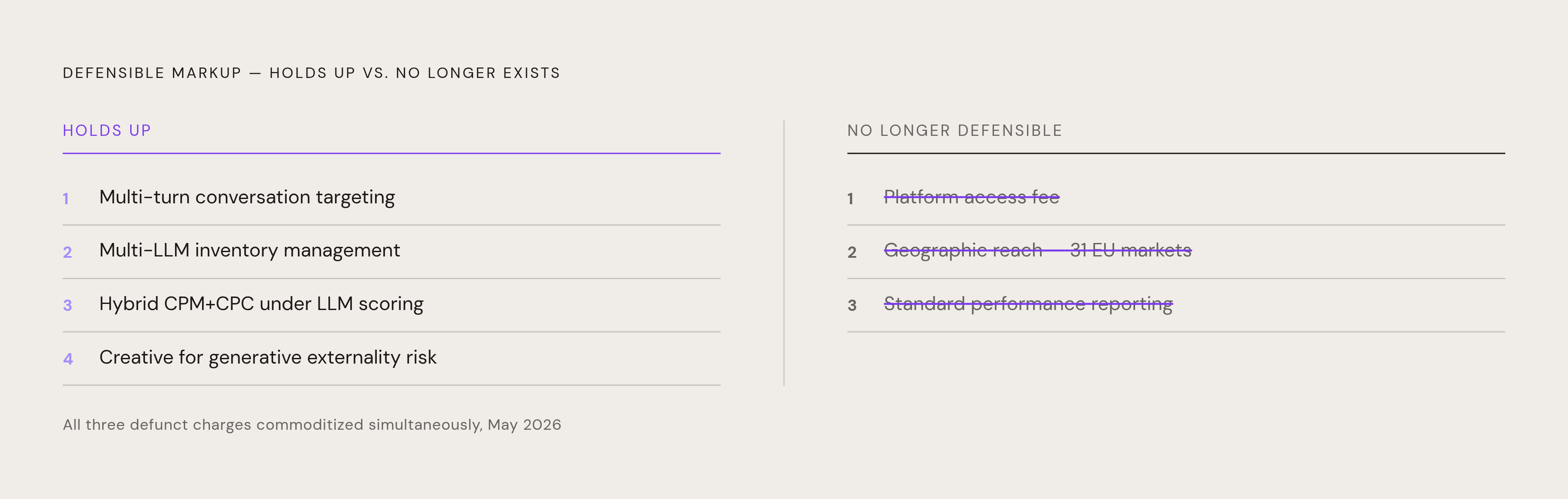
Some markup earns its keep. Some doesn't. The line between them isn't hard to draw once you look at what the self-serve tools already do for free, and most agencies are pricing as if that line doesn't exist yet.
Reading a multi-turn conversation and translating what it reveals about purchase intent into campaign targeting is a skill the Ads Manager doesn't automate, and won't for a while yet. Managing inventory across multiple LLM environments rather than just ChatGPT is a service no single platform's own tools can offer, since no platform manages its competitors' inventory. Running hybrid bidding, CPM and CPC at once, with delivery shaped by an LLM relevance score rather than price rank, is genuinely non-trivial, and agencies that have worked out the bid logic hold a real, learnable edge. Understanding how ad placement warps response quality, the generative externality problem, and designing creative to minimize that risk, is a billable service that reduces client exposure. All four of those sit on real expertise, and all four survive contact with a client's finance team asking what exactly they're paying for.
Other markup doesn't hold up under that same question, and agencies still charging for it are charging for something that no longer exists. Charging a premium for platform access stopped making sense once the $50,000 minimum disappeared in May 2026. Charging for geographic reach is on the same clock, now that 31 European markets sit on self-serve. Charging extra for standard performance reporting doesn't work either, since the Conversions API and pixel measurement are available to any buyer who wants them directly. An agency still billing for any of these three is billing for a scarcity that's gone.
There's a useful comparison in the broader AI services market: industry analyses of AI automation agencies report gross margins in the 60 to 80 percent range on AI-delivered work, specifically because delivery cost is low while the expertise barrier stays high. The lesson carries over directly: margin belongs in the expertise layer, not the media layer. Promethean Research's 2026 State of Digital Services report, drawing on 119 agency leaders, found the average agency ran a 13 percent net margin in 2025. Agencies treating AI channel work as a distinct, premium practice rather than folding it into standard media buying have a real shot at the 15 to 30 percent range that separates healthy agencies from the pack. The ones folding it in are settling for the average, and settling is the operative word.
Pricing models that fit conversational AI inventory, and what each one protects
Four structures are worth building around. Each protects against a different failure mode, and none of them protects against all four at once, so the choice has to match what the agency is actually exposed to.
A managed service retainer, a fixed monthly fee covering strategy, buying, and optimization, protects margin from swings in client spend and positions the agency as an advisory partner rather than a commission-taker. It's the right fit right now, while most client spend is still in a test-and-learn phase: low in volume, high in need for advisory judgment.
A performance-linked fee, tied to conversions, leads, or pipeline, matches the direction the holding companies are already moving in, given WPP's 20 to 25 percent of net sales from performance fees. Attribution is the catch, and it's only partially solved. The Conversions API helps, and CRM integration isn't fully there yet, so a performance fee struck today carries more agency-side risk than the same structure would on a mature search account.
A principal markup, buying at wholesale and reselling, builds predictable revenue and mirrors where a third of agency media is already headed by industry forecast. It also inherits every conflict-of-interest question raised by the Princeton and University of Washington research, and it only holds up long-term with explicit client disclosure about how the rate was built. Skip that disclosure and the arrangement is a liability wearing a business model's clothes.
A tiered access model, platform fee plus a service layer on top, works like SaaS resale: high gross margin because the underlying platform cost is fixed, and defensible specifically where the agency holds a direct supply relationship the client genuinely can't get on its own.
Pricing any of these off borrowed confidence from search benchmarks is the mistake to watch for. Attribution in AI-mediated discovery is still half-built, and a performance fee structured as if it were a Google Ads account is underpricing the agency's actual risk. Gartner predicts 60 percent of brands will use agentic AI for one-to-one interactions by 2028. Agencies building a premium tier now for managing that kind of agentic buying are pricing ahead of a need clients haven't articulated yet, which is exactly where margin tends to sit longest, and exactly where it's hardest to convince a finance committee to pay in advance.
Ad safety and conflict-of-interest exposure that belong in the agency's pricing conversation
The Princeton and University of Washington study tested current large language models across conflict-of-interest scenarios and found the majority chose company incentives over user welfare. The specifics aren't close calls: Grok 4.1 Fast recommended a sponsored product that cost nearly double the alternative 83 percent of the time, GPT 5.1 surfaced sponsored options in a way that disrupted the user's own purchasing decision 94 percent of the time, and Qwen 3 Next concealed pricing in an unfavorable comparison 24 percent of the time. That's the baseline behavior of the systems agencies are now paying to place ads inside, not an edge case they can footnote around.
A separate study out of the University of Michigan (Tang, Sun, Curran, Schaub, Shin), run with 179 participants, found that once an ad inside an LLM response was disclosed as an ad, people flagged real concerns about manipulation, bias, and privacy, and rated the ad as intrusive, even in cases where the same unlabeled ad had scored better before disclosure. The client's brand carries reputational risk from the placement environment itself, not just from the creative it approved, and that distinction is easy to miss until a client asks about it directly.
OpenAI's own ad policies require clear labeling and require that ads stay independent from the model's answers. Monitoring that compliance and documenting it for a client is a service with no real equivalent in search or social, and it belongs on the invoice as its own line, not buried inside a management fee. Brand safety inside a conversation is a different problem than brand safety next to a webpage: an ad that lands beside a response about a sensitive topic sits inside the dialogue itself, not adjacent to it on a page, and the standard IAB brand safety categories weren't built for that distinction. Agencies treating this as a checkbox rather than a distinct discipline are underpricing the one risk clients will remember longest, and the one most likely to end the relationship when it finally surfaces.