Pricing Models for Conversational AI Advertising Compared to Search and Display
Conversational AI ads match live intent, not keywords, changing what performance actually costs.
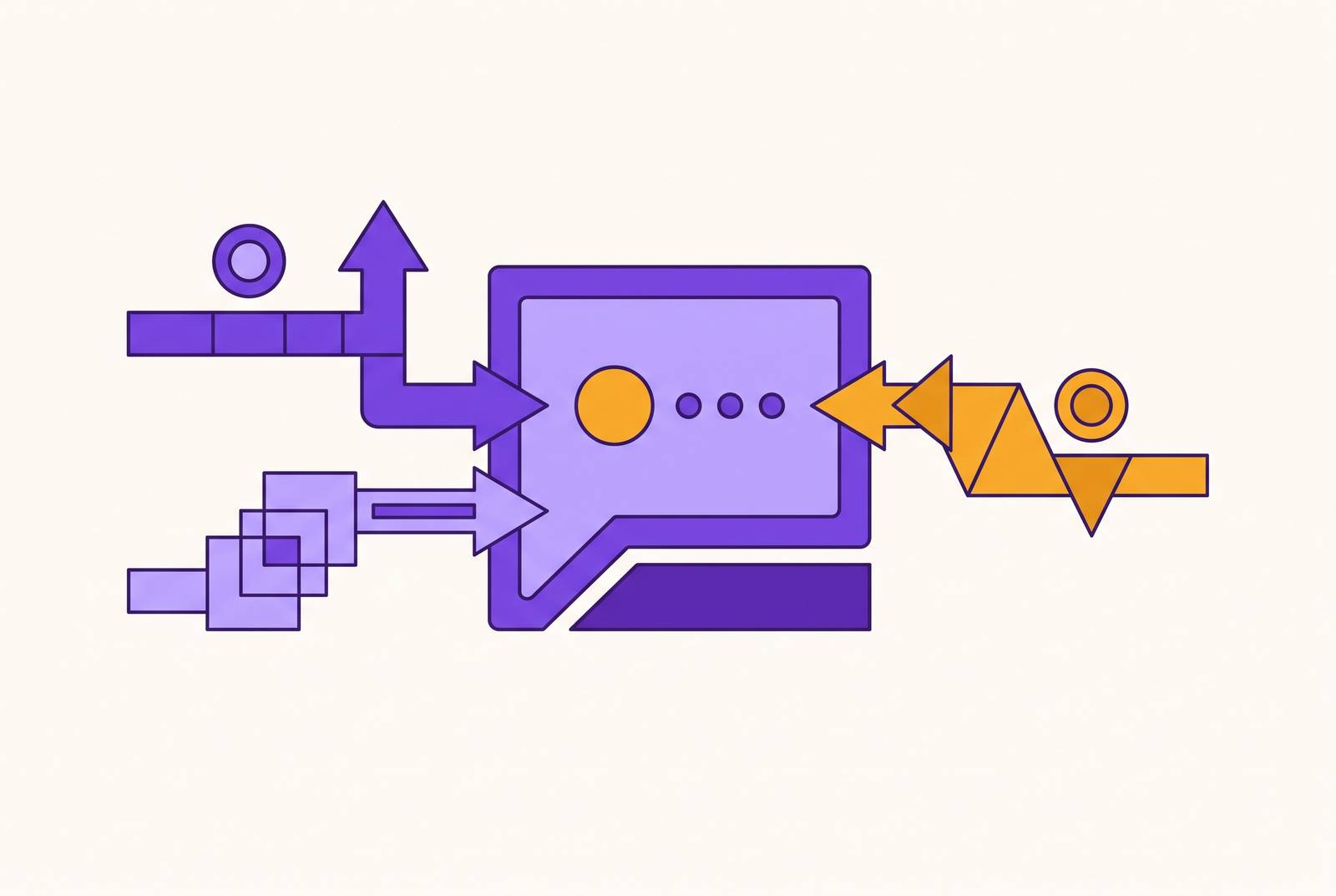
Conversational AI advertising is not search with a chatbot wrapper, and it is not display with better copy. The pricing logic behind ChatGPT ads matches to live, declared intent inside an active conversation, not to a keyword someone typed three seconds ago or an audience profile assembled from months of browsing history. That distinction changes what "expensive" and "cheap" actually mean once you put a $4 ChatGPT CPC next to a Google Ads benchmark in the mid-single digits. They are not pricing the same thing, and treating them as though they are is the fastest way to misjudge a media plan.
How search advertising prices attention: keyword auctions, intent as a proxy, and what the benchmark numbers actually reflect
Search advertising runs on a proxy. Advertisers bid on keywords, and a keyword stands in for intent, but it is only ever the word someone typed, not the problem they are actually trying to solve. Google's auction settles this with second-price logic: the winner pays the minimum needed to beat the Ad Rank of the next competitor down, calculated as that competitor's Ad Rank divided by the winner's Quality Score, plus a cent. Relevance modulates the effective rank, which is why a well-optimized account can beat a bigger budget. Most performance marketers know this mechanic cold.
The benchmark numbers tell a story about competitive scarcity, not about how deeply anyone is engaging with a brand. Cross-industry Google Ads data puts the all-industry average CPC in the mid-single digits. But the spread within that average holds the real information: entertainment and leisure verticals sit toward the low end, while legal services push toward the upper end. That gap has nothing to do with how urgently someone needs a lawyer versus a museum ticket, and everything to do with how many other advertisers are fighting for the same keyword.
AI-powered bidding now accounts for a large and growing share of Google Ads spend, and its impact on cost per conversion varies by industry and by how mature the account's conversion data already is. Still, none of this solves the underlying limitation. A keyword bid captures what someone typed. It does not capture what stage of the decision they're at, what they already know, or what's actually holding them back from buying. Search commands a premium over social advertising precisely because an imperfect intent signal still beats no intent signal at all, and that's the axis conversational AI advertising needs to be measured against.
How display advertising prices reach: audience segments, impression inventory, and the intent gap that keeps CPMs low
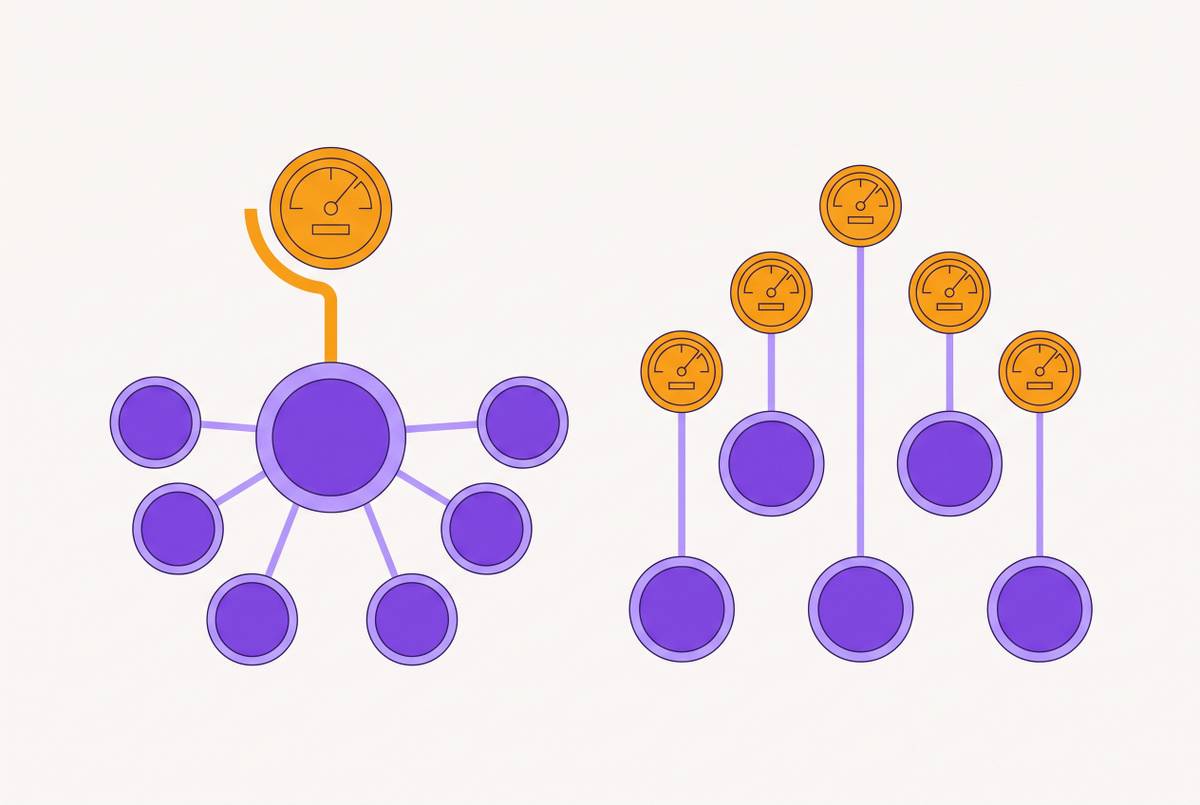
Display buys a different unit. Instead of a keyword, advertisers buy impressions against an audience segment, a demographic, behavioral, or interest profile, served into environments where the user is browsing, not searching. Meta is the clearest example: its system leans on behavioral tracking and audience profiles, and its rates reflect it, with CPMs averaging in the single-digit-to-mid-teens range and CPCs running $1.06 to $1.72. Those numbers sit well below search or conversational AI benchmarks, and the reason is structural rather than a matter of inferior inventory.
Social users are in a consumption mindset. They did not open the app looking for a mattress or a CRM tool, so the platform is pricing the probability that someone in a defined audience notices an ad, not a match to a declared need. That's a statistical bet on attention, and it prices accordingly.
Meta's own approach to AI conversation data is instructive here. When a user discusses kitchen renovation plans with Meta AI, that context doesn't surface as a sponsored suggestion inside the chat. It resurfaces later as a targeted ad in the Instagram feed, using the conversation as a behavioral signal rather than as a placement environment. It shows two entirely different philosophies of what a conversation is for in advertising terms: one platform treats it as raw material for retargeting, another treats it as the moment of sale itself. The comparison to conversational AI CPMs later in this piece only makes sense once that difference is on the table. Display's lower price reflects lower certainty about intent-match, not worse inventory.
How conversational AI advertising prices intent: the mechanics of ChatGPT's auction and what "context hints" change about the buying logic
ChatGPT ads appear after AI responses, labeled Sponsored, and matched by topic relevance to the conversation happening in real time. Not to a keyword. Not to a page. Not to a static user profile assembled weeks earlier.
The targeting format that makes this possible is called context hints. Advertisers don't bid on a term like "SaaS." They describe a scenario, something closer to "users comparing project management tools," and OpenAI's system pairs that description against the live topic of the conversation, then runs a relevance-weighted, second-price auction to decide who shows up. A tightly relevant ad on a modest bid can outrank a generic ad backed by a bigger budget, which is the same mechanic that rewarded Quality Score discipline in early Google Ads. Advertisers who write sharp, specific context hints get an edge that spending alone cannot buy.
As of mid-2026, three bidding models are live. CPM, under the Reach objective, charges per thousand impressions and suits awareness campaigns. CPC, under Clicks, lets advertisers pay per click and align spend with action inside decision-heavy conversations. OpenAI has confirmed this rationale on record. CPA bidding began rolling out in late May 2026 to select advertisers, letting a business pay only when a click turns into a signup or a purchase.
Reach carries a real ceiling. Ads serve to Free and Go tier users across an expanding set of markets, including the US, UK, Mexico, Brazil, Japan, South Korea, Canada, Australia, New Zealand, and a growing number of European markets. Plus, Pro, and Enterprise users see no ads at all, which narrows the addressable audience relative to ChatGPT's raw user count. Frequency behaves differently too: conversation-based delivery naturally limits how often the same person sees the same ad within a session, so each impression carries more weight than a comparable display impression, but repetition-driven brand-building tactics don't translate cleanly onto this surface.
What's structurally new is that the ad experience isn't fixed the way it is on search. Google's ad format and placement stay consistent interaction after interaction. ChatGPT can incorporate an ad differently depending on where the conversation stands, because the matching target is a live conversation state, not a stable keyword. Buyers work with context hints rather than direct access to what users are typing. The very thing that makes conversational intent valuable, the raw language of what someone is actually trying to figure out, stays inside the platform. Buyers work through context hints, not prompt access.
What ChatGPT ads actually cost in 2026, how those numbers evolved from launch, and what the vertical spread implies
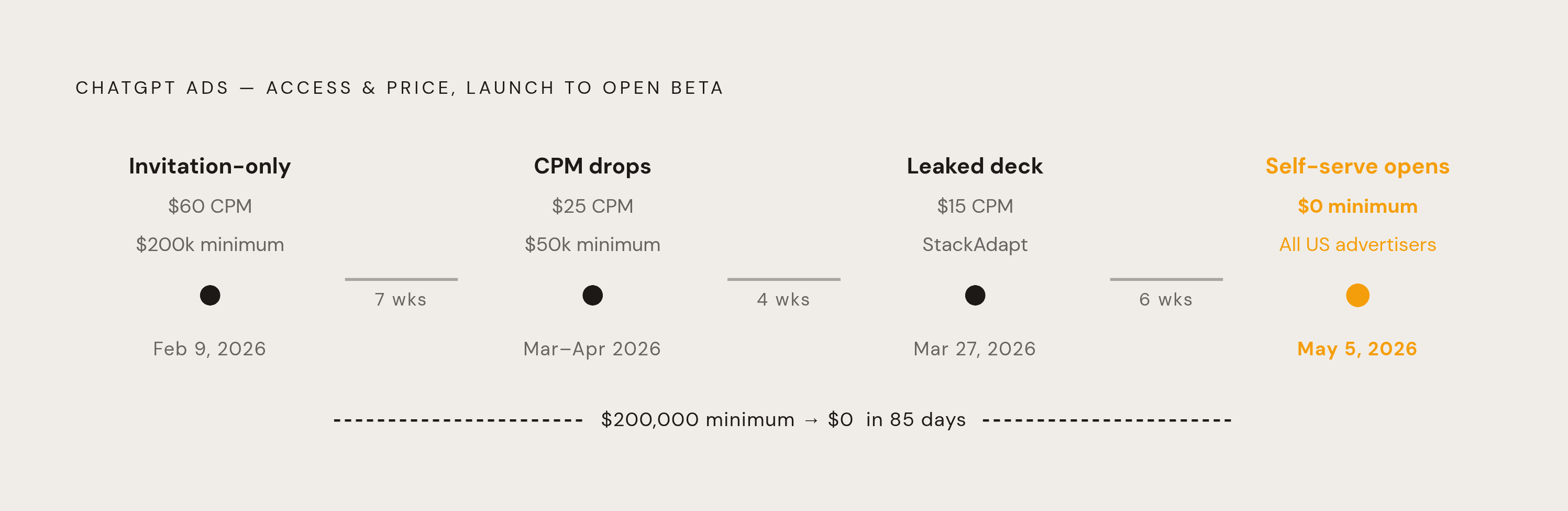
Rates have moved fast since launch. ChatGPT ads went live February 9, 2026, at a $60 CPM, invitation-only, with a minimum campaign commitment of $200,000 and a handful of enterprise partners in the first wave. That minimum dropped to $50,000 by April. Then, on May 5, 2026, OpenAI opened a self-serve Ads Manager Beta to all US advertisers with no minimum spend at all, a shift confirmed by VP of monetization Benji Shomair, who noted the removal of minimum spend requirements.
Prices fell as inventory scaled. CPMs dropped as low as $25 in less competitive categories by March and April 2026. A leaked deck from ad-tech platform StackAdapt, shared with select buyers on March 27, showed CPMs as low as $15. The current working range is $25 to $60 CPM, with $3 to $5 CPC as the recommended starting bid, and a low daily minimum per campaign inside the self-serve platform (there's no account-level minimum spend anymore).
The vertical spread tells you where the auction is actually competitive. eCommerce and retail run $3 to $5 per click. SaaS and software climb to a range well above that, reaching several times the lower end. Finance is $15 to $25. Legal services run a range starting well above eCommerce and retail, extending to nearly double its own starting point. Bids under $3 frequently fail to deliver at all, a floor the algorithm enforces regardless of how well-targeted the context hint is.
Go tier introduces its own considerations. The audience there skews toward more engaged, paying users, and B2B or professional-service advertisers may find that audience worth targeting, while consumer brands may see better overall economics on Free tier. Costs also run higher during a campaign's learning period before settling as the platform identifies which conversation contexts actually convert, and any major campaign change resets that clock.
OpenAI's stated targets, $2.5 billion in ad revenue for 2026 and $100 billion by 2030, are not just a growth story. They're a signal that friction will keep dropping and inventory will keep expanding, which means auction density is going to rise. Advertisers locking in relevance and conversion history now are buying at rates that will not stay this low.
Placing ChatGPT's rates alongside Google and Meta benchmarks, and why a direct CPM or CPC comparison obscures more than it reveals
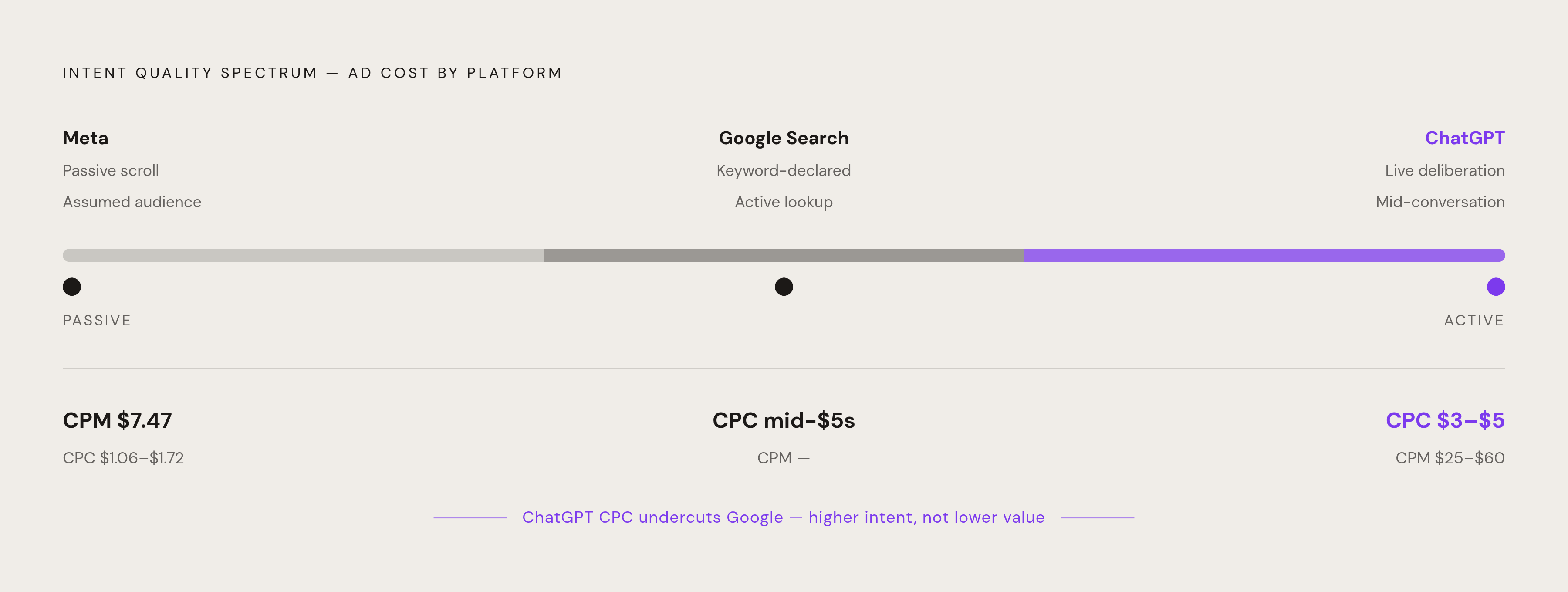
Line the numbers up and the picture looks contradictory at first glance. ChatGPT's $25 to $60 CPM sits well above Meta's roughly $7.47 average, making it look expensive on a raw impression basis. But ChatGPT's $3 to $5 CPC comes in under Google's mid-single-digit all-industry average, making it look cheap on a per-click basis. Stack it against LinkedIn, whose CPMs are reported in a similar range, and the two are broadly comparable. Meta's CPC of $1.06 to $1.72 remains the cheapest click on the table, but that click comes from someone scrolling, with no declared need attached to it at all.
Adthena CMO Ashley Fletcher has made the relevant point about Meta and Google specifically: Meta's CPCs run lower not because its inventory is worse, but because the intent behind the click is different. Social users are browsing. Search users are looking. ChatGPT users are actively deliberating, mid-conversation, about a decision they're already inside of. Extend that logic and the comparison gets clearer: a ChatGPT impression lands while someone is working through a purchase decision in real time, while a Meta impression lands during a passive scroll. Counting those as the same unit of attention is where the comparison falls apart.
A fair read weighs cost against the quality of the intent moment, not the sticker price per click or per thousand impressions. That's the same logic that already justifies Google's premium over Meta, just carried one step further along the intent spectrum.
There's a measurement wrinkle that makes ChatGPT look worse than it is. Clicks frequently route through in-app browsers, where client-side pixels lose a meaningful share of conversions before they're ever recorded. Per Aimerce's analysis, if roughly a third of real purchases never register, measured CPA comes out looking about 50% worse than the truth. That's not a small rounding error, it's the difference between a channel that looks unaffordable and one that's merely under-measured. Gartner VP analyst Nicole Greene has flagged the fix directly: consistent measurement is what lets advertisers justify shifting budget toward OpenAI's platform in the first place. Comparability, in other words, is a strategic unlock, not a bookkeeping nicety.
How Microsoft Copilot advertising fits into the conversational pricing landscape
Copilot is running its own version of this same shift. Ads appear below Copilot's organic AI-generated responses inside conversational search, and newer formats, like Offer Highlights, sit embedded directly within the response itself rather than tacked on below it. Offer Highlights, introduced in 2026, lets a brand surface concrete differentiators, free shipping, in-store pickup, right inside a relevant Copilot answer.
Copilot supports CPC, CPM, and CPA optimization, the same trio ChatGPT has been converging toward, which hints at an emerging standard for how conversational ad buying gets structured across platforms generally. Microsoft is positioning Copilot as a context-aware AI search advertising surface, distinct from traditional search, where the surrounding conversation shapes relevance instead of a keyword match doing that work.
For a buyer already running Microsoft Ads campaigns, Copilot lowers the switching cost considerably: existing advertiser relationships and infrastructure carry over. What's missing, though, is transparency on price. Specific CPM or CPC benchmarks for Copilot's conversational placements haven't been made public the way ChatGPT's figures have. Treat the ChatGPT numbers above as a reference point for the category, not as a stand-in for what Copilot actually charges.
Why the bidding discipline that works on search and display does not transfer directly to conversational AI campaigns
Search discipline is built around keywords: bid on them, push Quality Score up, and let AI bidding, which already manages the majority of Google spend, handle the fine adjustments. The whole system optimizes toward a keyword-to-page match. Display discipline is built around audience segments: pick a CPM strategy for reach, accept that click intent is probabilistic, and treat frequency as a lever you can pull.
Neither discipline moves cleanly onto conversational AI, for a few concrete reasons. There are no keywords to bid on, only context hints describing scenarios, which means thinking in situations and intents rather than search terms, a genuinely different skill. Relevance acts as a multiplier inside the auction, so a precisely written ad on a $3 bid can beat a generic ad on a much higher one, which makes the craft work here feel closer to SEO and copywriting than to traditional media buying. Frequency can't be used as a reach lever the way it can in display, since conversation-based delivery already caps repeat exposure on its own. And because learning periods are real and costly to reset, structural changes to a live campaign in its first weeks are expensive mistakes, not minor course corrections.
Measurement infrastructure lags behind, too. The Conversions API and pixel only launched May 5, 2026, younger by a wide margin than the equivalent tools on Google or Meta. Server-side conversion piping isn't a nice-to-have here, it's the only reliable path to an accurate CPA read given the in-app browser tracking loss described earlier.
Budget calibration should follow conversion volume, not a flat dollar target. An entry-level diagnostic test runs $5,000 to $10,000 a month, enough for meaningful click volume without full commitment. Mid-range pilots testing CPC and CPM side by side run $15,000 to $30,000. Scaled campaigns aiming for real share of voice start at $50,000 and up. At a $4 CPC with a 2% conversion rate, reaching 100 conversions costs roughly $20,000, which is the number that should size a test, not the budget line alone.
Watch two pause thresholds closely: a CTR that drops below 0.3%, or a CPC that climbs past $8 for a given vertical. Either one is a signal to re-examine whether the context hint actually fits the audience before pushing more spend into it. Advertisers building relevance history and conversion data now, while auction density is still comparatively low, are setting themselves up for lower effective CPCs later, the same dynamic that rewarded the earliest operators on Google Ads back in the mid-2000s.
How
How a buyer treats these three channels comes down to one question: what is the price actually attached to? Search prices a word against a static page position. Display prices a demographic against an impression slot. Conversational AI prices a live, in-progress moment of deliberation, something neither of the older models was ever built to capture. None of that makes one channel superior to another in some absolute sense, and the comparison was never really about ranking them.
It's about reading the number correctly before deciding what to do with it. A $60 CPM on ChatGPT and a $7.47 CPM on Meta are not two prices for the same good. They're prices for two different kinds of attention, one declared and active, the other assumed and passive, and a media plan that ignores that difference will misallocate budget no matter how carefully the spreadsheet gets built. The channels that will win the next few years of this shift are the ones whose buyers understood the mechanism before they started arguing about the price.