Minimum Spend Requirements for Conversational AI Ad Platforms
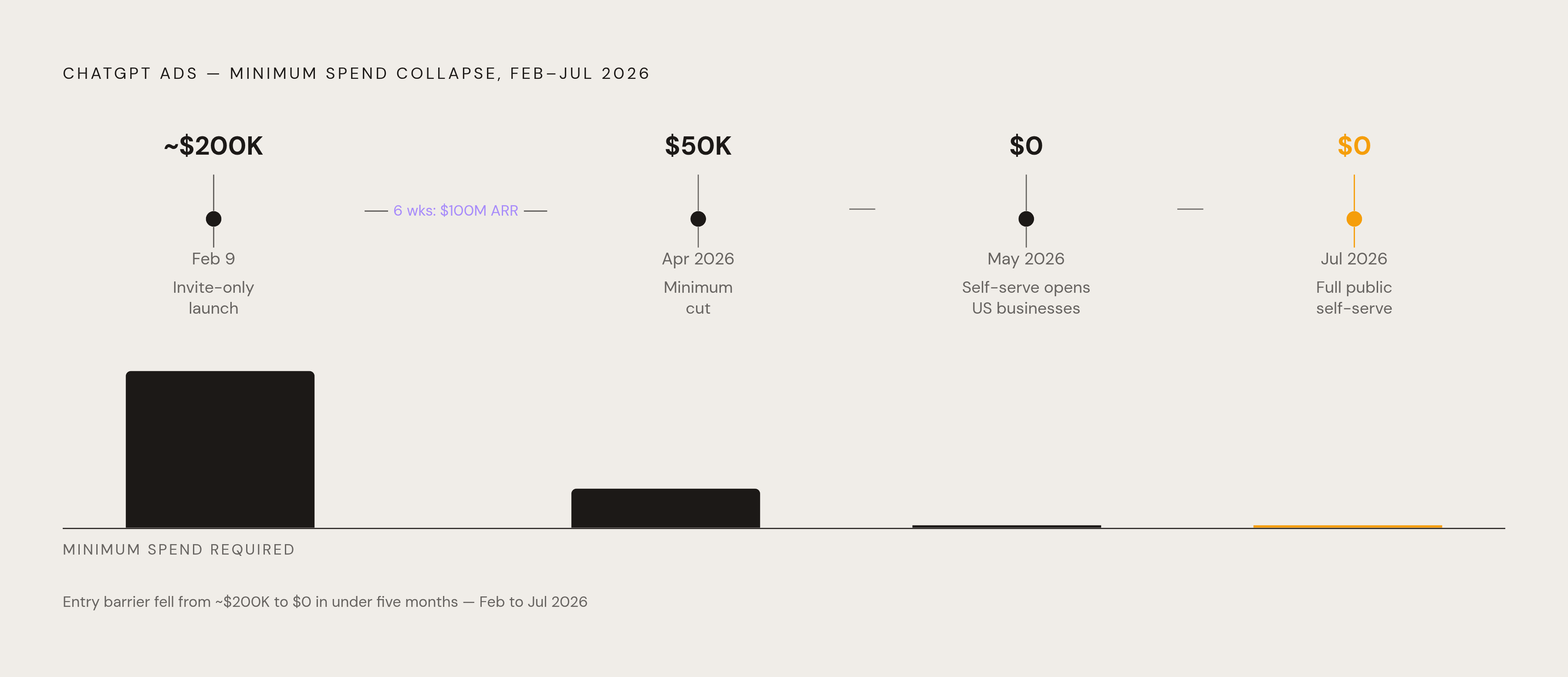
ChatGPT's minimum ad spend collapsed from six figures to zero in just five months.
Minimum Spend Requirements for Conversational AI Ad Platforms.
The minimum spend story from February to July 2026
Minimum spend requirements on conversational AI ad platforms have fallen faster than almost any comparable channel launch in the history of digital advertising, and the collapse happened in a matter of months, not years. OpenAI turned on advertising inside ChatGPT on February 9, 2026, which is worth fixing in mind because everything that follows happened inside a single calendar year. The early roster read like a who's who of brand marketing and holding-company muscle: Adobe, Ford, Target, and Mrs. Meyer's ran ads through agency partners WPP, Omnicom, and Dentsu, with Publicis joining later, while Adobe, Criteo, Kargo, Pacvue, and StackAdapt built the integration layer that made these partnerships function.
Then the floor started moving. By April 2026, the minimum spend commitment had dropped to $50,000, the first concrete sign that the floor was moving. May 2026 brought the bigger shift: a self-serve Ads Manager opened to US businesses, and the enterprise minimum spend requirement disappeared entirely. What had been an invitation-only program with a six-figure buy-in became, within roughly three months, a platform any business could enter without committing to a fixed dollar amount up front.
None of this should read as a tidy, planned rollout. Pricing models, eligibility rules, targeting tools, and country availability have all shifted multiple times since February, which is the behavior of a channel still finding its shape, not a mature one with settled rules. And demand showed up early, before the floor dropped: the pilot reached a $100 million annualized revenue run rate within its first six weeks, meaning advertisers were willing to pay enterprise prices for access even while the terms were at their most restrictive AuthorityTech / ChatGPT Ads. That detail matters for anyone tempted to read the falling minimum as OpenAI struggling to fill inventory Aimerce / How Much Do OpenAI Ads Cost. Demand was already there. What changed was OpenAI's appetite for how many advertisers to let in and at what price of entry Aimerce / How Much Do OpenAI Ads Cost. Launch CPM was $60, roughly 3× what Meta charges, per the sourced figures (Aimerce / How Much Do OpenAI Ads Cost).
The spend floors that remain even when the platform says "no minimum"
Calling this "no minimum" without qualification would be a mistake, and the platform itself hints at why: dropping the enterprise commitment is not the same as removing every constraint on what a buyer can actually spend and expect to see something happen Aimerce / How Much Do OpenAI Ads Cost. There's a nominal floor, which is the number OpenAI publishes, and there's a functional floor, which is the amount you need to spend before the system treats your campaign as real Aimerce / How Much Do OpenAI Ads Cost. Those two numbers are not the same thing, and buyers actually need to plan around the gap between them.
That's the number a buyer sees in the interface. The functional floor sits underneath it, in the auction.
Running the arithmetic makes the real constraint clear. At a $4 CPC and a 2% conversion rate, getting to 100 conversions costs roughly $20,000. It's the minimum sample size a buyer needs before drawing any conclusion about whether the channel works for their product. It's running an underpowered test, one with too few conversions to tell signal from noise, and mistaking a small sample's bad luck for a verdict on the channel. The fix is not to inflate the budget arbitrarily; it's to accept a longer test window if the daily spend has to stay modest, rather than declaring the channel a failure after a week of thin data.
Geography adds another kind of floor, one that has nothing to do with dollars. A business outside that list faces a structural wall regardless of how much it wants to spend. No universal recommended minimum exists across this landscape; the honest answer is that the right floor depends on category and conversion rate, not on a number that applies evenly to every advertiser. The minimum daily budget is $25 per campaign in the US (the platform-set floor that persists). Early advertiser reports indicate bids materially below the $3–$5 CPC range mostly fail to clear delivery thresholds, effectively setting a pricing floor even without a stated minimum (ChatGPT Ads Pricing in 2026: CPM, CPC & What It Actually Costs - eSEOspace). The CPM range in self-serve is $25–$60 per 1,000 impressions depending on context competitiveness (the low end exists but so does the high end). Self-serve access is currently live in the United States, Canada, the United Kingdom, Australia, New Zealand, Japan, South Korea, Brazil, Mexico, India, 31 European markets, and 11 MENA markets as of August 2026 (52 countries total); businesses outside those markets face a structural barrier regardless of spend intent.
Conversational AI advertising mechanics: what buyers need before they budget
Before any budget conversation makes sense, the mechanics need to be clear, because conversational ad delivery does not resemble a search results page or a social feed, and buyers who assume it does will misjudge everything from creative to measurement. The foundational architecture: the model generates its answer first, completely independent of any advertiser relationship, and only after that does the ad system append a contextually matched sponsored suggestion below it. OpenAI has stated directly that ads do not influence what ChatGPT says. Whether every buyer takes that assurance at face value or not, it shapes how the ad unit behaves: it's a suggestion appended to a conversation, sitting apart from the organic answer rather than occupying its slot.
Targeting follows from that separation. The system matches ads to the current conversation topic, the user's chat history, and past ad interactions, not to demographic profiles or cookie-based behavioral data. Advertisers don't get access to the underlying user data; the platform keeps that signal to itself, and users retain the ability to turn off ad personalization and clear their ad data whenever they choose. That's a real structural departure from how programmatic advertising has worked for the past two decades.
As of August 2026, buyers can choose from three campaign objectives: CPM for reach and awareness, CPC for clicks and traffic, and oCPC, which optimizes cost per click toward conversions. The auction itself runs on a second-price, relevance-weighted basis, so outbidding a competitor doesn't guarantee placement if the ad is a poor match for the conversation. Format matters just as much as bid. Static sponsored links, the text-based ads sitting at the bottom of an AI response, are the format both ChatGPT and Copilot use. Beyond static links, the wider conversational advertising landscape includes native text placements built specifically for chat interfaces, and more interactive formats built around guided question-and-answer exchanges, chip selections, and direct paths to conversion. ChatGPT's own format shows a single ad per response, which changes the entire volume calculation for a buyer used to a search results page or a social feed showing multiple placements at once.
Reach numbers need the same scrutiny. The addressable audience is a subset of the headline number, and any planning built on the full user base rather than the ad-eligible slice will overestimate reach. For agencies and programmatic buyers, the single-surface nature of any one platform is itself a limitation, which is part of why buying infrastructure built to serve across ChatGPT, Claude, Gemini, and Copilot simultaneously has become relevant to how larger buyers think about avoiding lock-in on one surface. Ads are seen only by logged-in adult users on Free and Go plans (Plus, Pro, Business, Enterprise, and Education subscribers do not see ads), which constrains addressable inventory. The 300M+ weekly ChatGPT users figure is the headline audience number, but the ad-eligible subset is the Free and Go population, not the full base. Writers should frame reach claims carefully.
What each active platform currently offers, charges, and requires
ChatGPT sits at the center of this landscape and reached public self-serve status in July 2026. There's no minimum spend commitment required to start, but the minimum daily budget of $25 per campaign in the US still applies. As of August 2026, geographic availability for this product specifically covers the United States, Canada, and the United Kingdom. Buyers can run sponsored product cards and conversational ads through the Ads Manager, through partners, or through agencies, and the pilot alone generated $100 million in revenue in its first six weeks AuthorityTech / ChatGPT Ads.
Microsoft's Copilot tells a different story, because its ad presence predates ChatGPT's entirely. Ads have been live on Copilot since 2023, inherited from Bing Chat, which makes it the longest-running live conversational AI ad product among the platforms covered here. Copilot offers Showroom Ads, Brand Agents, a Checkout feature that launched in January 2026, Compare & Decide ads, and shopping campaigns, all run through Performance Max bidding. Microsoft's own testing found Copilot ads produced 153% higher click-through rates and a 54% improvement in user experience compared to traditional search. Copilot is live and generating results, but it is not a fully self-serve product in the way ChatGPT's Ads Manager is.
Perplexity moved in the opposite direction. Only the platform's original launch partners are still testing anything resembling ads; no self-serve product exists. For planning purposes, Perplexity belongs in the earned-visibility category.
Claude, from Anthropic, occupies a firmer position. As of August 2026, Claude remains ad-free by published company policy, and Anthropic chose the American Super Bowl, just three weeks after OpenAI's ad launch, to publicly reaffirm that stance. Claude is an earned-visibility surface, and nothing in the current record suggests that is changing soon.
Google's AI Mode is the platform to watch, still emerging rather than fully open. Gemini-powered formats, announced at Google Marketing Live 2026, include Conversational Discovery Ads, Highlighted Answers, AI-Powered Shopping Ads, and a Business Agent for Leads product, with broader Gemini ad integration expected sometime in 2026. Google AI Mode shows ads in 25.5% of AI results, up from 5.17% in early 2025 AuthorityTech / ChatGPT Ads.
Grok and X, Meta AI, DeepSeek, and Mistral round out the landscape, and as of July 2026, no dedicated conversational self-serve ad product is confirmed for Meta AI, DeepSeek, or Mistral, though Grok ad creation and X Ads Manager AI features are emerging and worth checking before committing spend. The practical takeaway from this whole map is that paid opportunity right now concentrates on ChatGPT and Google, Claude and Perplexity function as earned-visibility surfaces rather than paid channels, and Copilot is live but not fully self-serve. Treating this as one generic "AI ads" line item is a planning error. Each surface has its own rules, its own eligibility, and its own maturity level. Pricing runs roughly $3–$5 as a reported starting CPC bid, with a CPM range of $25–$60, and a self-serve CPC of $2–$8 depending on category (ChatGPT Ads Pricing in 2026: CPM, CPC & What It Actually Costs - eSEOspace). Advertising is no longer a near-term focus; per Financial Times and multiple industry sources, all advertising tested from late 2024 through 2025 was phased out, and company executives stated no current plans to revisit the ad model, though a return was not ruled out entirely.
Intent signals inside AI conversations versus keyword and demographic targeting
The advantage conversational advertising claims over search and social comes down to where the ad sits inside the user's decision process. A search ad interrupts a scan of results. A social ad interrupts a scroll. A conversational ad appears inside an active, trusted dialogue where the user has already stated, in their own words, what they're trying to solve.
A user typing "what's the best project management tool for remote teams" hasn't just supplied a keyword; they've disclosed category, use case, and evaluation stage in a single sentence, which is a denser intent signal than almost anything a keyword match or a demographic segment can offer on its own. An industry executive quoted in Campaign US in March 2026, identified as Vikram, framed the shift this way: the monetizable unit moves from pages and impressions to intents, tasks, and decision moments happening inside the conversation itself. That's a genuine reframing of what advertisers are buying. They're buying proximity to a slot within a larger reframing of what advertisers are purchasing. They're buying proximity to a moment where someone is actively deciding.
The privacy architecture reinforces this rather than working against it. OpenAI's targeting model works on conversation context, not user profiles, which is a structural difference from cookie-based or demographic targeting, not a cosmetic one. Advertisers accustomed to programmatic buying built on years of accumulated behavioral data are working with a system that deliberately withholds that layer and substitutes real-time context instead.
One more wrinkle deserves attention before moving to performance numbers. Large language model interfaces may remain, in significant part, a clickless environment: a user can see a brand named or recommended inside a response and never click anything, yet the exposure still shapes what they buy later. In that world, inclusion in the answer itself, being recommended, shortlisted, or chosen, becomes as important a commercial signal as the click, and click-through rate alone stops being an adequate way to judge the channel's value.
Early performance data on conversational AI ad results
The intent argument would be academic without evidence that it converts, and the early data suggests it does. AI search referral traffic converts at a higher rate than traditional organic traffic, because users arriving from an AI conversation have typically already narrowed their options before they ever click through. That's a meaningful gap, and it lines up with the intent-density argument made in the previous section.
Click-through rate needs careful handling here, because ChatGPT shows a single ad per response rather than the multiple placements a search results page or social feed offers, so the volume math simply isn't comparable. A lower raw CTR doesn't signal lower commercial value when the format itself limits how many chances a user has to click in the first place. Microsoft's own Copilot testing backs this pattern from a different angle, showing 153% higher click-through rates and a 54% improvement in user experience relative to traditional search.
Performance also varies sharply by industry, and Ruler Analytics, drawing on more than 5 million tracked conversions in 2026, mapped that variation clearly. Education led at 8.7%, which makes sense given that students researching courses through AI conversations are often ready to enquire the moment they land on a site. Legal converted at 8.4% and automotive at 8.5%, both categories where a period of considered research typically precedes any action. Real estate and travel sat much lower, at 2.5% and 2.8% respectively, converting from AI referral traffic at rates more in line with their overall channel performance.
All of these figures need one caveat attached. Auction density is changing month to month as more advertisers onboard, and early figures from managed pilots at $200,000–$250,000 minimums reflect different competitive conditions than the self-serve market that opened in May–July 2026. Treat every number above as orientation for what a new campaign might see. Sources point to roughly $100 in average order value as a rough dividing line for AI-generated creative performance. Below that threshold, AI-generated creative matches or beats human-made creative on return on ad spend; above it, human creative still wins by a meaningful margin. Interactive conversational ads deliver 3–8× higher engagement than static formats because users actively engage rather than passively view (sourced figure).
Measurement as the hidden variable determining whether the spend floor feels high or low
Every number in the previous section depends on tracking working correctly, and for a meaningful share of ChatGPT traffic, it doesn't, at least not by default. Clicks from ChatGPT frequently arrive through in-app browsers, environments where standard client-side pixels lose a substantial share of the conversions that actually happened. It's a structural gap between what actually occurred and what gets recorded, not a minor reporting quirk. It's a structural gap between what occurred and what gets recorded.
The consequence compounds rather than staying flat. A cost-per-acquisition number built on incomplete tracking looks worse than reality, and because the platform's own optimization algorithm learns from whatever signal it's given, it then optimizes toward that partial, distorted picture, making delivery genuinely worse over successive optimization cycles rather than simply misreporting a static result.
OpenAI provides a tracking pixel and a Conversions API for server-side event matching. Advertisers who wire this up before launching get a materially more complete picture of what their spend is actually producing than those who rely on pixel-only setups and hope the in-app browser behaves. The honest framing here is that this is a solvable problem, hard, but solvable with discipline in how the tracking stack gets built.
The clickless dimension makes measurement even harder to fully resolve. That's the real reason the minimum spend floor feels different to different buyers. A brand with disciplined server-side tracking sees a materially different, more favorable cost-per-acquisition than a brand running the exact same budget through a bare pixel. The dollar figure on the floor is the same for both of them. What that dollar figure buys, in terms of visible results, depends entirely on the measurement work done before the first ad ever runs. If a user sees a brand recommended in a ChatGPT response and later converts via, attribution becomes difficult to trace.