Conversation Turn Depth as a Signal of Commitment Intensity
Deep conversation exchanges reveal buyer intent more accurately than search queries ever could.

Turn depth in an AI conversation measures something a search query simply cannot: how far a user has moved from vague curiosity toward a decision. That distance, counted in exchanges rather than keywords, is becoming the most reliable intent signal available to performance marketers, and it changes how an ad impression should be priced, placed, and measured.
Turn depth in AI conversations
A search query gives an advertiser three words and a guess. Legacy advertising has always worked this way: it reconstructs what a person wants from thin material, a short query, a demographic bucket, a cookie trail, and treats that reconstruction as close enough to act on, even though it's only ever an approximation of the actual want behind the click. A multi-turn AI conversation replaces that guesswork, because it states what the user wants. The user lays out the situation, the budget, the must-haves, the options already tried and rejected, in plain language, across several exchanges. Nobody has to infer a shortlist. The user names it.
That shift matters because what the ad system needs to evaluate has changed shape. Contextual targeting inside an LLM conversation works on the meaning of the whole exchange, not on a page of static content to be matched against a query. The "page" doesn't exist yet when the ad system starts evaluating relevance. It gets written, turn by turn, in real time, so relevance has to be reassessed continuously rather than fixed once at page-load. A system built for this environment tracks where a conversation has traveled and where it still seems to be going.
Put side by side, a three-word query encodes almost nothing about budget, prior research, or what's already been ruled out. A five-turn exchange about team coordination problems, missed deadlines, and the friction of coordinating a remote team contains a buying situation an advertiser doesn't need to guess at, even if the user never types the category name, "project management software," at all. Intent arrives declared, not inferred. The practical consequence is that advertisers no longer need to reconstruct what a person wants from fragments; the person has already explained it, in their own words, at whatever length the conversation ran.
What specificity signals across turns
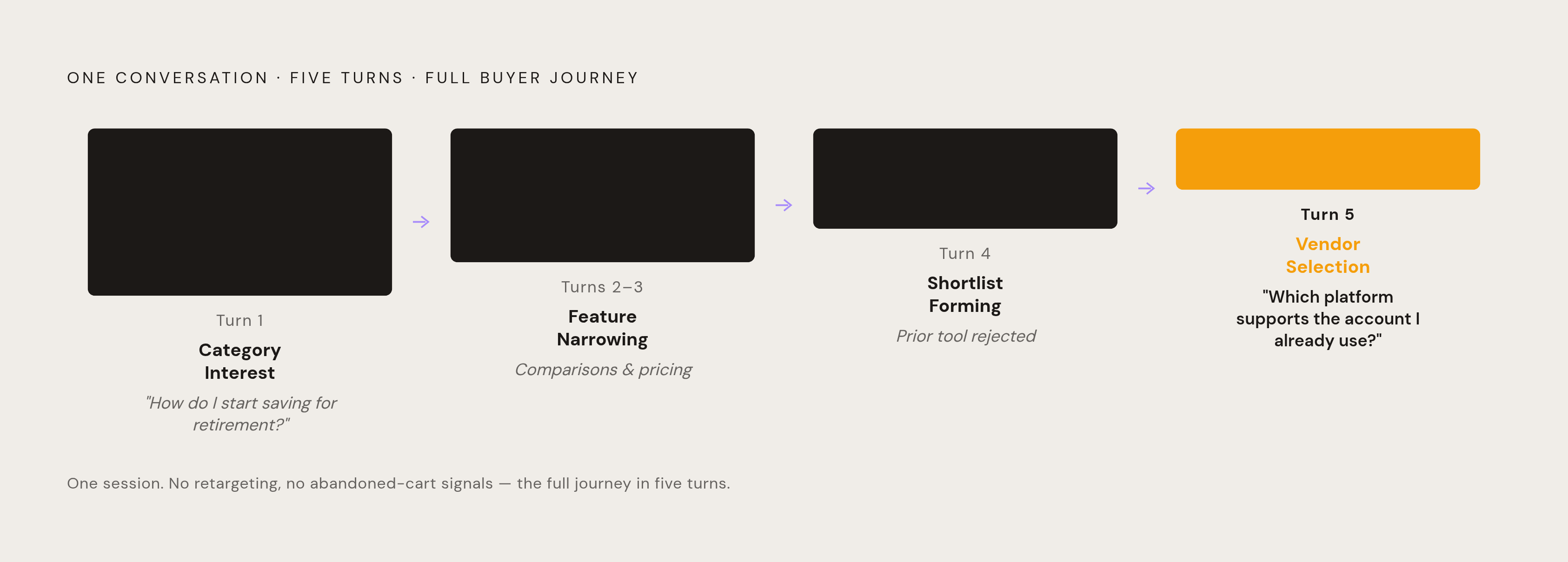
Picture a conversation about financial planning that opens with a broad question: "How do I start saving for retirement?" That first turn establishes category interest and almost nothing else. It's the equivalent of a one-word search, except it arrives in a sentence instead of a fragment.
The next few turns do the narrowing. Each of those statements, the comparison, the pricing question, the prior-tool rejection, adds a layer of specificity that a single query could never hold at once. By the fourth or fifth turn, the user might be asking which platform supports a specific account type they already use. That's not a category question anymore. That's a vendor-selection question, and the two sit at entirely different points in a buying journey, a difference that's visible simply by counting how deep the conversation has gone.
The same arc plays out in travel planning, in B2B software research, in any category where you have to work through options before committing. A user exploring features, asking about pricing, comparing alternatives, and then asking how to actually buy has moved through a recognizable sequence, and someone who does all of that in one sitting shows materially higher intent and a materially higher chance of converting than someone who asks a single question and closes the tab. The conversation also reveals how much the user already knows. If someone asks what a product category even is, they sit at a different stage than someone asking which specific vendor handles their edge case better. Turn count alone makes that distinction legible, with no extra signal layered on top.
What used to scatter across multiple search sessions, abandoned carts, and retargeting cookies, picked up piecemeal over days or weeks, now unfolds inside a single thread, in order, with each step visible to whatever system is reading it.
How the auction system reads turn depth
None of this matters commercially unless a bidding system actually reads it, and the mechanics show that it does. There's no keyword layer at all in this environment. Targeting runs on a 280-character natural-language context hint set at the ad group level, and a relevance-weighted second-price auction resolves that hint against the ad's title, its copy, and its landing page. "Relevance-weighted" is the operative term: a bid alone doesn't win the slot. A smaller advertiser with a precise, well-written context hint can beat a larger advertiser running a vague one, which is an unusual property in paid media, where budget size has historically done most of the work.
Writing a good context hint isn't a matter of listing topics the way a keyword list would. A comma-separated string of category terms just doesn't match well against a live conversation. What works is a plain description of what the user is actually trying to accomplish, a problem statement rather than a search term, because that's the form the auction is built to read against an ongoing dialogue.
Bidding models now in development push this further. Cost Per Engaged Conversation would charge an advertiser only when a user interacts with an ad and keeps the dialogue going, rather than for a bare impression. Conversation Value Optimization would adjust bids automatically based on the predicted lifetime value of users who follow particular conversational patterns. Both are forthcoming rather than live, but their direction says something important on its own: turn depth isn't a metric that gets reported after the fact, but a direct input the auction weighs while the conversation is still happening.
The conversion gap between AI referrals and search clicks
The clearest evidence that this changes outcomes, rather than just theory, appears in conversion data. Digital Applied's 2026 strategy guide found that early eCommerce adopters who used Meta Advantage+ AI chat intent signals saw their return on ad spend improve by an average of 18%. That figure is directional evidence for a broader pattern: traffic that arrives after a multi-turn conversation behaves differently than traffic that arrives after a search click, because the two groups have done different amounts of work before they ever land on a page.
A user who's had a real back-and-forth with an AI assistant typically already knows the category, already knows the brand, and already knows roughly what the product does by the time an ad or a link reaches them. They click to confirm a decision rather than to start researching one. That's a structurally different kind of visitor than the one search advertising has trained marketers to expect, and it's the conversation itself, not the ad, that did the qualifying work search campaigns have historically needed several sessions and retargeting touches to accomplish.
Microsoft has reported that Copilot placements outperform traditional search ads on both click-through and conversion rate, and the company attributes the difference to a targeting approach that reads an entire session's context rather than just the most recent query. That claim comes from a vendor with an obvious interest in making its own placements look strong, so it deserves the skepticism any vendor claim deserves. It's also consistent with the structural argument running through this whole piece: a system reading a full conversation has more to work with than one reading a single line of text.
The planning consequence follows directly. An impression that appears after five turns of sustained engagement carries fundamentally different weight than one triggered by a single broad query, so pricing it identically misvalues the inventory.
Why inventory scarcity raises the value of high-turn impressions
Conversational ad placement is also scarce in a way banner inventory or a search results page never was. A ChatGPT ad appears as one labeled sponsored card beneath the assistant's answer, a single unit sitting adjacent to the response rather than distributed through it, which puts a hard ceiling on how much commercial inventory any one conversation can hold.
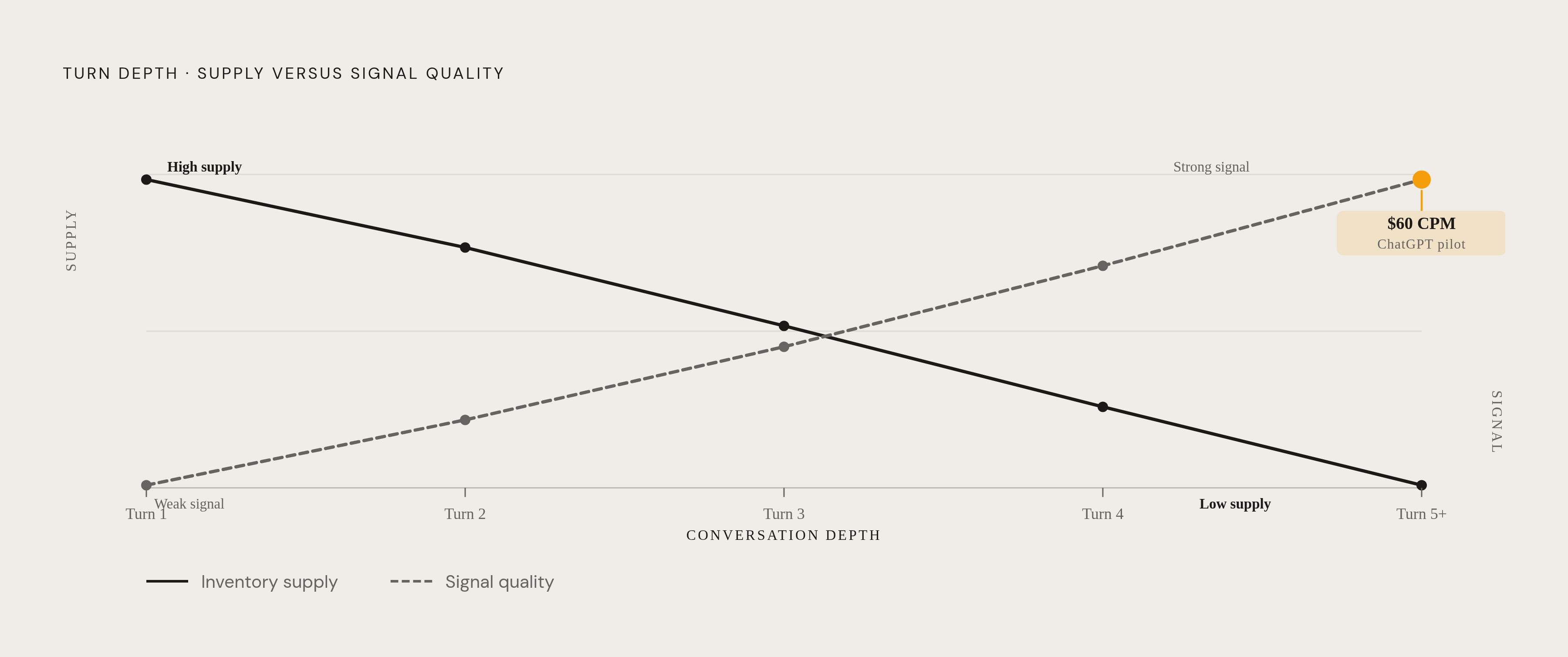
That ceiling gets tighter as conversations get longer. Fewer users sustain a conversation to five turns than stop after one, so the pool of eligible high-depth impressions shrinks exactly as the quality of each impression in that pool rises. Demand and supply move in opposite directions at once: the more valuable the signal, the smaller the inventory carrying it.
That's the condition premium pricing needs to exist, and the ChatGPT pilot priced accordingly, at a CPM of roughly $60, with Target, Adobe, Williams-Sonoma, and Albertsons among the launch partners. OpenAI opened self-serve access to its Ads Manager on May 5, 2026, and removed spend minimums, but that lowers the barrier to entry without touching the underlying scarcity of the high-depth inventory itself. More advertisers being able to bid doesn't create more five-turn conversations; it just means more of them are competing for the same limited supply.
How much commercial load a conversational surface can actually carry before users start noticing and start minding is the open question behind every optimistic revenue projection for this category. Scarcity here isn't an early-stage limitation you can engineer away; it's a structural feature of the format, baked into how a conversation is built to look and feel.
The model-layer problem: what happens to signal quality when the AI itself degrades at depth
The strongest challenge to everything argued so far comes from inside the model, not from the market. The same conversations that produce the richest intent signal also run into a documented weakness in how large language models handle extended dialogue. Depth, in other words, doesn't only concentrate commercial value. It can also concentrate risk.
Testing has found meaningful double-digit accuracy drops across GPT-4.1, Claude 3.7 Sonnet, and Gemini 2.5 Pro, and larger, more capable models showed no particular advantage at resisting the decline. Scale doesn't appear to fix it. The researchers behind the finding put the failure mode directly: "When LLMs take a wrong turn in a conversation, they get lost and do not recover". Once a model locks onto a wrong assumption early in an exchange, it tends to carry that error forward rather than catching and correcting it later.
That creates a genuine tension for anyone buying placements at depth. A user at turn seven has said more about what they want than a user at turn one ever could. At that same moment, the response that user just received may be less reliable than the one the model gave several turns earlier, and any ad appearing alongside that response sits next to an answer that might already have drifted off track. The objection doesn't undercut the case for turn-depth targeting. It adds a condition to it: the value of a deep-turn impression depends in part on how reliable the underlying model is at that point in the conversation, and that reliability varies by platform and isn't standardized across the industry.
Attribution gaps that make turn-depth value invisible to standard measurement
Even where turn depth signals intent reliably and the model holds up, standard reporting tends to miss the value. Attribution models built around last-click logic weren't designed for a channel where the qualifying work happens inside a conversation that ends well before a purchase does. A user might work through several deep turns, close the chat, and buy something hours or days later through an entirely different touchpoint, and a last-click model will hand the credit to whatever channel happened to be closest to the purchase, not to the conversation that actually did the persuading.
Models that weighted an impression by how deep the conversation had gone at the moment it appeared would value a turn-one impression very differently from a turn-five one. Those models aren't standard yet. Multi-turn conversation retargeting, which OpenAI is targeting for Q4 2026, would close part of this gap: it would let advertisers reach people who'd had a deep conversation about a relevant problem without converting, based on having engaged with the problem itself rather than having visited a specific page.
Until something like that becomes standard, marketers relying on last-click reporting, or even on more generous multi-touch models, will understate what this channel is actually contributing, and that understatement will push budget away from a channel that the underlying behavior says deserves more of it. The near-term fix isn't a platform setting. Teams serious about this channel need their own incrementality tests, brand lift studies, and assisted-conversion analysis running alongside whatever the platform reports, because the platform's own numbers just won't tell the full story yet.
Brand safety and transparency in deep-turn placement
Depth also raises the stakes on brand safety in a way shallow placements don't. An advertiser controls the wording of its own ad but has no control over what the AI said in the turn immediately before that ad appears, and the deeper a conversation runs, the more likely the response has drifted from where the user originally started. A placement that looked safe at turn one can sit next to a very different kind of answer by turn seven.
OpenAI's stated "Answer Independence" principle holds that ads don't influence the content of answers; it protects the integrity of the AI's answer, but it doesn't give the advertiser any say over what that answer contains.
A related opacity compounds the problem. System prompts, the instructions that shape how a model behaves and that take precedence over whatever the user types, are generally kept private, and most platforms instruct their models not to reveal them, which leaves users, and by extension advertisers, with limited visibility into the mechanism actually steering the conversation. Anthropic's Claude has taken the opposite path entirely: it stays ad-free and draws substantial revenue mainly from enterprise API contracts and subscriptions, which shows an ad-free model can work at real scale, and that not every conversational surface will carry commercial inventory at all.
For advertisers operating at depth, the right response to this is more scrutiny, not less. Deep-turn placements need closer content review and more careful exclusion-list management than shallow ones, precisely because depth raises the quality of the intent signal and the unpredictability of what the ad will sit beside, at the same time, as part of the same mechanism.