Pass-Through vs. Marked-Up Pricing in AI Channel Resale

Conversational AI advertising is a distinct category of inventory, one where ads get matched to intent as it forms mid-conversation, not to a page a user landed on, a keyword they typed into a search box, or a stored user profile. That distinction sounds academic until you look at the cost structure that produces it. Every impression served inside an LLM interface carries a real inference cost, a genuine compute expense tied to that specific response, and that has no equivalent in legacy display, where serving the millionth impression costs the publisher next to nothing.
Bessemer Venture Partners made this point in a playbook published in February 2026: unlike classic SaaS, where marginal cost approaches zero once the software is built, every single AI query incurs a non-trivial expense, and that cost of goods sold weighs on monetization in a way that has no real parallel in traditional programmatic advertising. Programmatic display built its economics on the assumption that supply was, for practical purposes, free to produce. Conversational AI breaks that assumption at the root.
That has a direct consequence for anyone reselling this inventory. Margin here is not simply a function of what rate card you negotiate. It's a function of cost-per-conversation, how often that conversation resolves into something billable, and how tightly your pricing is tethered to the infrastructure generating the response. Two architectures dominate how agencies handle that tether: pass-through, where the client pays at cost, and marked-up resale, where the client pays cost plus a stated or embedded premium. Neither is a neutral choice made once and forgotten. The model an agency picks is a structural commitment, one that shapes billing transparency, client trust, and the durability of the channel relationship over time.
AI ad inventory delivery to an agency and billing at each hop
Picture the stack in four layers: demand and auction, context and targeting, creative generation, and measurement and attribution. Each layer is a place money can change hands, and each is a place a markup can hide. OpenAI, Google, and Microsoft are the layers closest to the surface, setting the underlying token and impression economics everyone downstream has to work within.
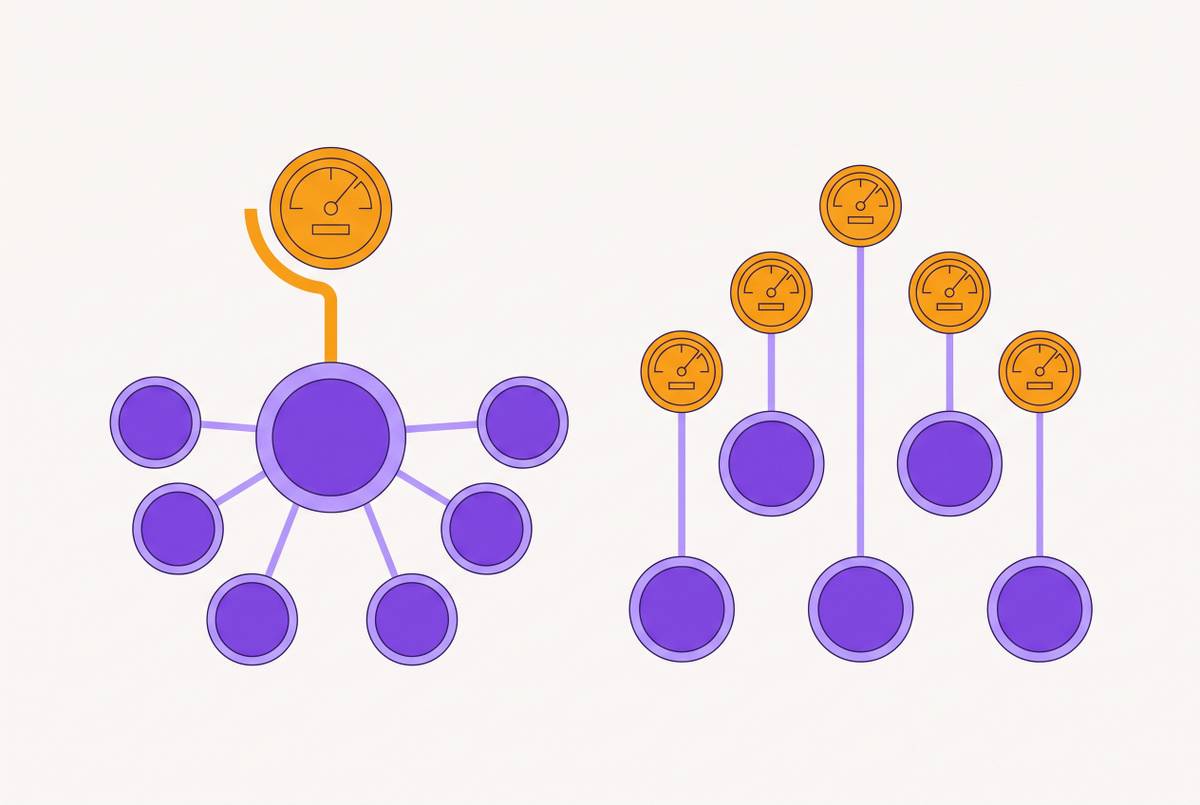
Below that sits the gateway layer, and this is where most agencies actually live. An agency accessing AI ad supply through a platform or exchange is positioned between the provider's rate and the client's bill. The platform holds the account with the model provider directly, and every impression, every message, flows through that platform's own billing system before the agency ever sees an invoice. That's a chokepoint, and chokepoints get monetized.
The markup at that gateway layer typically runs 5 to 20% of token spend, which sounds modest until you compare it to the actual spread between the cheapest and mid-priced models in most providers' catalogs ofox.ai. The gateway markup is often wider than that entire spread ofox.ai. Run the arithmetic on a mid-sized account: a team routing $1,000 a month in tokens through a typical AI gateway gives up somewhere between $600 and $2,400 a year on a charge that never appears anywhere as its own line item theactionelite.com hyperfx.ai beet.tv Per-Resolution vs Per-Conversation AI Pricing (2026). Nobody signs an invoice that says "gateway markup." It's folded in.
That's precisely why this is harder to audit than a DSP fee in legacy programmatic. Legacy media at least built a convention of disclosed line items on a media invoice. AI gateway billing has no equivalent standard yet, and a markup can sit embedded in a blended CPM rather than broken out as its own number.
There's a structural alternative, and it's gaining traction: Bring-Your-Own-Key, or BYOK. The client holds their own account with the model provider and pays provider rates directly, no intermediary billing hop in between. Same seat at the table, different toll booth. GoHighLevel has been moving in this direction since roughly October 2025, passing AI token cost through to clients at provider rates with no additional token markup, according to its own published AI product pricing documentation. The supply chain doesn't force a markup on anyone. It just determines where in the stack that markup, if it exists, sits, and whether the client at the end of it can actually see it.
The pass-through model's promise and its quiet punishment of the agency
Pass-through pricing sells itself easily. The client sees what the inventory costs, dollar for dollar, and there's no reconciliation dispute waiting at the end of the quarter. Billing transparency of that kind builds trust fast, especially with a client new to the channel.
But pass-through carries a structural trap: it punishes efficiency gains rather than rewarding them. Billing the client for raw tokens plus a flat markup is operationally simple, yet it punishes the agency for its own efficiency gains. Every prompt optimization that trims token usage, every latency improvement, every smarter model switch, shrinks the agency's own revenue rather than rewarding the work that produced it. The agency's incentive to get better is, in effect, taxed.
This isn't hypothetical. Application companies whose pricing was tethered directly to infrastructure cost have already lived through a version of it: when hyperscalers cut their own prices, intending to help downstream customers, the benefit flowed straight through to the client, and the reseller's margin compressed instead of holding steady. The savings never stuck to the middle layer.
The discipline that guards against this is well established. BVP's February 2026 playbook found: aim for 50 to 60% gross margin, and never pass token costs through to customers at a flat 1:1 ratio hub.causo.ai. Pure pass-through only really makes sense when the inventory itself is commoditized and the agency's actual value lives entirely in the service wrapped around the media buy, not in the media itself. In that case, the margin belongs in the service layer, not the token line.
BYOK offers a cleaner variant of this same idea. The client pays the provider directly, and the agency charges separately, and visibly, for targeting, optimization, and reporting. That produces cleaner margin accounting for the agency, though it does require the client to hold and manage its own provider credentials, which not every client wants the operational burden of doing. And there's a subtler cost to pass-through generally, one that appears less in the invoice and more in the relationship: it creates cost predictability for the client, but it removes the agency's incentive to optimize, an alignment problem that tends to become visible right around contract renewal, when the client starts asking what, exactly, they've been paying the agency to do.
The marked-up model: where margin lives in the transparency required to hold it
The standard version of marked-up resale looks like this: the client pays actual costs plus a stated premium, commonly cited in the 15 to 25% range, disclosed as its own number and requiring the agency to track cost with some rigor. That's the transparent version. The alternative folds the premium into a blended CPM or a package rate, which is simpler to sell in a pitch meeting but much harder for a client to ever audit on their own.
Marked-up pricing earns its place when the agency is adding genuine yield, not just standing in the transaction path. Better contextual targeting, a lower cost-per-outcome than the client could get on their own, and access to supply the client has no direct route to are the things a markup is supposed to be paying for.
The data on where this affects margin is fairly stark. ICONIQ's research found that companies combining model-layer innovation with product-layer innovation report gross margins around 53%, while companies operating purely at the application layer, reselling someone else's model with little added on top, sit closer to 45% digitalapplied.com. The closer an agency sits to pure pass-through, the thinner its margin runs, almost mechanically.
There's a useful parallel from the managed service provider world. Scopable's guidance from May 2026 said agencies that price AI like a straight license pass-through will undercharge for what they actually deliver, while agencies that price it like open-ended consulting tend to make clients stall at the quote. The middle path is packaging the specific work the agency controls, with an explicit margin target attached, rather than letting the number drift.
Itpro.com's reporting from May 2026 captures the tension at the industry level: enterprise demand for AI platforms is surging, but the resale economics driving that demand remain fundamentally unbalanced. Hyperscalers capture the direct license revenue, and partners do the integration and account management work for comparatively thin margins. The markup has to be justified by value the agency actually adds, not by the volume it happens to be pushing through.
And marked-up resale has a known failure point. It breaks down the moment a client becomes sophisticated enough to compare the blended CPM against the provider's published rate directly. Once that comparison is possible, an undisclosed markup no longer amounts to a margin decision but a relationship risk.
Outcome-based pricing as a third path for the agency's role
There's a third model, and it starts from a different premise entirely: when an AI agent acts on a customer's behalf, the customer wants to pay for the result it produces, not for the compute it burned getting there. The same logic maps cleanly onto AI ad delivery, where the unit that actually matters to a client is a conversion or a resolved intent, not a raw impression count.
Adjacent AI service categories already show this model working in practice. Intercom's Fin charges per outcome, at $0.99 per genuine positive resolution Per-Resolution vs Per-Conversation AI Pricing (2026). Zendesk prices at $1.50 per automated resolution on committed volume, or $2.00 on a pay-as-you-go basis hub.causo.ai beet.tv Per-Resolution vs Per-Conversation AI Pricing (2026). Gorgias runs somewhere between roughly $0.60 and $1.27 per resolution depending on plan tier hyperfx.ai beet.tv Per-Resolution vs Per-Conversation AI Pricing (2026). Salesforce's Agentforce takes a different structural approach entirely, charging $2.00 per conversation regardless of whether that conversation actually resolves Per-Resolution vs Per-Conversation AI Pricing (2026).
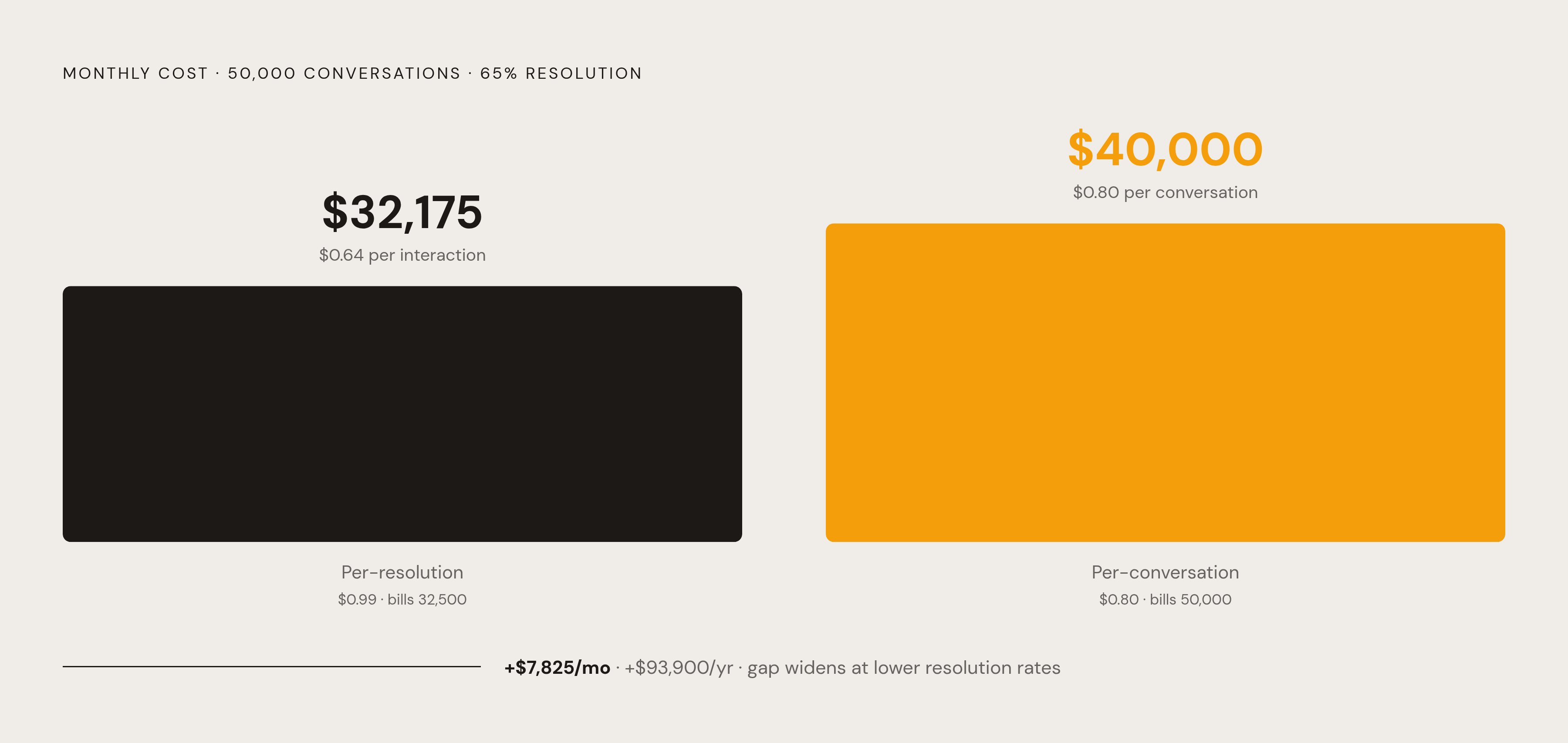
That distinction, resolution versus conversation, turns out to matter enormously, and fin.ai worked through the math on it using a scenario of 50,000 conversations a month at a 65% resolution rate. Priced per outcome at $0.99, only the 32,500 conversations that actually resolve get billed, for a monthly cost of $32,175, working out to $0.64 per customer interaction across the whole volume hub.causo.ai Per-Resolution vs Per-Conversation AI Pricing (2026). The client pays nothing for the 17,500 conversations that didn't resolve hub.causo.ai Per-Resolution vs Per-Conversation AI Pricing (2026). Priced per conversation instead, at a lower unit price of $0.80, every one of the 50,000 conversations is billable, for a monthly cost of $40,000, roughly $7,825 more per month, or about $93,900 more over a year, despite the lower headline rate hub.causo.ai beet.tv Per-Resolution vs Per-Conversation AI Pricing (2026). Per-conversation pricing only turns cheaper once resolution rates climb above roughly 80%, and even there the gap is still around $1,000 a month, closing to zero only as resolution approaches full completion hub.causo.ai beet.tv beet.tv Per-Resolution vs Per-Conversation AI Pricing (2026). Drop the resolution rate to 50%, and the gap widens to roughly $15,000 a month hub.causo.ai beet.tv beet.tv Per-Resolution vs Per-Conversation AI Pricing (2026). A lower sticker price, in other words, can still be the worse deal, depending entirely on how well the system performs.
Translate that into AI ad resale and the model becomes charging per high-intent conversational moment, a completed inquiry, a product selection, a confirmed lead, rather than per impression served. That aligns the agency's revenue with the client's actual performance goal instead of with raw volume. BVP frames the trade-off honestly: outcome-based pricing maximizes value alignment, but it also carries the maximum cost risk for whoever is selling it, since the agency now has to model inference cost per outcome carefully before it commits to a per-resolution rate.
That risk has a specific failure mode. What counts as a billable outcome, a click, a confirmed purchase-intent signal, a downstream conversion, has to be defined in the contract before billing starts. Leave that definition vague, and the pricing model degrades into a measurement dispute at the worst possible time, usually right when the invoice lands. Handled well, though, outcome pricing is also a positioning statement. It tells the client the agency is confident enough in its own targeting and optimization to tie its revenue to whether the work actually performs, which is a meaningfully different pitch than "trust us on the markup." Live examples in adjacent AI service pricing, all per fin.ai and published April 2026, illustrate outcome-based pricing as a third path and what it changes about the agency's role.
The pricing model's effect on client trust and contract durability over time
Clients don't stay naive forever. A client who buys conversational AI advertising through an agency will, given enough time in the channel, develop a real understanding of what provider rates actually look like, and at that point they'll start evaluating what they're paying above cost. The pricing model chosen at the start of the relationship sets the terms of that future conversation, whether the agency likes it or not.
Stated-markup pass-through tends to survive that maturing client best, precisely because there's nothing left to discover. The client already knows the markup number, so there's no renegotiation trigger waiting when they eventually learn the underlying provider cost. Embedded markup is the most fragile model as clients mature, because what got accepted early on as an ordinary blended CPM turns into a transparency grievance the moment the client can decompose it into its parts.
Outcome-based pricing holds up over time under one condition only: the resolution definition has to be rigorous, auditable, and agreed to in writing before the relationship starts billing against it. Fin.ai's framing on this applies directly to ad resale as much as to customer service: buyers should be able to audit every billable outcome, with access to the underlying conversation-level data behind it.
The MSP sector offers a governance parallel here too. ChannelE2E's reporting from August 2026 makes the point cleanly: the harder question facing resellers isn't whether to sell AI services at all, it's whether they can build a service model the client actually understands, can price predictably, and where both sides come out ahead. Pricing architecture is what determines whether the answer to that is yes at the renewal conversation.
There's also an external force pressing on all of this regardless of which model an agency picks. The 5 to 20% gateway markup layer is itself under competitive pressure, as BYOK adoption and direct integrations keep spreading ofox.ai. Agencies whose margin depends entirely on that gateway layer face structural compression no matter how they choose to bill their own clients ofox.ai. The durable position, consistent with the ICONIQ finding that pure resale is around 45% gross margin against 53% for value-add models, is to build margin into the service and optimization layer, targeting quality, contextual strategy, measurement, rather than into the media pass-through itself digitalapplied.com.
Conversational AI advertising's targeting mechanics and the markup question
The targeting mechanics of conversational AI are genuinely different from anything programmatic display ever worked with, and that difference is exactly where a markup gets earned or exposed as unjustified. ChatGPT conversations can carry persistent identifiers across sessions, and targeting can draw on both what's being discussed right now and what's been discussed before. A user might never once type "project management software" into the box, yet spend a long conversation working through team coordination problems that amount to the same buying signal.
Reading that kind of pattern, recognizing a semantic cluster of intent even when no product category gets named outright, is a real skill, and it's the skill an agency can legitimately sell a markup against. An agency that builds problem-narrative targeting and matches creative to conversational context is delivering something measurably beyond what a client buying media directly would get on their own. That's the difference between a markup that's earned and one that's simply extracted because the agency happens to sit in the billing path.
The infrastructure enabling this is already live, not theoretical. OpenAI's ads launched February 9, 2026, for logged-in adult users in the US on the Free and Go tiers, targeted by the topic of the current conversation, with past chats and prior ad interactions folded in when a user opts into personalization. CPM bidding came in at launch; CPC bidding, a self-serve Ads Manager in beta, and conversion measurement followed in May 2026. The programmatic side is moving in parallel: PubMatic has been bringing AI chatbot inventory into the OpenRTB protocol, Criteo holds the position of OpenAI's first advertising technology partner, and Verve Group launched conversational intent signal targeting in March 2026, described as the first open-market platform built to operationalize high-fidelity intent data pulled from AI chat interactions.
Against that backdrop, an agency's defensible pitch isn't inventory access. Inventory is becoming available direct or through programmatic channels regardless. What's defensible is the ability to translate conversational intent signals into targeting logic, creative strategy, and measurement that actually holds up, and that's the work a markup should be paying for.
A practical framework for agencies choosing between the three pricing models
Three questions decide which model actually fits a given client relationship.
Can outcomes be measured at the conversation level, with a definition of a billable result that's rigorous enough to survive an audit? If yes, outcome-based pricing is genuinely available. If not, it isn't, no matter how appealing the alignment story sounds in a pitch deck.
Is the client sophisticated enough today, or likely to become so within the contract term, to decompose a blended CPM into provider cost plus margin? If yes, stated-markup pass-through is the safer bet than anything embedded. And where does the agency's genuine value actually sit, in media access, in targeting quality, in optimization, or in measurement? That answer determines which layer should carry the margin and which should stay fully transparent to the client.
Stated-markup pass-through fits agencies still building credibility with clients new to the channel, where establishing trust matters more, near-term, than maximizing margin, though it demands real discipline in cost tracking to hold up. A marked-up blended rate can work early in a relationship, while a client still can't evaluate the underlying economics on their own, but it comes with a structural expiration date attached. The agency should plan its transition away from that model before the client forces the issue. Outcome-based pricing is the highest-margin, most defensible model over the long run, but it asks the agency to absorb real cost variability, to define resolution criteria in the contract before a single dollar bills against them, and to build the measurement infrastructure needed to audit every outcome it charges for.
Whichever model an agency lands on, the gross margin discipline behind it doesn't change. Aim for the 50 to 60% range BVP lays out, resist the temptation to pass token costs through at a flat 1:1 ratio, and keep the margin anchored in the layer where the agency is actually adding value, not in the layer where it simply happens to be standing between provider and client hub.causo.ai.
Sources
- Per-Resolution vs Per-Conversation AI Pricing (2026)
- MSP AI Services Pricing: What to Charge in 2026
- Why reselling AI isn’t where MSP margins are made
- Channel Brief: The MSP AI challenge: Sell it, price it, make it profitable | news | ChannelE2E
- The AI pricing and monetization playbook
- How to price an AI product in 2026: the margin playbook
- theactionelite.com