Buying Programmatic AI Chat Placements When There Are No Cookies, No Segments, and No Keywords to Bid On
Conversational AI requires new bidding strategies built on real-time intent, not keywords.

No cookie fires in a chat window. No keyword gets typed into a search box. When you buy ad placements inside any AI assistant, you're bidding against the live meaning of a conversation as it happens, a signal with no equivalent in cookie-based or keyword-based programmatic buying. This piece covers how that signal gets read, what it means for bid strategy, campaign structure, supply evaluation, and measurement, and which platforms are built to act on it.
The targeting primitive in a conversational channel
A media buyer opening a campaign against conversational AI inventory runs into a problem fast: there is no keyword list to bid on, no cookie to attach a segment to, no stored identifier that says who this user has been across sessions. Search advertising starts with a keyword the user types. Display starts with a cookie or a segment tied to that user. Neither exists in conversational AI. The only thing available at the moment a bid has to be placed is the conversation itself, what the person is actually asking about, right now, in their own words.
That doesn't mean the plumbing underneath has changed. PubMatic's EVP of product management has pointed out that campaigns in this channel still run on OpenRTB, the real-time bidding standard other programmatic buys also use. The auction mechanics are familiar. What's different is the signal feeding that auction: not who the user is across time, but what they're asking about in this exchange. That is why the IAB Tech Lab built its Agentic Audiences standard, which came out in November 2025. Identity signals, contextual signals, and reinforcement signals pass between agents in a conversational environment in ways the cookie-era standards never anticipated, so a new wire had to be defined for them to travel on.
Luke Jinu Kim, CEO of Liner, draws the contrast sharply: social platforms and connected TV hand advertisers "fragmented signals about a user's interests," pieced together from behavior scattered across time and context. AI search, in his framing, engages customers in conversation about "explicit, in-the-moment needs." That's a different kind of signal, not a worse substitute for the old one. A sentence a user types into a chat about a product they want to buy this week carries more confidence than a behavioral segment built from months of inferred interest, because it's specific, it's present-tense, and the user offered it voluntarily. This real-time prompt analysis approach is built around exactly this difference: rather than bidding on pre-defined keywords or audience segments, it reads the semantic content of a conversation as it unfolds and matches placements to what the user is actually asking about in that moment. Buyers who treat that as a structural advantage, rather than a gap to patch over with old tools, are the ones who will get this channel right.
How conversational context gets classified into a targetable signal
A conversation doesn't arrive at a platform's bidding system as a neat input. It has to get turned into something a bidder can act on, and that translation step, the classification layer, is the most important variable in the entire chain, because every bid that follows depends on how well it was done.
adMarketplace's AI Discover product shows what that classification layer actually does. Its Commercial Intent Vector scans a chat for commercially relevant topics, things like products, brands, and categories, and turns them into targeting signals. From there, its Arena engine matches those signals against an index running into the millions of product ads, ranked by relevance. No keyword string gets matched against another keyword string. The system reads meaning and ranks candidates against that meaning.
A single conversation can also pass through more than one kind of intent as it goes. Someone might open by researching a topic, move into comparing a few options, and end by signaling they're ready to buy, all inside the same thread. In search advertising, those stages used to require separate campaigns built on separate keyword sets. In conversational AI, they can show up one after another in the same exchange, and the platform has to track the shift as it happens.
The shape of the inventory that comes out of this is unlike anything search produces. During adMarketplace's alpha on Opera's Aria, a single answer surfaced as many as 50 monetizable slots in some interactions, but a typical conversation gave you only about three sponsored placement opportunities. It's a conversation generating a variable number of opportunities depending on what gets said and how the exchange unfolds, not a linear, one-query-one-ad-slot model. What replaces the keyword list here is the quality of a brand's own data: its product feed, its structured data, its entity associations inside knowledge graphs. The classifier draws on those as its upstream inputs, because it matches semantic content against semantic content, not strings against strings. Platforms operating as both buy-side and sell-side infrastructure in this space maintain direct supply relationships and detailed product feeds from AI publishers for this reason: semantic matching only works as well as the structured data feeding it, and buyers can't optimize a campaign without understanding that upstream data architecture.
What the decision window means for bid strategy
An ad has to be selected while the assistant is still putting its response together. That puts the decision window inside the same stretch of milliseconds the model uses to generate its answer, a constraint with no equivalent in search bidding, where a system looks up a pre-scored match against a keyword the buyer defined well in advance.
In conversational AI, there is no pre-indexed term to look up. The signal gets generated at the moment the user types, from content that didn't exist a second earlier, so the bid has to rest on a semantic classification made during inference itself. Ad selection has to complete inside the response window without slowing the experience down, because a delayed ad insertion doesn't just cost a few milliseconds, it disrupts the conversation the user is having.
That timing constraint carries a direct consequence for how bids get set. Buyers can't lean on historical keyword-level quality scores the way they would in search, because there's no keyword history to draw on. Bids instead need to be set at the level of an intent cluster or a topic, with the buyer accepting that the classification the platform hands back at auction time is the only ground truth available in that moment.
The pricing model adMarketplace runs on AI Discover reflects this constraint directly. Because a single conversational response can surface several relevant placements at once, charging a flat CPM would misprice inventory where relevance is high but the chance of a click is spread across multiple options rather than concentrated in one. Paying only for clicks that actually happen fits a world where the number of slots per response varies from one conversation to the next. Buyers used to search will ask, reasonably, why they can't just apply their existing keyword bid matrix here. No keyword was typed. The platform classified what the conversation meant, not a query string, so a keyword bid matrix built for search doesn't approximate this channel, it misreads it from the start.
Structuring a campaign around intent stages instead of keyword tiers
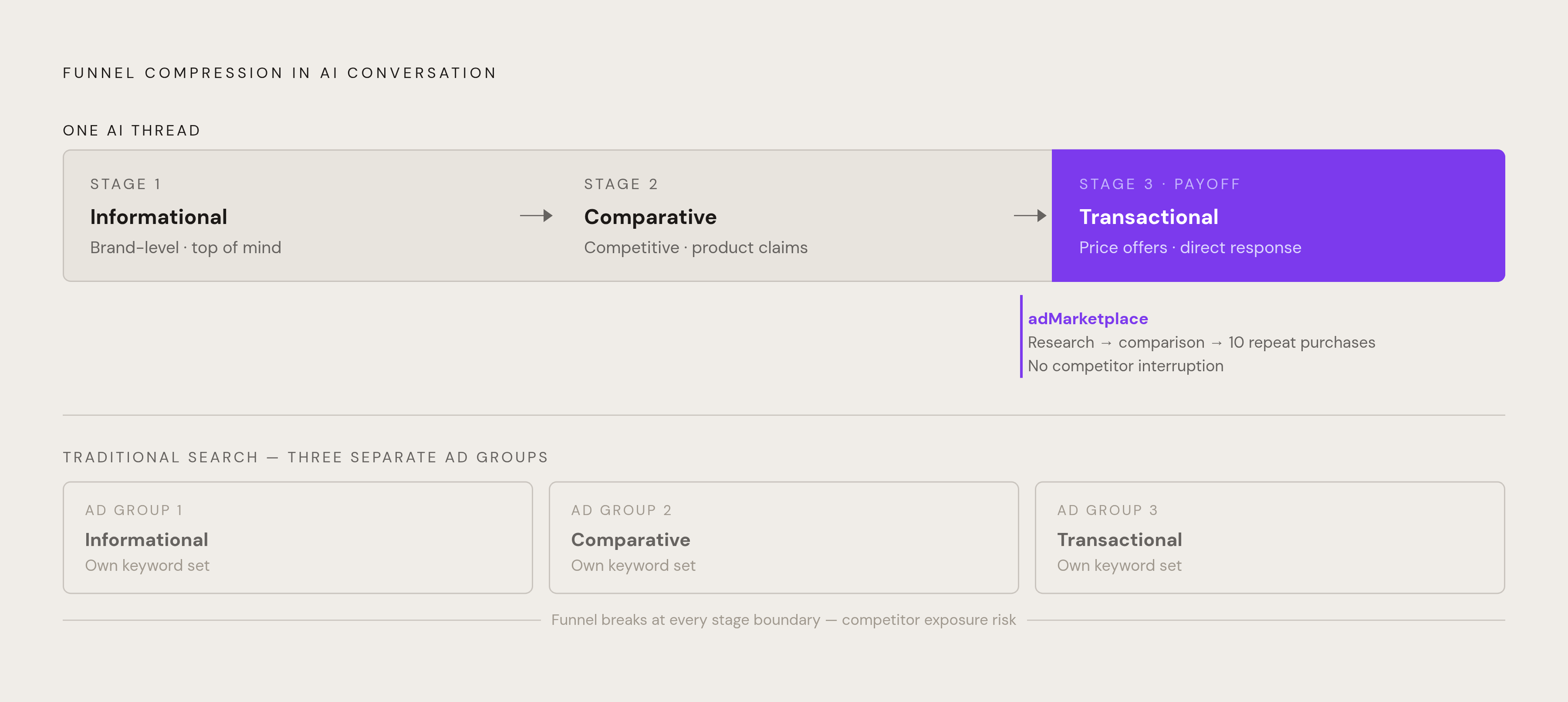
Search campaigns build separate ad groups for awareness, consideration, and purchase, and each one gets its own keyword set and its own landing page. Conversational AI collapses those stages into a single thread. A campaign built for this channel has to anticipate a user moving from one stage to the next mid-conversation, rather than treating every placement as a standalone impression disconnected from what came before it.
If a user is still researching a topic, you need brand-level and educational creative for that informational-intent moment. The goal there is staying top of mind, not closing a sale, and a hard direct-response pitch at this stage mismatches the moment and wastes the impression. If the user is weighing a few options against each other, that comparative-intent moment is where competitive positioning and specific product claims belong. This is the conversational version of a comparison-shopping query in search, and it's where a well-built product feed does the most work. If the user signals they're ready to act, you need direct-response creative and price-based offers for that transactional-intent moment.
That last stage is where the funnel compresses in ways search rarely allows. adMarketplace's chief product officer has described asking an AI search tool which car parts he needed, clicking through and buying all four, then asking what else on the car might fail next and buying ten more parts on top of that, all inside one thread, without ever returning to a search engine. Research, comparison, and repeated purchase happened back to back, with no gap where a competitor's ad might have interrupted the sequence. Format choice should follow from these stages rather than get fixed in advance: inline product cards and sponsored results that sit next to or just beneath a model's answer suit the transactional moment, while text links and hover-over formats fit better while a user is still informational or comparative, still forming a preference rather than acting on one.
Supply quality, surfaces, safety, and classification quality
Once a campaign is structured around intent stages, the next question is what inventory to buy against. Because the targeting primitive here is conversational context, the quality of a supply source comes down to how accurately it classifies intent and how reliably it keeps unsafe or mismatched conversations out of the pool a buyer bids into, not how large its reach is or how recognizable its name is.
You should start by asking whether a supply source will say which AI apps and surfaces actually ran its ads, down to the level of each individual surface. A platform that only reports aggregate impression counts is withholding the detail that tells a buyer whether its signal quality is any good. From there, the question turns to how the platform classifies conversational context in the first place, and how it keeps sensitive, unsafe, or simply mismatched conversations out of the inventory a buyer can bid on. This is the conversational version of brand-safety filtering in display advertising, but it carries more weight here, since an ad that lands wrong inside a private, personal exchange disrupts the user far more than a mismatched banner ever could on a content page. You also need to ask whether the ad-selection process can finish inside the model's response window without slowing the conversation down. If supply can't meet that bar, it will drag down the assistant's speed and produce placements that feel bolted on beside the answer they sit next to. And because a meaningful share of AI-influenced conversions happen after the click, a supply source that only reports last-click numbers, impressions, clicks, and the conversions it can trace directly, will undercount its own contribution and understate what it's actually delivering.
Buyers also face a structural choice in how they access this inventory. If you go through a platform that spans multiple AI surfaces, you get classification consistency across all of them, the same intent logic applied the same way everywhere. If you negotiate with each surface separately, each one applies its own classification logic, so you end up holding signals that can't be compared and reporting that doesn't add up into one picture. The latency constraint described earlier favors platforms built from the ground up for conversational AI rather than search or display tools with a chat feature bolted on, since bidding logic and inventory selection have to run inside milliseconds with no room for an external lookup or a delayed optimization pass. Purpose-built conversational DSPs sit in one tier of this market; legacy DSPs adding chat integrations on top of existing search or display infrastructure sit in another, and the latency and classification demands of this channel tend to separate the two cleanly.
Measurement when conversions happen outside the click window
A meaningful share of conversions influenced by an AI conversation happen after that conversation has already ended, through a later search, a direct visit to a site, or a return trip days afterward. Last-click attribution misses all of that; a buyer relying on it to judge a test campaign will often pull budget from a channel that is, in fact, working.
A user researches something inside a conversation, forms a preference during that exchange, and then converts through an entirely different touchpoint, a search query, a typed URL, a link saved for later, because the AI interface itself often doesn't carry a persistent click path all the way to the conversion event. This isn't a new problem invented by conversational AI. View-through attribution in display and assisted-conversion modeling in search were both built to handle versions of the same gap. What makes it wider here is that the conversational context that generated the original intent is invisible to a buyer's standard attribution stack, which has nothing built to read a chat transcript.
In the interim, buyers get more honest answers from a different set of measurements. Incremental lift studies compare an exposed group against a holdout group, and they show whether the channel drives outcomes that would not have happened otherwise, in a way last-click ROAS cannot. Brand search volume works as a leading indicator of the awareness an AI conversation generated, even when it never produced a click at the time. You can read direct traffic and return-visit rate as a reasonable proxy for the consideration an AI conversation sparked. The IAB Tech Lab's CoMP working group focuses on how publishers and AI companies transact over the content large language models draw on, so it sits in the best position to eventually produce a durable attribution framework for this channel. It remains a working group for now, so buyers should plan for this measurement gap to persist for at least the near term. The practical response is to build test budgets around lift studies, brand search, and direct traffic from the start, rather than waiting for a last-click number that was never going to tell the whole story.