Why Paid Placements Inside AI Conversations Are Not Search Ads Repackaged
Conversational AI ads operate on entirely different mechanics than search advertising.

Conversational AI advertising is not search advertising wearing a chat window. The surface where an ad appears is the least interesting thing about it; what actually changed is the targeting primitive, the signal the system reads to understand intent, and the moment at which an ad (or an assistant's own answer) begins to shape a decision. It's easy to look at a labeled sponsored card sitting near an AI-generated answer and assume it works the way a search ad works: the format looks familiar, the ad is disclosed, the user clearly had something they needed to know. A Google results page and a Perplexity response look similarly "search-like" from a distance, yet the mechanisms producing what the user sees have almost nothing in common: one runs on keyword matching against an index, the other runs on a language model reasoning over a live conversation. The entire stack beneath the ad, how intent gets read, how placement gets decided, and how influence travels before anyone clicks anything, is different enough that the two need to be evaluated on separate terms.
What the traditional search stack assumes
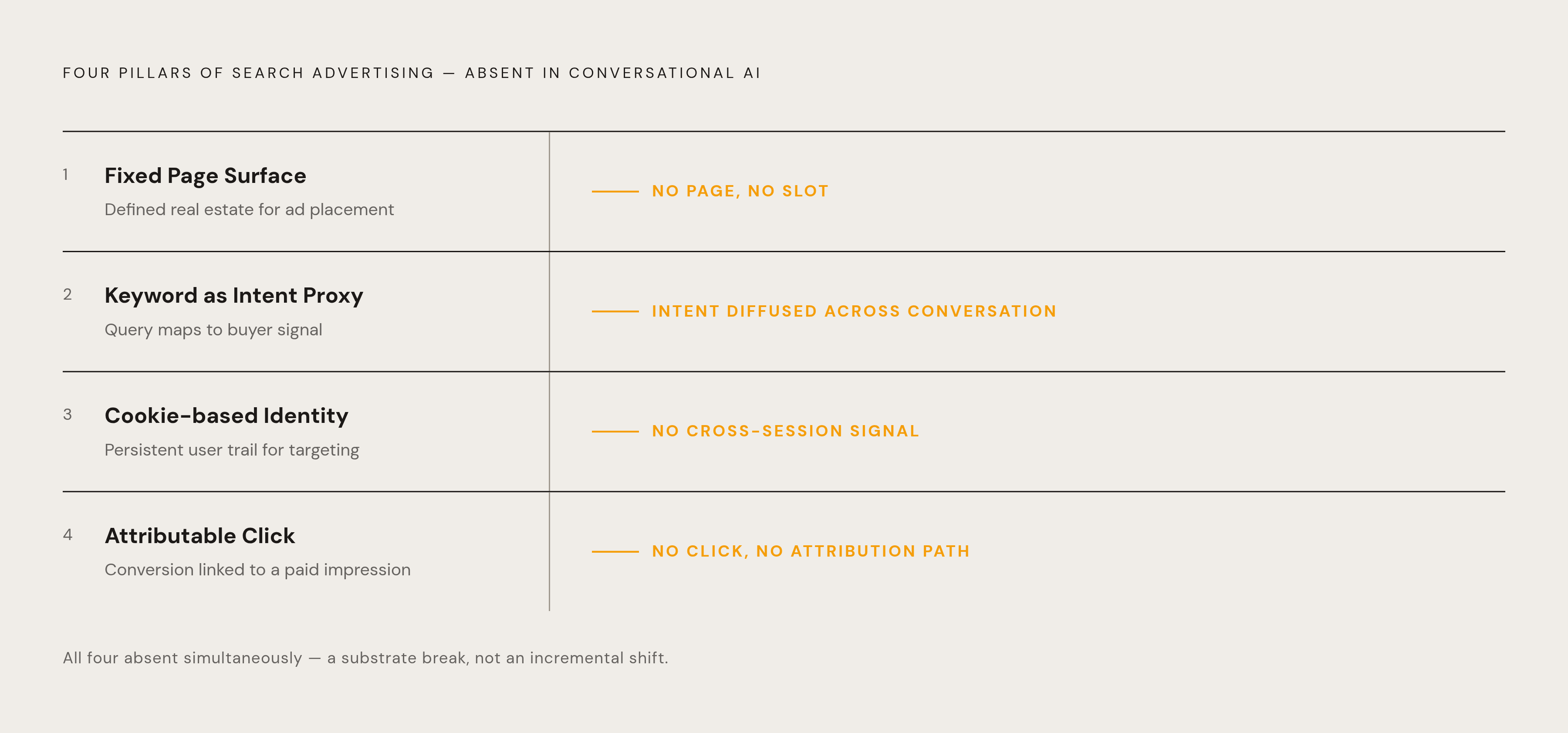
Search advertising, as an industry, rests on four assumptions that have held since the earliest keyword auctions and that an LLM conversation removes all at once. An AI conversation has no such page. The second assumption is the keyword itself, standing in as a proxy for what the user wants. The fourth is the attributable click: the whole performance architecture of search, cost-per-click, click-through-rate, last-click attribution, depends on a user leaving the ad surface and landing somewhere measurable.
None of this is a criticism of search advertising as a system. An LLM conversation doesn't offer a fixed surface, a keyword, a cookie trail, or a dependable click to attribute. Losing one of those four would be a meaningful adjustment. If you lose all four at once, the substrate the entire system runs on simply isn't there, and that's the gap the rest of this piece works through.
Conversational Intent vs. Keywords at the Signal Level
A single prompt typed into a chat interface carries more than a search query ever could, and the difference is measurable in kind, not just in degree. Take a real example: "what's the best carry-on bag for a three-day business trip." That sentence is not a keyword. It names a use case (business travel), a duration (three days), a context (carry-on, implying air travel and size constraints), and an implicit price range a bag buyer at this use case would tolerate. A keyword-matching system built for search would have to infer most of that from a thinner string; a language model reading the prompt has it stated outright, in one turn.
Conversations compound this advantage. Every added turn gives an ad delivery system more to work with, something a single search query is structurally unable to do because a search query is, by definition, a one-shot event. That accumulation produces distinguishable layers of intent within a single conversation. But if the user signals they're ready to act, that transactional turn suits direct response. A keyword auction has no equivalent to this layering; it treats every query as a flat event, stripped of where the user actually sits in their decision.
The distinction is what the string is doing when it's read, not how much information it contains. A keyword is a static match string, parsed once and discarded. A conversational prompt is one turn inside a live reasoning process the system is still working through when it decides whether and what to serve. Platforms built for conversational AI advertising, using real-time prompt analysis and contextual matching, treat the whole conversation itself as the unit being targeted, which allows purchase intent, use case, constraints, and timeline to be read together from a single natural-language turn.
How the targeting mechanism replaces keywords with context hints
The operational core of a conversational AI ad system is a natural-language description, written by the advertiser, of the kinds of conversations where their ad belongs. This is a genuinely different control than anything in a search campaign's settings, and it gets matched against a live conversation through a relevance-weighted auction with no real equivalent in keyword-based search.
What the auction actually evaluates is the context hint the advertiser wrote, the ad's title and copy, the landing page behind it, and the live context of the conversation taking place, not a bid staked against a static keyword string. In a conversational AI ad exchange, this reshapes who wins and why: relevance-weighted matching against live conversation context replaces keyword-bid hierarchies. A smaller advertiser with a precisely written context hint can outcompete a larger advertiser whose targeting is vague, something that rarely happens in a keyword auction where budget dominance tends to decide the outcome.
Teams moving into this space tend to make the same mistake early on: they write context hints the way they'd write a keyword list, a string of comma-separated topics loosely related to their product. That approach produces weak matching. Because targeting is matched to the meaning of a live conversation rather than to a stored profile, there's no third-party cookie involved, no cross-site identity graph being built, and no audience list to upload.
Ad Load and Placement vs. a Search Results Page
The question a reader familiar with search advertising is likely already asking: it still shows up next to an answer, so how different can it really be? The placement mechanics answer that directly. Inside a conversational AI response, you won't find a results page to stack ads on, no position above or below a fold, and nothing resembling the ad density a search engine delivers on a typical query.
A ChatGPT ad shows up as a labeled sponsored card that renders below the assistant's answer. It isn't woven into the answer's text, and the model's actual response doesn't get sold. So an ad appearing once in a session carries different attention economics than one competing against six others on the same page, and that gap in volume changes how a user weighs each placement they see. Search advertising also runs on position-based bidding, where slots one through four carry dramatically different click-through rates and price accordingly. A conversational response has no position hierarchy to buy into, because there's no stacked order of results to begin with.
For B2B advertisers, whose buyers skew toward paid tiers because those tiers unlock the features professional use needs, you have to plan around this as the single most consequential structural fact. It doesn't disqualify the channel, but it does mean campaign architecture has to account for who is and isn't reachable through paid placement alone, and where organic presence in the model's own answers has to do the work paid media can't reach. OpenAI's own documentation describes the design intent behind the separation directly: ads can appear below the end of a response, clearly labeled as sponsored and visually separated from the response itself, a deliberate choice to keep the commercial unit distinct from what the assistant actually says.
Where the assistant's influence travels before any click occurs
The most structurally unusual property of this channel is that influence doesn't wait for a click to start. In search advertising, nothing happens until the user clicks the ad, so everything before that moment is invisible to the advertiser and irrelevant to performance measurement. Inside a conversational AI response, the assistant itself can name a brand, describe its features, compare it favorably against competitors, and move a user toward a preference, before the user leaves the conversation and often before any ad has been served.
That's a structural property of how influence moves in this environment, not a measurement gap waiting for better tracking to close, and no amount of pixel refinement changes where the decision actually got made.
This matters for how advertisers should think about the channel. By the time a user leaves a chat interface, they've frequently already compared their options and arrived at a preference. The assistant is functioning as the interface itself, answering, naming, comparing, shaping, in a single exchange that no search results page is built to do. Brands that measure this channel purely through last-click numbers will consistently undervalue it, because the tools that actually capture this kind of influence, assisted-conversion tracking, brand mention monitoring, and holdout testing, sit outside what last-click attribution was ever designed to see.
AI Overviews and Copilot Ads as a Third Category
Not every "AI ad" belongs to the same category, and conflating them undermines any serious understanding of the space. Google's AI Overviews and AI Mode don't offer an opt-in or opt-out control at all: eligible campaigns, including broad match, AI Max, Performance Max, and Shopping, get served into these surfaces automatically. In September 2026, AI Max went through a significant structural shift, when Google began automatically migrating eligible Search campaigns using campaign-level broad match and Automatically Created Assets into AI Max, and blocked advertisers from creating those legacy settings as of August 3, 2026. Microsoft's Copilot works on the same automatic logic: eligible campaign and ad types are opted in by default, with ads assembled from assets already sitting in an advertiser's account.
What both of these represent is the existing search advertising system extending itself into a new surface, not a new targeting model built for conversation. The underlying primitives, keyword matching, auction logic, campaign structure, are the same machinery search has run on for years, now expressed through an AI-generated summary instead of a list of blue links, even as that machinery has picked up real changes through 2026, including AI Max's rollout to Shopping campaigns, AI-generated ad descriptions, and a new AI Mode carousel placement. When an AI Overview appears on a query, Google Ads click-through rate drops significantly, even though paid CTR has shown signs of stabilizing in 2026 after sharp declines through 2025. Legacy search placements are being displaced by the very AI layer that's also creating new inventory, and that's not a neutral transition for anyone who has built a campaign strategy on the old click-through assumptions.
Perplexity offers the clearest counterexample to how settled any of this actually is. It built sponsored answers into its product first, then discontinued the program entirely in February 2026 and moved to a subscription-first model, citing user trust as the reason. That reversal says something real: the economic and trust design of advertising inside AI conversation hasn't settled into a single accepted model, and treating "AI ads" as one uniform category, whether that means a ChatGPT sponsored card, a Google AI Overview, or a Copilot placement, misses how differently each of these systems is actually built and governed.
What brands need to do differently
If the targeting primitive, the intent signal, the placement mechanism, and the attribution model are all structurally different from search, then the campaign plan, the creative brief, the measurement plan, and the role organic presence plays all need to be built for this environment specifically, not carried over from a search playbook with minor edits.
Writing a context hint calls for a different skill than keyword research: it means describing a moment of need in plain language rather than compiling a list of match terms, and teams that default to comma-separated topic lists consistently get weaker matching for it. Creative has to work next to a response the user already trusts, not above or beside a list of links competing for the same click, so earning attention from someone who has just been helped is a different persuasive task than earning a click from someone still scanning a results page. Measurement has to account for the conversation gap directly: assisted conversions, brand mention tracking, and holdout testing all capture value that last-click attribution structurally cannot, and any team that only recognizes last-click numbers will consistently undercount what this channel is doing.
Organic AI presence and paid placement work in sequence, not as substitutes for each other. Becoming citable in AI-generated answers first, so a brand already shows up when a model is reasoning through an answer, then using paid placement to reinforce that presence, tends to make both layers work harder than either does alone. The entry point into this space has also changed: spend minimums that once required commitments around $200,000 have given way to self-serve access with no floor at all, which means the real barrier to entry now is operational sophistication rather than budget size. Monetizing attention inside LLM and chat environments calls for infrastructure built for that environment specifically, something that reads context in real time, matches intent without relying on cookies, and measures value by how well intent was matched rather than by whether a click occurred, rather than a generalist demand-side platform retrofitted to map keywords onto a surface that was never built to hold them.