Implicit vs. Explicit Intent in AI Conversation Threads
Implicit intent reshapes how advertisers should read conversation threads.
Traditional ad targeting works off a single layer of intent: a keyword typed into a search box, a page visited, a demographic guessed from cookies and past behavior. AI conversation threads break that model, because they throw off two structurally different signals at once: what a user directly asks for, and what the rest of the conversation gives away without ever being asked. Most ad systems get this wrong. They read one signal and ignore the other, or they treat both as the same thing and lose the precision that makes conversational advertising worth building in the first place. This gap carries real weight: buying a conversion that was already decided is a fundamentally different act from buying a hand in deciding it, and any advertiser still building media plans around explicit intent alone is optimizing for the smaller, less valuable half of the conversation.
What explicit intent looks like in an AI thread and why it is the easier signal to catch
Explicit intent is the part of a conversation that looks like a search query wearing a full sentence. A user asking an AI system to "recommend a running shoe under $150" or to "compare credit cards with no annual fee" is doing what search users have done for two decades with transactional and navigational queries. The request now shows up as a sentence instead of three keywords jammed together.
Profound's 2025 analysis of more than 50 million ChatGPT prompts found that only 6.1% classified as transactional and 9.5% as commercial. That's the slice most performance advertisers already know how to work: match the product to the request, apply a cost-per-click or cost-per-action model, measure the conversion. Simple, mechanical, done.
The catch is scale. A strategy built only around that small transactional-plus-commercial slice hands away most of the conversation, including the stretch where purchase decisions actually take shape. Anyone building a media plan around explicit intent alone should be worried about this math, not comforted by how clean it is to execute. The rest of the traffic isn't noise to filter out. It carries a different signal, and reading it takes a different set of tools entirely.
How implicit intent forms across a conversation thread and what makes it hard to read
Implicit intent never announces itself as a purchase signal. It builds across a conversation: in the questions a user asks before the commercial one, in context volunteered without being prompted, in constraints mentioned almost as an aside. Profound's same 2025 analysis put 32.7% of prompts in the informational category and 37.5% in generative or task-completion. That's where implicit intent lives, and it's the majority of the traffic, not a footnote to it.
Picture a runner training for a marathon. Across a session that eMarketer puts at roughly 23 prompts on average, that runner might ask about training schedules, then nutrition, then recovery gear, never once typing anything resembling "buy shoes." By the end of the thread, though, the conversation has revealed shoe preferences, a location, and dietary restrictions, none of it stated as a shopping signal, all of it commercially useful. Each prompt adds a layer, and the session read whole becomes a purchase-intent portrait no single keyword could produce.
That's also what makes the signal hard to catch. No individual prompt triggers it; the signal sits in the sequence, in the relationship between one turn and the next, so reading it means parsing context across turns rather than scoring the current query on its own. An informational prompt asking whether a moisturizer works for a specific skin concern looks like harmless research by itself. Read as part of a thread, next to earlier mentions of skin type, an existing routine, and a hierarchy of concerns, it turns into a detailed and commercially usable profile that never once used the word "buy."
Pulling that signal out of live traffic, at the volume OpenAI and Google process daily, takes a different kind of logic than the one built to index search queries. Search infrastructure was built to score a query against an index. Thread-level intent asks a system to hold a running memory of everything said before it and update its read of the user with every new turn.
How the distribution of prompt types shapes what advertisers can actually target
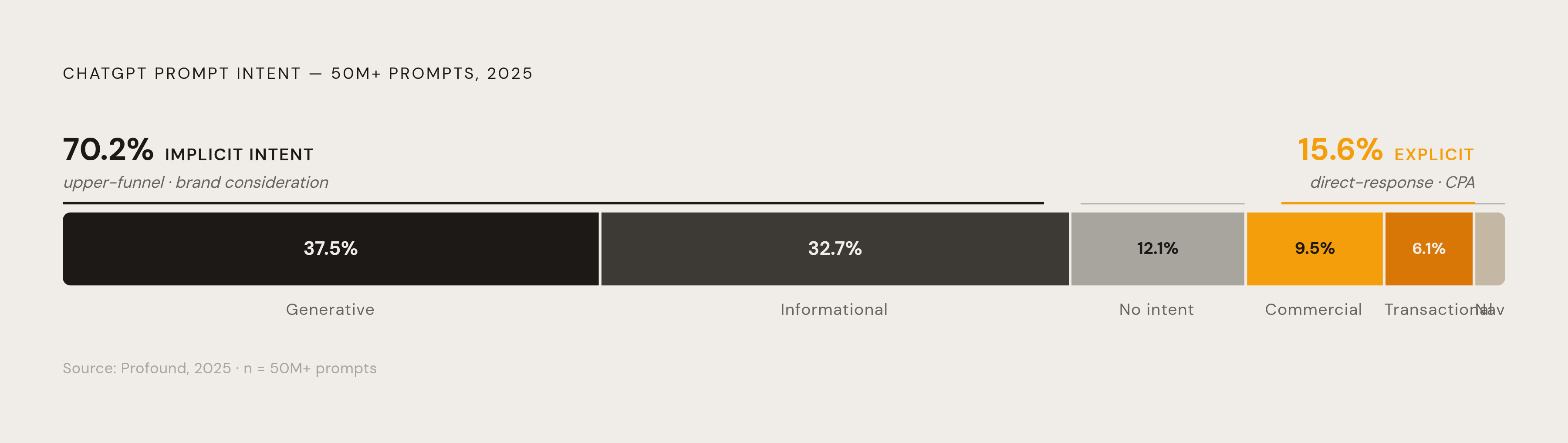
Profound's full taxonomy, from the same 2025 study, breaks down as 37.5% generative or task-completion, 32.7% informational, 12.1% with no clear intent, 9.5% commercial, 6.1% transactional, and 2.1% navigational. A separate analysis splits things differently, putting the informational-to-transactional ratio at roughly 60/40. The gap between the two studies comes down to differing classification methods, not a disagreement about the underlying reality: informational and implicit prompts dominate conversation volume, no matter whose taxonomy gets used.
That distribution sets the terms for targeting. Explicit-intent prompts, the commercial and transactional slice, are small in volume but convert at a high rate, which suits direct-response and CPA-driven campaigns. Implicit-intent prompts, the informational and task-completion majority, suit upper-funnel work: brand consideration, category entry, the phase where a user is forming a decision rather than making one. The two aren't sealed off from each other, either. A thread that opens informational can turn transactional by the tenth turn, and that turn itself is a signal worth targeting.
Optimizing only for the explicit slice means fighting over a small pool of transactional prompts while handing the much larger consideration phase to whoever shows up earlier in the thread. Verve's 2026 analysis found more than 20% of pre-purchase digital journeys now start in an AI chat interface, and in travel that figure climbs to 37% of queries starting in an LLM. Those opening prompts are almost always unbranded and informational. That's implicit-intent territory, and it's where the real fight for attention is already happening, whether most advertisers have noticed or not.
The technical approaches that read implicit intent at the thread level
Reading explicit intent is close to a solved problem: classify the current prompt against a commercial taxonomy, match it to advertiser categories, serve the result. Implicit intent asks for more. It needs thread-level analysis: tracking how the topic drifts prompt to prompt, picking out contextual details volunteered with no commercial framing at all (a location, a life stage, a stated constraint), and modeling where a user sits in a consideration arc rather than what they typed this turn.
Retrieval-Augmented Generation, the framework behind how many AI systems pull outside content into a response, offers one technical path. Researchers examining auction mechanics for RAG systems have looked at models where ad placement depends on both a relevance score from the retriever and an advertiser's bid. The retriever's relevance judgment works, in practice, as a form of implicit intent detection, since it ranks content against the full conversational context rather than the single query that triggered it.
A more direct approach comes from Zhao et al.'s December 2025 work on what they call LLM-Auction, which folds the auction mechanism into the model's generation process itself using reinforcement learning. The model learns, jointly, to optimize for response quality and ad revenue at the same time. Implicit context shapes where an ad lands in real time, through the generation process itself rather than a separate layer bolted on after the response gets generated.
On the targeting side, a few parameters put this into practice: conversational intent targeting based on the topic and content of current and prior turns, publisher category targeting based on the AI surface and how users behave there, and session-depth signals that separate early-thread placement from late-thread placement. The conversation itself carries the signal, without relying on cookies.
The gap in the market is structural, and it isn't closing on its own. Thrad, for instance, pairs a DSP for AI chat inventory with its own exchange and direct publisher supply precisely so it can read conversational context that page-level buying infrastructure cannot. Generalist demand-side platforms, built for page-level or keyword-level context, have no mechanism for parsing a multi-turn thread. Single-surface AI ad networks can read context, but only inside the one environment they operate in. Neither is built to match explicit and implicit signals across multiple AI surfaces at once, and that gap is exactly where campaigns leak value today.
How different AI platforms handle the two intent layers differently — and what that means for advertisers
Amazon's Rufus, as of January 2025, reads explicit shopping intent almost exclusively, matching a query against product metadata, Q&A content, and reviews. It sits near the bottom of the funnel and does that job well; it isn't built to catch the upper-funnel implicit signals sitting earlier in a shopping conversation, and it doesn't try to.
Meta AI takes a different route. Rather than placing ads inside the conversation itself, it uses what gets said in that conversation to target ads served elsewhere, on Instagram or Facebook. A conversation about a kitchen renovation might surface a home-improvement ad an hour later on a completely different surface. Meta began using AI conversation data to personalize ads across its properties this way.
Perplexity is testing a third model: sponsored follow-up questions, generated contextually and labeled as sponsored. The mechanic matters because a follow-up question, by design, points at where the intent arc is heading, which is exactly the forward-looking read implicit intent requires. The format is transparency-first by design, since the sponsorship gets disclosed rather than folded invisibly into the response.
Google's Marketing Live 2026 announcements pointed to a similar fracture inside its own core product. AI Mode and its Conversational Discovery Ads are built for conversational context rather than a standalone search query, which amounts to Google retrofitting decades of explicit-intent search infrastructure to handle a signal that no longer arrives as a clean keyword.
None of these approaches agree with each other, and that disagreement is the point worth sitting with, not smoothing over. No shared standard exists yet for how implicit intent gets read or matched across surfaces. Campaign design has to account for where in the intent arc a given platform's inventory actually sits, and the fullest picture only comes from buying across surfaces rather than betting on one. That's the specific gap a cross-surface demand-side platform, built on top of direct publisher supply, is positioned to close: legacy programmatic can't read conversational context at all, and single-surface AI ad networks read it but can't offer reach past their own walls.
What each intent layer unlocks for specific categories — travel and beyond
Travel makes the clearest case. Verve's 2026 analysis puts 37% of travel queries starting inside an LLM, and the opening prompt in that sequence is almost never branded. It's "best time to visit," "what's the weather like in October," "family-friendly or adults-only." Those are implicit signals about destination, travel party, and budget, all showing up well before the explicit request to book a flight or compare hotels. A brand that only shows up when the explicit question finally arrives has already missed the phase where the traveler ruled out every option that wasn't a fit.
Sports and fitness follow the pattern the marathon example already laid out: a 23-prompt session, per session-level data on that category, generating signals about footwear, nutrition, gear, and location all at once, none of it phrased as a purchase. Skincare works the same way; a user answering an informational question about a specific product ends up revealing skin type, existing routine, and sensitivity concerns in more detail than any demographic segment could capture. Finance follows suit: a prompt asking how a HELOC works, or what separates a Roth from a traditional IRA, reveals life stage and financial literacy well before any transactional signal shows up.
The pattern holds across every category examined. Implicit intent clusters at category-entry and consideration, explicit intent spikes at the point of decision, and the strategy that wins matches format and message to the stage rather than just to the topic. A brand treating implicit intent as noise ends up advertising only at the tail end of decisions it had no hand in shaping, which is a worse position than it sounds, because by then the decision is basically made.
Why multi-turn signal stacking changes the value of a single conversation
The advantage in conversational advertising comes from layering the two signal types, not picking one. Explicit intent marks where a user sits in the funnel; implicit intent explains how and why they got there, a distinction Verve's analysis draws directly. A single session carrying both layers produces a fuller purchase-intent portrait than search or social typically assembles across several sessions and several separate data sources.
There's a depth-versus-volume tradeoff worth naming plainly, and it cuts against the instinct to chase scale. A single multi-turn AI session can carry more usable context than dozens of scattered search queries ever would, simply because the thread holds its own history. Volume without memory is worth less than a shorter session that remembers what the user said five turns ago.
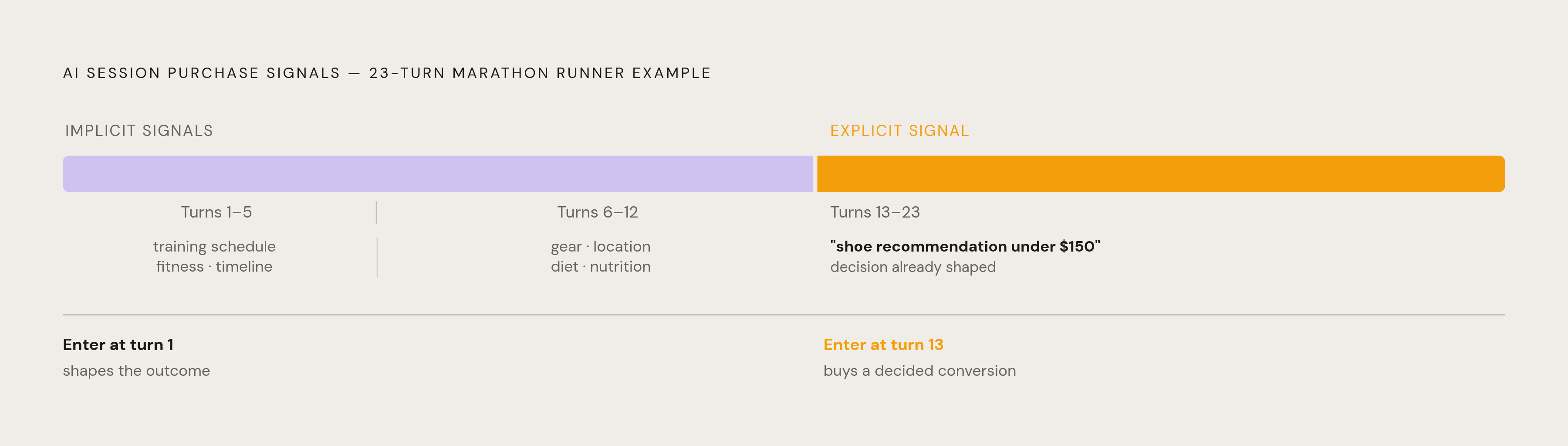
Take the marathon runner again. Turns one through five carry implicit signals about fitness level and timeline. Turns six through twelve add gear preferences, location, and diet. Somewhere around turn thirteen, the explicit commercial question about shoe recommendations finally shows up. An advertiser that only appears at turn thirteen is buying a conversion that was already decided; an advertiser present from turn one had a hand in deciding it.
Signal stacking also changes what good creative looks like. A message calibrated to early exploration lands differently than the same generic message served to anyone who mentions a related topic late in a thread. That has a direct measurement consequence: click-through alone can't capture value generated during the implicit-intent phase, and brands that measure only final conversion will keep undervaluing the upper-funnel placements doing the real work of shaping the decision.
What ad safety and transparency look like when ads touch implicit signals
Explicit-intent matching is easy for a user to make sense of. They asked a commercial question and got a commercial answer; the line between the two is visible. Implicit-intent matching doesn't offer that same clarity. A user volunteers context inside what feels like a private research conversation and later runs into an ad that clearly reflects it, without ever seeing the connection spelled out.
Perplexity's sponsored follow-up format is worth returning to here, because labeling contextually generated suggestions is a direct attempt to make that pipeline visible instead of hidden. It also shows how much ground the rest of the industry still has to cover on disclosure. Meta's approach, using signals from an AI conversation to target ads that show up later on an entirely different surface, raises the same question in sharper form: the user who mentioned a kitchen renovation in one context has no clear line of sight into why a home-improvement ad turned up in another. As conversational advertising scales, the platforms treating disclosure as part of the product, not a compliance step bolted on afterward, are the ones keeping the trust the format runs on.