Detecting New and Emerging Consumer Segments Through Prompt Vocabulary Shifts
AI conversations reveal emerging consumer segments before traditional market signals catch them.
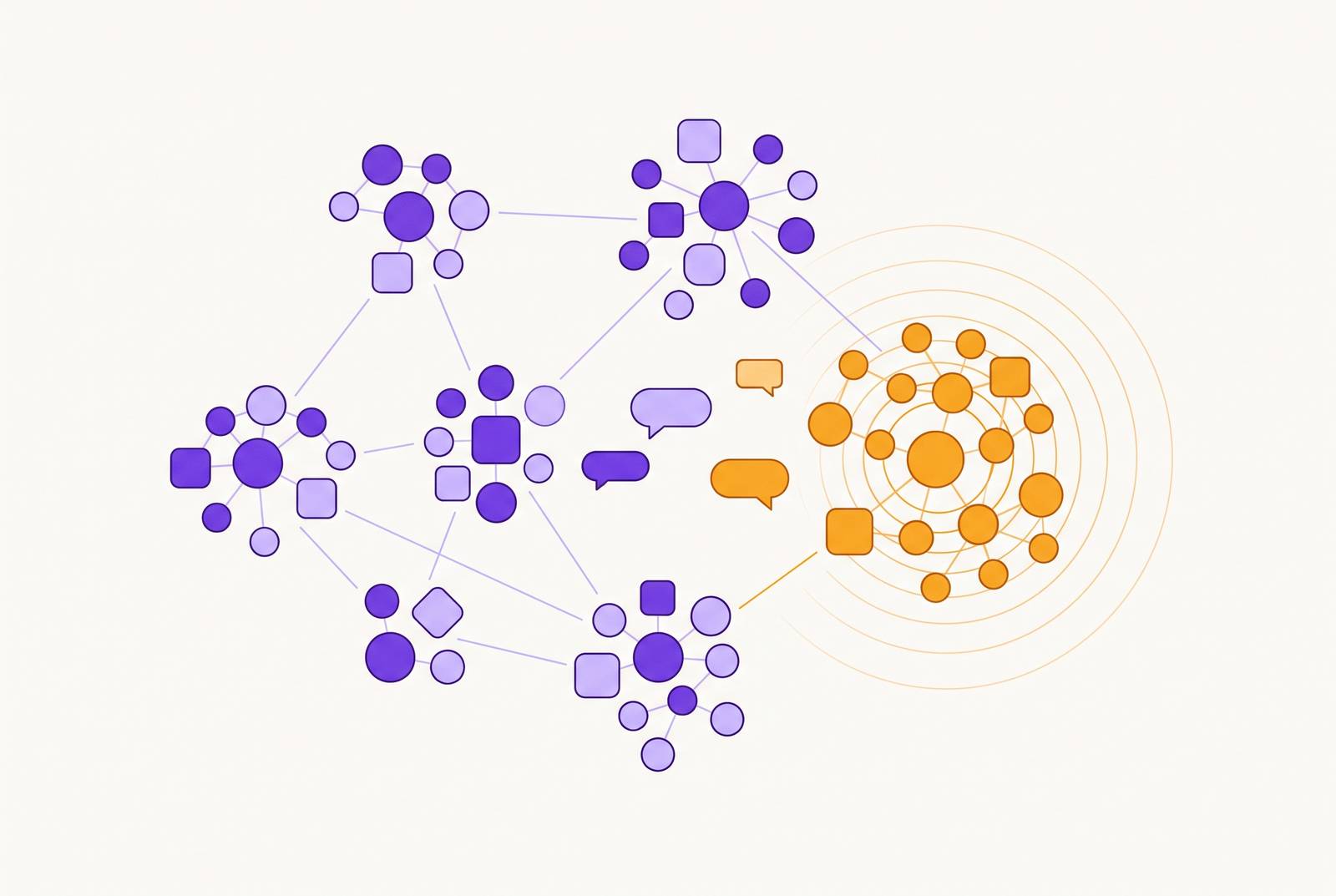
Consumer segments used to announce themselves after the fact: a spike in purchases, a new cluster in a survey panel, a cohort a brand tracker finally has a name for. Prompt vocabulary breaks that timeline. The words people type into AI conversations, before they've committed to a product or even settled on a category, reveal a segment while it is still forming, and the brands that learn to read those shifts get to a market before anyone else knows it exists.
Traditional segment detection has always looked backward. Purchase histories describe what already happened. Survey panels ask people to categorize themselves using language that already exists. Social listening catches conversation only after it has enough volume to trip an alert. Third-party audience files are built on all of the above, so they inherit the lag baked into each one. By the time a segment shows up cleanly in a Nielsen cohort or a brand tracker, the brands paying attention to earlier signals have already built a position around it.
Keyword tools were supposed to close that gap, and for a while, they did. A keyword tool records what someone typed into a search box, but not what they meant by it; a three-word query flattens a dozen different reasons someone might have typed it into one undifferentiated volume number. That gap never closed. Brands often treat prompts as an upgraded keyword tool, but this is the mistake worth correcting up front: prompts belong to a different category of data entirely, shaped by the reasoning that produced them rather than by the act of searching itself. Longer, more specific, a prompt reads closer to a diary entry than a search term.
What makes a prompt categorically different from a keyword
Start with length, since it's the most visible difference and the easiest one to underrate. A typical search query runs a handful of words. A typical AI prompt runs many times longer, written in full sentences, in the user's own phrasing, with the user's own hesitations built in.
That extra length carries information a keyword structurally cannot hold. A prompt carries context: "I'm a freelancer in my first year, not yet VAT-registered" tells a brand something a search query never could. It carries constraints stated outright, budget ceilings, timelines, prior experience, deal-breakers. It carries comparison framing, since users frequently name the alternatives they've already considered and ruled out before asking the question at all. And it carries emotional register, anxiety, urgency, excitement, the kind of thing a three-word query has no room to express.
Most AI prompts are unique constructions, not repetitions of some stock phrase. Users aren't selecting from a dropdown of common searches; they're narrating where they actually stand in a decision. A keyword records a destination. A prompt records the reasoning that led there, which is the entire distinction, and treating the two as points on the same scale is where most keyword-trained marketers go wrong.
Call this quality intent density: how much a single prompt reveals about where someone actually is in a decision, not just what they're searching for. Intent density is the variable that makes everything below possible, and it's worth naming because keyword volume was never built to measure it.
How a single keyword fractures into distinct micro-segments when viewed through prompt data
Take a single keyword, the kind that shows up as one clean volume line in any keyword planning tool. In prompt data, that keyword doesn't stay clean. It appears inside dozens of distinct sentence constructions, and each one carries its own buyer profile, its own stage of decision, its own blocking concern, its own desired outcome.
One version of the prompt comes from someone early in exploration, unsure what the category even contains. Another comes from someone who has already shortlisted three competitors and wants a tiebreaker. A third comes from someone who has already decided and just wants language to justify the decision to a boss or a spouse. All three might contain the identical keyword, yet none of them are the same person asking the same question for the same reason.
Each cluster functions as a distinct micro-segment, with its own messaging needs, its own proof points, its own price sensitivity. A brand that optimizes toward the keyword is, by construction, optimizing toward the average of all three, which means it serves none of them well. That's the flaw in keyword-first strategy: chasing the volume number instead of the clusters hiding underneath produces copy that speaks to no one in particular. Reading the prompt vocabulary underneath the keyword lets a brand write copy, build landing pages, and set bids for each cluster on its own terms.
This isn't a special case that turns up occasionally in unusual categories. Apply prompt-level analysis to nearly any high-volume category term and it fractures the same way. Prompt vocabulary describes a different map of the same territory, one keyword data was never built to draw, and brands still reading only the keyword layer are navigating with half the map.
The early-warning mechanism: how new vocabulary signals a segment before it has a name
Segments say what they are before they act like what they are. New word combinations, unfamiliar modifiers, category framings that wouldn't have made sense a few quarters back: these show up in prompt vocabulary before they show up in behavior anyone can measure by other means.
The mechanism is repetition without coordination. When a cluster of users, none of whom know each other and none of whom are copying a template, independently start phrasing questions with the same novel terminology, that convergence is the signal. It means something has shifted in how a group of people think about a category, and they've reached for new language to describe it before anyone handed them the word.
In practice, this looks like a new modifier attaching itself to a familiar product category with rising frequency: something like "offline-first" or "AI-native" showing up where it didn't before. A constraint enters the conversation that wasn't common six months earlier, an explicit refusal to use anything requiring a particular kind of financial account, for instance. Two product types start getting compared to each other that were never previously treated as substitutes.
None of this shows up in a survey panel yet, because nobody has written the survey question. None of it shows up in social listening yet, because the volume hasn't crossed whatever threshold trips an alert. The segment already exists, already articulating its priorities in its own words, inside an AI conversation. It just doesn't have a name in anyone's segmentation model yet. The brand that notices the vocabulary first gets to build a position around that segment while competitors are still filing it under a generic bucket in last year's taxonomy.
Where intent is highest and why certain categories accelerate segment formation
Segment formation shows up fastest, and gets caught earliest, in categories where consumers turn to AI tools before they open a search engine at all. Categories that move slower along this axis deserve less monitoring budget: the signal won't pay it back as quickly there, and spreading attention evenly across every category just wastes it where it earns the least.
That behavior, using AI as the first stop in product discovery rather than a later step, has become common across categories where the decision is genuinely complicated and the stakes feel personal. These are categories where the decision is genuinely complicated, the stakes feel personal, and users want something closer to a thinking partner than a page of ten blue links.
What makes these categories especially valuable for vocabulary monitoring is that the earliest prompts inside them are usually unbranded. Someone exploring a financial product or comparing software categories isn't naming a specific vendor yet; they're working through the structure of the decision itself. The vocabulary gets exposed before commercial intent fully surfaces, and that's exactly the window a brand wants visibility into. High-intent prompts, the kind involving direct comparison or financial decision-making, already make up a substantial and growing share of AI interactions. It's not a coincidence that these same categories generate the deepest, most substantive multi-turn conversations; complexity is what drives people to think out loud with an AI tool in the first place.
How brands can structure a prompt vocabulary monitoring practice
Tools now exist that aggregate and analyze prompt volume across major AI platforms, surfacing what users are asking, how often, in what framing, and how the answers shift over time. Building a monitoring practice on top of that data works best as three layers, stacked in order, and the order is not optional. Skipping the first layer to chase drift signals is the most common way this work goes wrong: drift looks more exciting than baseline work, so teams rush past it, then wonder why the drift they caught doesn't mean anything against a baseline they never built.
Baseline mapping comes first. Document the vocabulary clusters that currently exist in a category, the phrasing patterns, the constraints and comparisons that show up most often. Without a baseline, drift is invisible, because there's nothing to measure it against.
Drift detection comes second, and it's the layer doing the actual early-warning work: tracking when new terms, new modifiers, or new constraint types start appearing with rising frequency. That rising frequency is the tell.
Cluster validation comes third. Once a vocabulary cluster is large enough and stable enough to describe a coherent buyer profile, it graduates from a curiosity to a named segment with its own brief, its own messaging, its own targeting logic.
A few operational notes matter here. Prompt vocabulary analysis is an earlier-stage input that tells a research team where to look next; it feeds existing research methods rather than replacing them. The goal is to catch directional shifts, new terms rising, old framings fading, across a manageable slice of a category, not to monitor every prompt in it. Different AI platforms also attract different user bases with different average prompt lengths and different levels of conversational complexity, so a monitoring practice has to account for that variation instead of treating all AI query data as one undifferentiated pool.
There's also an organizational question worth naming plainly. This work sits at the intersection of market research, media strategy, and product marketing, and it doesn't automatically belong to any one of them. Brands that assign clear ownership early act on what they find faster than brands still arguing about whose job it is. That argument alone has cost more than one team the window it was trying to catch.
Reaching a forming segment at the moment its vocabulary is most active
None of this matters if a brand can't act at the moment intent gets expressed. Detecting a forming segment three weeks before a retargeting campaign catches up to it is still too late to matter.
Conversational AI advertising works on a different mechanism, and the difference deserves precision rather than a hand wave. Ads placed inside AI conversations get matched to the intent of the conversation itself, a sharper signal than a static page, a typed keyword, or a demographic guess about who the user probably is. That match wins on relevance every time it's tested against the alternative. A brand that has identified a rising modifier in travel prompts, for instance, can bid against that conversational context directly, reaching someone while they are actively reasoning through the decision instead of after they've already made it.
Search advertising matches to what a user typed. Social advertising matches to who a platform thinks a user is. Conversational advertising matches to what a user is thinking through right now, a meaningfully earlier point of contact than either of the other two.
The practical constraint is a reach-versus-context tradeoff, and most current options force a brand to accept one half of it. Ad networks built around a single AI platform read conversational context well but only within that one surface. Generalist buying platforms have reach across the wider internet but no ability to parse conversational signal. A demand-side platform built to operate across multiple AI surfaces, on top of direct publisher supply, addresses both constraints at once, and that combination is the whole point: detection shows a brand where a segment is forming, and delivery lets it show up inside that exact conversation while it's still active.
What prompt vocabulary cannot tell you — and where the signal breaks down
None of this should be oversold, and the honest version of this argument has to say where it stops working. Prompt vocabulary is a leading indicator. Skipping past its limits to make the pitch cleaner would defeat the purpose of writing any of this down.
Attribution remains genuinely unresolved, and this is the limit that matters most. When someone moves from an AI conversation to an actual purchase, that path is frequently invisible; an AI interface doesn't close the loop the way a search ad click does, and there's no reliable way yet to trace a prompt directly to a transaction. The data available to marketers is also aggregated and modeled probabilistically. It shows patterns across a population, not a full transcript of every conversation happening in a category. Platform opacity compounds the problem: users on paid tiers of some AI products see no ads at all and generate no ad-visible signal, so the universe of observable prompts skews toward free-tier behavior and may not represent the category evenly.
Vocabulary spikes can mislead on their own terms, too, and this is the failure mode worth taking most seriously. A sudden surge in some new phrase might reflect a viral moment in the broader media cycle, or a quirk of how one platform's users happen to talk, rather than a genuine consumer segment with commercial depth behind it. Skip the validation step against purchase data or survey research, and a brand ends up chasing noise dressed up as a trend, which is worse than missing the signal outright, since it burns budget and credibility at the same time.
Prompt vocabulary is the earliest signal currently available for a forming segment, meaningfully earlier than anything else on offer, but it stays a first signal, not a final answer. Trust it as more than that, and the method stops being useful right at the point a brand starts trusting it most.
The compounding advantage of acting on prompt signals early
The real advantage here isn't speed for its own sake. It's the compounding effect of joining a category conversation before anyone has named it or claimed it, because the brand that shows up first gets to shape how the segment understands its own choices.
A brand that reaches a forming segment early becomes the reference point everything else gets compared against. A brand that waits for the segment to surface in a third-party audience file is walking into a conversation someone else already framed, using language someone else already normalized. That's a weaker position no matter how much budget follows it, and no amount of later spend closes a gap that started with someone else defining the terms.
There's a useful parallel in how search advertising played out in its early years. The brands that built strong positions while search was still new captured advantages that turned out to be expensive, in some cases nearly impossible, for later entrants to displace. The same dynamic is starting to take shape in conversational AI, at an earlier and more visible stage than search ever offered.
The practice described here, monitoring vocabulary, spotting forming clusters, reaching people inside live conversations, validating what's found before scaling it, is available right now, built on tools and infrastructure that already exist. The brands leading customer acquisition in the AI era won't necessarily be the largest ones, or the ones with the most sophisticated data teams. They'll be the ones that treated prompt signals as a serious input to segmentation before the rest of the category thought to bother.