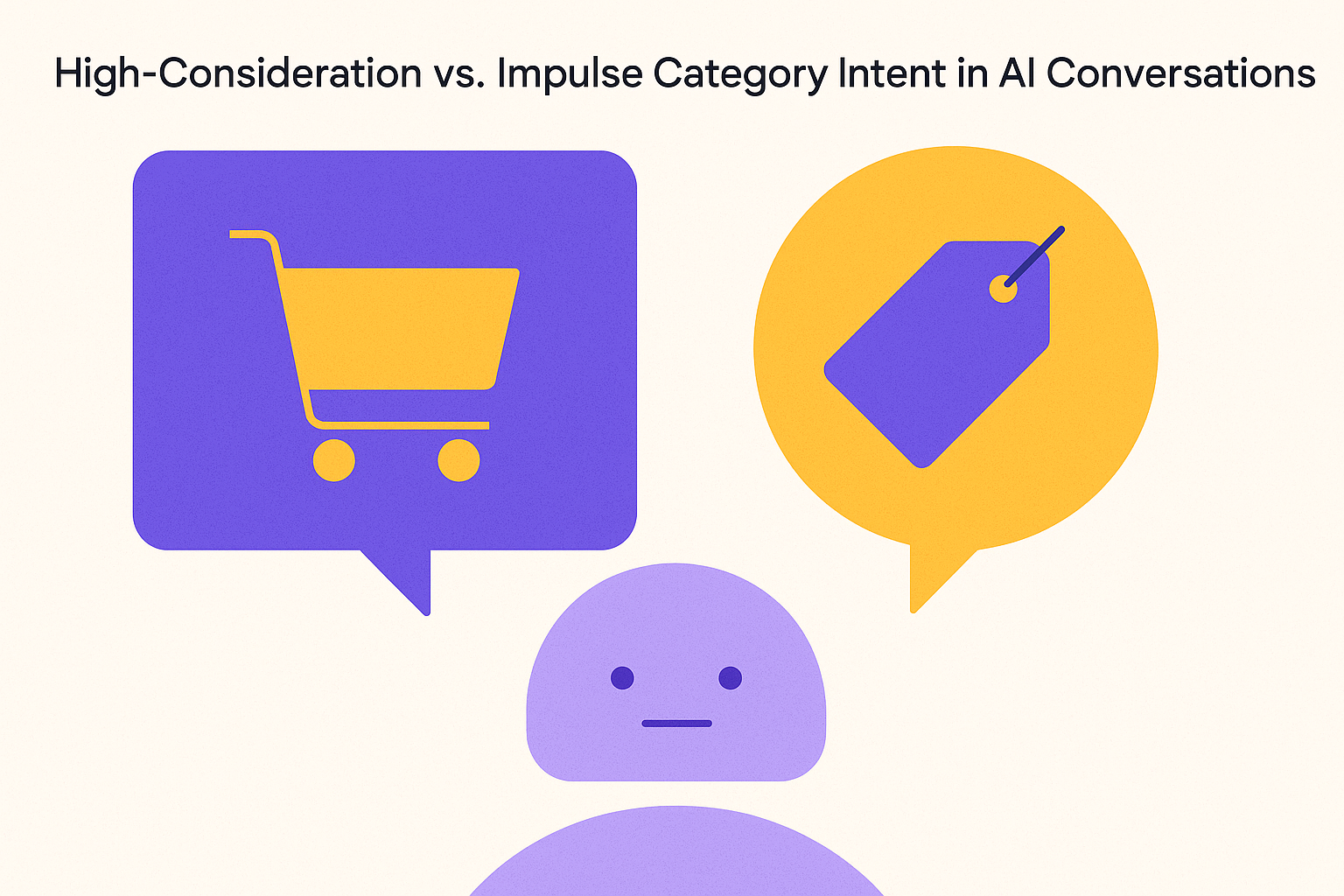
High-Consideration vs. Impulse Category Intent in AI Conversations
Conversations reveal high-intent buyers through constraint language and deliberation, not keywords.
A three-word search query captures a moment. A multi-turn conversation captures a trajectory: budget, constraints, prior rejections, and proximity to a final decision can all appear within a single thread. That difference is the starting point for understanding how AI advertising actually works, and why it behaves so differently from the search advertising that preceded it. Contextual targeting in ChatGPT ads has to work at the level of the whole conversation, not the latest prompt: the targeting system needs to read what was asked three exchanges earlier, how the assistant answered, and which follow-up questions came out of that answer. A contextual system built to read that conversation can spot the pattern as high intent, even when the product category never gets named.
That capability sounds like a uniform upgrade over search, a richer signal replacing a thinner one across the board, but it is not. The depth of a conversation depends entirely on what is being bought. Others resolve in a single exchange, with the buyer arriving already decided and wanting nothing more than a fast, direct answer. Building one targeting approach and one creative format for both situations treats a ten-turn research session and a single-line request as the same kind of event, when the intent signal they produce is fundamentally different in shape, not just in volume.
How a conversation unfolds across its multi-turn arc
An AI conversation does not sit still: it moves through distinct phases, and each phase produces a different quality of intent signal, so the arc itself becomes the asset an advertiser is really targeting. Understanding that arc requires naming its parts, because the vocabulary matters for everything that follows.
A conversation opens with a query that establishes initial intent, whether broad or specific, informational or close to a decision. Because the exchange is generated turn by turn rather than published once, relevance has to be reassessed continuously as new information comes in rather than locked in at the first message. From there, the conversation typically moves into a phase of intent refinement, where follow-up exchanges narrow the focus, introduce specific use cases, or raise alternatives. This is where category and preference data starts to accumulate, turning a vague opening into something an advertiser could actually act on.
The pivotal moment in most conversations is what can be called constraint language: a budget ceiling, a dietary or health restriction, a logistics detail like needing something shipped to Canada. This kind of constraint almost never opens a conversation. Buyers tend to start broad and narrow as they go. The constraint, once it appears, retroactively sharpens the meaning of everything said before it. A person who mentioned a general interest in solar power ten minutes earlier becomes, the moment they state a monthly electric bill and a home address, a qualified lead with a specific financial profile.
Many conversations then move into a comparison and evaluation stage, where the user starts weighing named alternatives or raising specific objections. This stage is the closest conversational equivalent to a purchase-intent keyword in search, but it appears much later in the exchange and carries far more context with it than a keyword ever could.
This structure matters for targeting because of how Microsoft Copilot's ad system is built. Copilot's targeting model draws on the entire session context rather than treating the most recent prompt as the trigger, so the complete arc of a conversation determines which advertisers are relevant rather than a single isolated query. Because relevance comes from the conversation happening right now rather than a browsing history built over months, advertisers do not need persistent identifiers or cross-site tracking to find the right moment. Each conversation stands as its own self-contained targeting context, built from what the system reads from the thread itself, not from a profile assembled elsewhere.
High-consideration purchases: how budget, constraints, and shortlists reveal themselves across many turns
In high-consideration categories, the full multi-turn arc produces a signal that no search history or retargeting cookie could reconstruct, and a brand that reaches the buyer at the right turn holds a stronger position than any click ever delivered. A high-consideration purchase is defined by the fact that research, comparison, and deliberation are part of the decision itself rather than friction standing between the buyer and the purchase. The conversation has room to run long enough for budget, constraints, and earlier rejections to appear on their own, without anyone prompting for them directly. This pattern concentrates in B2B software, financial services, education, travel, and health and wellness, categories where the stakes and the price both justify the extra turns.
A solar shopper illustrates the pattern about as completely as any single example can. The conversation starts with a location, Phoenix, and a monthly electricity cost. From there it moves to a question about whether a recent change in federal tax credit policy still applies, then to the choice between leasing and buying, then to a question about how net metering works in that specific utility district. At no point does this buyer call an installer or search a single brand name. Yet by the end of that thread, the conversation has already disclosed geography, utility context, financial framing, awareness of a specific policy change, and a buyer clearly moving toward a decision. That same progression, from vague concern to openness to near-readiness to buy, used to take multiple separate search queries and a retargeting cookie strung together over days to detect. Here it happens inside one thread, where the ad systems built for search cannot see it.
The pattern holds even in categories that look, at first glance, far more impulsive. Sportswear is a useful check on the theory, because a large share of prompts in that category are upper-funnel and informational rather than obviously transactional, and those informational prompts still carry buying signals that traditional search simply does not catch. A runner training for a first marathon might type "Nike sneakers" into a search bar and reveal almost nothing. The same runner, in a ten-prompt conversation about marathon running, reveals far greater depth of insight into needs, preferences, and purchase timing than that search ever could.
The economics of conversational advertising invert what advertisers have learned to expect from e-commerce. Low-ticket, high-frequency categories have historically converted at higher rates in traditional online retail, but the conversational channel flips that advantage: impulse categories need no deliberation support, so there is little for a conversation to add, while high-consideration categories are exactly where the back-and-forth of dialogue does real work. A buyer in one of these long conversations can also ask follow-up questions and push back on claims made to them. An advertiser has to be ready to substantiate a pitch with something concrete: social proof, third-party reviews, or a relevant certification. A claim that cannot survive a direct follow-up question is a liability in this format, not an asset.
Impulse categories: why a single-exchange conversation demands a different kind of intervention
Impulse categories resolve inside a single conversational exchange, so there is no arc to read and no constraint turn worth waiting for. The only targeting window is the query itself, and the creative has to close the sale inside that same exchange. An impulse purchase, in this context, is defined by the absence of any need for deliberation: the buyer arrives with intent already formed or nearly formed and wants a fast answer rather than a research partner. Food, beauty products, and everyday consumer goods are the clearest examples of this category, the low-ticket, high-frequency purchases that make up most impulse buying generally.
The conversation structure from the previous section does not apply here. There is no later phase to wait for, because whatever constraint exists, if any, gets stated in the opening message itself rather than emerging turns later.
That changes the targeting math completely. In a high-consideration session, an advertiser can afford patience, waiting for the constraint or the comparison stage to show up before committing a bid. In an impulse session, that later turn never arrives, so patience gets you nothing. The context hint written for an impulse campaign has to match the opening query directly, and the creative behind it has to be frictionless and immediately actionable, because a call to action that asks the buyer to think something over will not convert in a single-exchange format. Context hints written as loose, comma-separated lists of topics tend to match poorly in any setting, but the cost of that mismatch is highest in impulse categories specifically, since there is no second turn available to correct for it.
The creative implications follow directly from the structure. A high-consideration ad can afford to introduce nuance, surface an offer tailored to a specific constraint the buyer just mentioned, or invite a follow-up question. An impulse ad has to deliver the entire value proposition inside one card, because there will not be a second card. In practice, impulse ads inside conversational AI behave more like the strongest-performing display ads ever have: single-minded, immediate, and frictionless, rather than resembling the consultative, evidence-heavy creative that earns trust in a high-consideration thread. Impulse is not a smaller or lesser version of high-consideration advertising. It runs on a different logic entirely, built around a single moment rather than an accumulating one, and it needs a strategy built for that moment rather than borrowed from the other kind.
Targeting and creative strategy built around the distinction, not around the platform
The variable that should decide a targeting approach is purchase complexity, not which platform is serving the ad, because the same platform behaves differently depending on which kind of conversation it happens to be carrying at that moment. That single idea reorganizes most of what a marketer needs to decide before a campaign goes live.
For high-consideration sessions, context hints should describe the problem the buyer is working through, not the product category they have not named yet, since a buyer still in research mode has rarely settled on a brand or even a specific product. A precise advertiser working with a small budget can outcompete a vague advertiser with a much larger one simply by describing the conversational moment more accurately. Patience pays off here: the constraint turn, whether it is a budget ceiling, a location qualifier, or a health restriction, marks the point where a buyer moves from exploring to evaluating, and the ad that matches the context immediately after that turn is the one that earns the placement. Microsoft Copilot's session-level model, built to read the whole arc of a conversation rather than react to the latest query alone, fits high-consideration sessions better than any system built around a single bid trigger. The creative built for this kind of session needs real evidence behind it, social proof, certifications, reviews, because a buyer this far into a conversation is likely to ask a follow-up question that tests the claim directly, and a claim that collapses under that question costs more than it would have cost to leave unmade.
For impulse sessions, the opposite discipline applies. The context hint has to match the opening query exactly, because there is no second turn to correct a mismatch on. ChatGPT's self-serve Ads Manager runs on a 280-character context hint and a relevance-weighted auction, a structure that rewards precision over breadth: an impulse advertiser who writes a tightly scoped hint aimed at one specific moment of need will beat a generalist competitor bidding on broader terms. The creative that follows has to be just as narrow, single-minded and immediately actionable, with the entire value proposition and the call to action compressed into one card rather than spread across an implied conversation.
Because conversational intent comes from the thread itself rather than from a profile built up over months of browsing, advertisers working in this channel do not need persistent cross-site identifiers to find a high-intent moment. A platform built natively for AI conversations can read patterns like budget, constraints, and prior rejections directly out of the thread, without leaning on third-party data at all.
That distinction also shows why no single type of platform covers the whole problem. A generalist demand-side platform, built for the display and search ecosystem, has no way to read conversational context. A single-surface AI ad network can read that context well but only within its own walled garden, and the relevant conversational arc for a given buyer is just as likely to be unfolding somewhere else entirely. High-consideration conversations accumulate signals, location, a budget ceiling, specific rejections, feature priorities, that no retargeting cookie could ever reassemble, and a platform built specifically for conversational advertising can put a contextually relevant offer in front of the buyer at the exact turn where they have revealed enough to be genuinely receptive, rather than waiting on a post-click conversion that may never arrive. Matching bid strategy to purchase complexity, across every surface a buyer might be using, and doing it in real time, is the structural advantage a DSP built specifically for conversational AI inventory can offer that a retrofitted search or social tool cannot. Impulse categories demand a different kind of discipline from a platform built around multi-turn sophistication: the ad has to land in the opening exchange, before the conversation has any chance to narrow. The available context is thin by nature, and the opening query is the only intent signal that is ever going to appear. Getting that distinction right changes both who a campaign targets and what the creative looks like, for any brand selling across both kinds of purchase at once.
Industry-specific cases where the high-consideration vs. impulse split has the sharpest consequences
The high-consideration versus impulse distinction maps onto real industry verticals in predictable ways, and the categories where conversational intent and traditional ad strategy are most out of step are the categories with the most to gain from closing that gap.
Travel is the clearest high-consideration case in the entire landscape. Travel puts a large share of its total digital ad spending into search, which leaves the category more exposed than almost any other to disruption as search itself gets displaced by conversational AI. More than a third of travel queries already begin inside a conversational AI interface rather than a search bar. A trip is rarely booked in one exchange: dates, destinations, budget, and traveler preferences tend to surface gradually, much the way a solar shopper's location and electricity bill surfaced earlier in this piece. Travel brands have as much reason as any solar installer to build a strategy around the constraint turn rather than the opening query.