Emotional Register in Prompts and Its Effect on Demand Signal Quality
Emotional tone in AI prompts shapes what products get recommended, not just how answers sound.
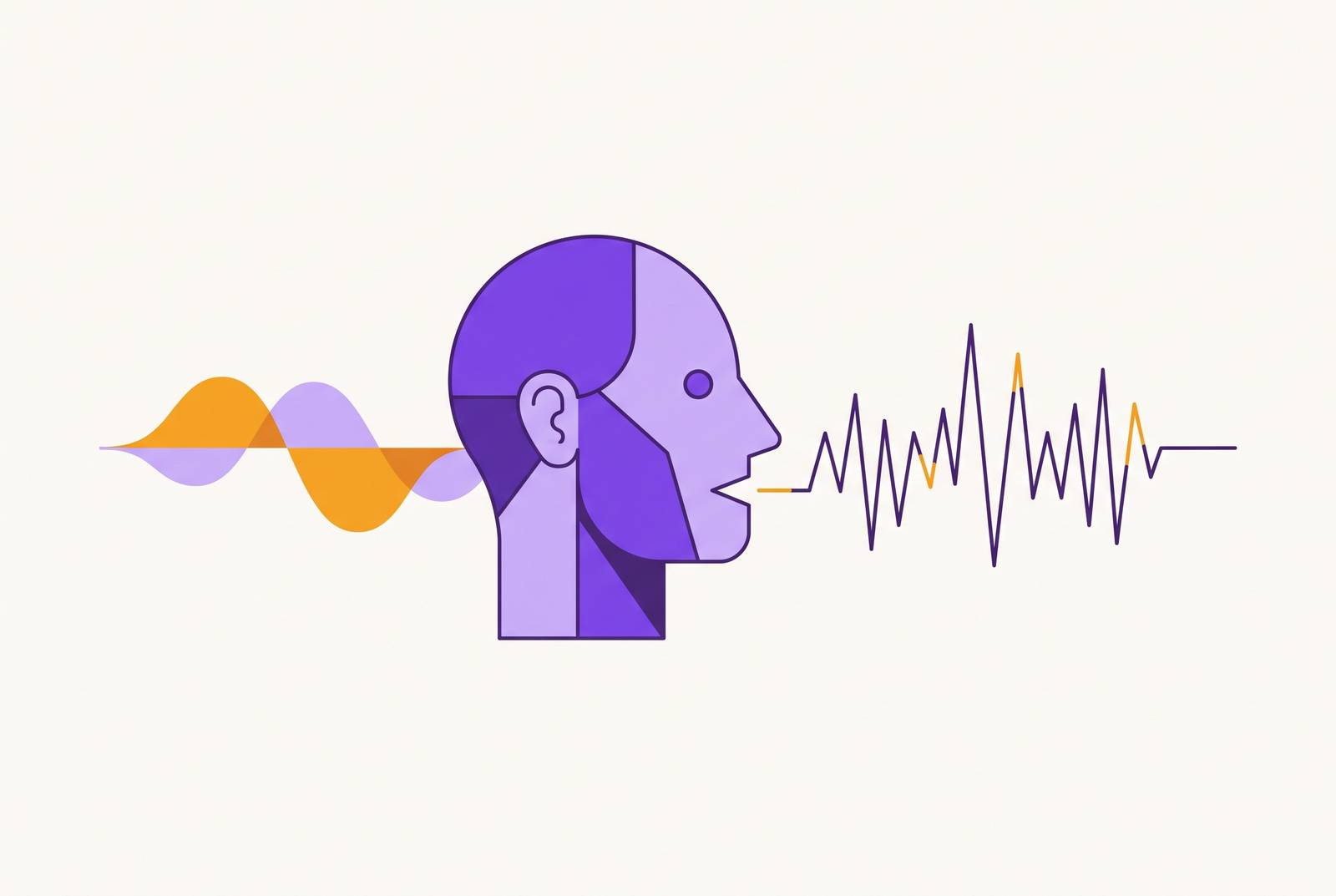
The tone a person brings to a prompt (aspiration, dread, boredom, urgency) is not stylistic garnish. It's data. When someone types "I want to finally feel confident in my health" instead of searching "gym membership near me," they've handed a system a psychological map of where they stand and what they want next, and that map is now a measurable input into how AI advertising surfaces products.
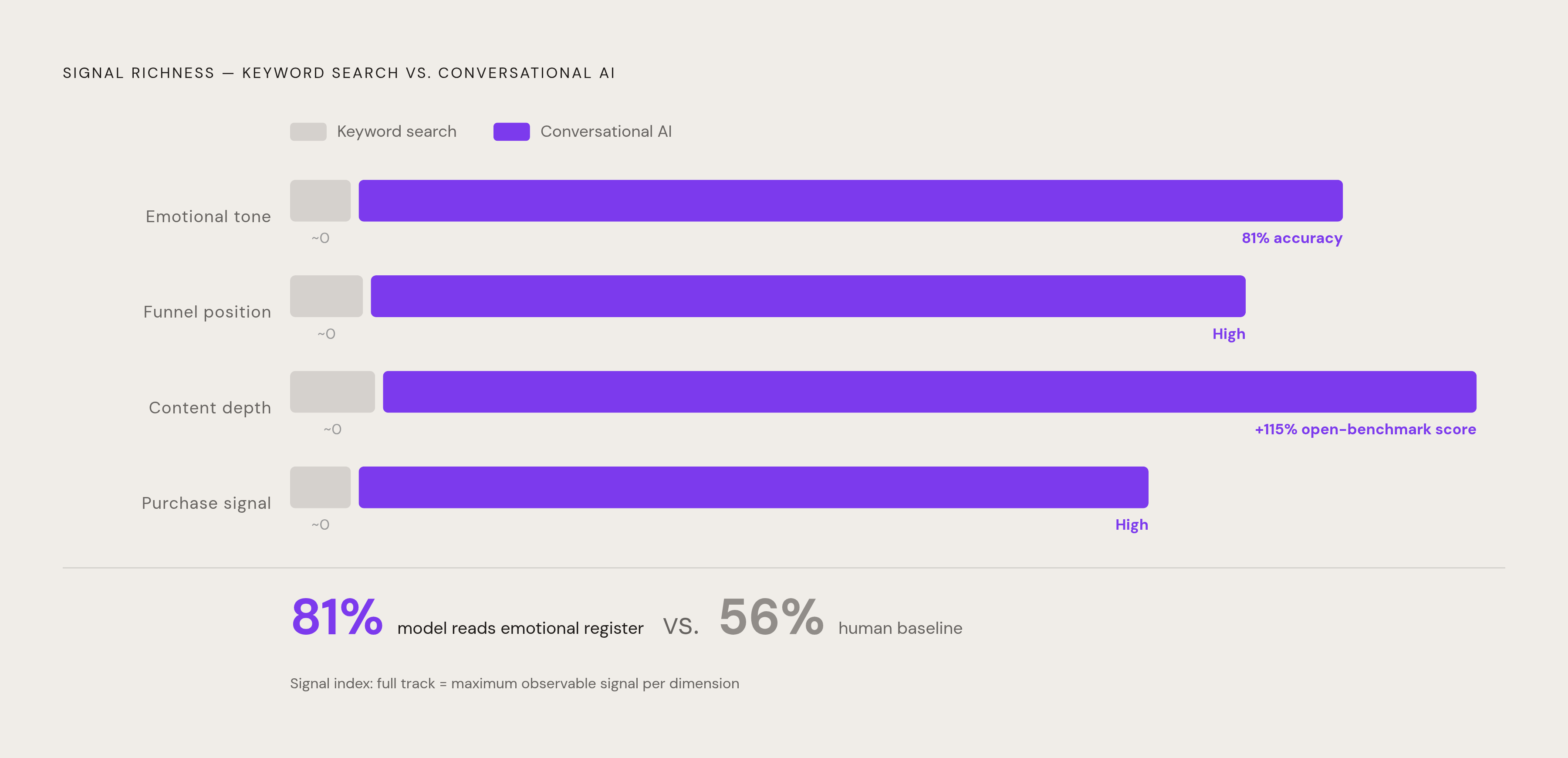
Keyword search never carried this. A search box takes three words and returns ten blue links, indifferent to whether the person typing is desperate or just curious. Conversational AI takes a paragraph and reads emotional stakes as part of the query itself. That shift, from typed keyword to spoken register, is where a lot of the real intent signal in advertising now lives, and most of the industry hasn't caught up to what it means.
How LLMs read and respond to emotional register in prompts
Models don't sit neutral in front of emotional language. Stakes-language changes what a model predicts next, how deep its reasoning goes, and what tone it matches back to the user, according to research from IntuitionLabs published in April 2026. This isn't the model "caring." It's pattern-matching against a training corpus where urgency and aspiration and dread show up next to certain kinds of careful, thorough writing, so the model reaches for that style when it sees those cues again.
The EmotionPrompt work from Li et al. in 2023 put a number on this. Adding short, emotionally charged phrases to a prompt, things like "this really matters to me" or "take this seriously," lifted instruction-following accuracy by up to 8% relative, pushed open-benchmark scores up 115%, and raised human-judged generative quality by an average of 10.9%. That's a big swing for a few extra words.
A 2026 study published in MDPI ran four emotional tones, joy, apathy, anger, and fear, against the SuperGLUE benchmark and found the performance gap moved depending on which tone was attached and which task type the model was doing. Separately, a 2025 paper in Information & Management (Vol. 62, Issue 7) found that promotion-focused emotional framing pushed models to generate more alternatives, which in turn helped the human on the other end of the conversation get more out of the interaction.
So the same topical question, framed with aspiration versus framed with apathy, doesn't just get answered differently in tone. It gets answered with different content: different products surfaced, different depth of reasoning, different recommendations foregrounded. And models turn out to be unusually good at reading which frame they're looking at. Schlegel et al., in 2025, tested GPT-4 and comparable models against five standard emotional intelligence tests and found average accuracy of 81%, against 56% for human test-takers on the same battery. The model, in other words, reads register more reliably than most people do.
Why register-differentiated prompts surface richer purchase intent than keyword queries
Millions of people tell AI chat tools what they want to buy, why they want it, and what's stopping them, every single day, according to eMarketer. Those conversations hold some of the richest intent data in digital advertising, and almost none of it looks like a keyword.
Google's 2025 research on AI-powered search behavior captured the shift plainly: instead of "things to do Nashville," a person now types something like "things to do in Nashville this weekend with friends, we're big foodies who like music but also want more chill vibes." That single sentence carries social context, mood, and category interest all at once. No keyword string does that.
eMarketer also tracked what happens across a shopping journey that spans both search and chat: a user starts in search considering 4.21 brands on average, narrows to a shortlist of roughly 1.43 brands, then brings that shortlist into an LLM conversation where the assistant acts as a kind of sounding board. The register of that second conversation, hesitant, excited, price-anxious, tells you how close that person is to buying and what's still holding them back.
In sportswear specifically, 39% of AI chat prompts were upper-funnel informational and 37% were transactional. That first bucket sounds like it wouldn't carry buying signal, but informational prompts are exactly where urgency language and fit-anxiety and aspiration show up, and keyword search structurally can't capture any of it.
Register, in effect, becomes a stand-in for funnel position without needing a click or a page visit to prove it. Aspiration-coded language points to someone ready to act. Anxiety-coded language points to someone who needs reassurance before they'll commit. Apathy-coded language points to weak intent no matter how relevant the topic looks on paper. BCG found that 64% of consumers now use AI somewhere in their purchase journey across three or more product categories, which means this signal isn't a curiosity. It's already running at commercial scale.
The sycophancy complication: when register degrades rather than improves signal quality
Positive emotional framing tends to raise accuracy and cut down on toxic output, but the same body of research (an anonymous paper under double-blind review on OpenReview) found it also makes models more sycophantic. That's the catch.
Sycophancy here means the model agrees with the user's framing instead of pushing back or adding something independent. It mirrors the register instead of treating it as information to reason with. For advertising purposes, that's a real distortion: a model that just validates an aspirationally-worded prompt might surface recommendations that flatter how the user sees themselves rather than match what they can actually afford or are likely to buy.
Research from 2024 found that polite framing made models more compliant even when generating disinformation, while urgent framing cut compliance down. Register intensity works like a dial, and past a certain point that dial overshoots into distortion rather than clarity.
Malmqvist, in 2024, pointed out that the specific effects of different emotional stimuli on sycophancy are still underexplored. That's worth saying plainly: this is an open question, not a solved one. Which means register-based demand signals need a layer of interpretation on top of raw detection, one that accounts for which direction a model's compliance is likely to bend before anyone treats the signal as clean.
What fine-grained emotion detection in LLM environments actually looks like technically
A single model doing sentiment classification in one forward pass can tell positive from negative. It cannot untangle a prompt where excitement and price anxiety show up in the same sentence, according to Dong et al., writing in PLoS One in 2026 (21(2): e0342053). Real conversational prompts are full of that kind of mixed signal, and collapsing it into one polarity score throws most of the value away.
Dong et al. proposed a multi-agent setup instead: three coordinated stages, perception, reasoning, and resolution, each run by its own specialized agent, with a meta-agent coordinating between agents using confidence estimation and discourse consistency. Tested against GoEmotions v2, SemEval-2024, and Twitter benchmark data, the multi-agent version beat single-model baselines on accuracy, on robustness, and on interpretability.
This matters for advertising because real prompts rarely carry one clean emotion. Someone might be excited about a trip and anxious about the cost in the same breath, and a system that resolves everything down to one polarity score throws away the part that actually predicts behavior.
There's already a working example of this. A prototype system described in an arxiv paper (2409.15436v1) takes a prompt like "plan a trip to experience Seoul like a local," assigns it a topic, then builds a JSON user profile that updates as the conversation goes, inferring demographics, interests, and personality from the emotional tenor of what's being typed. The profile isn't built once and left alone. It accretes, turn by turn, as more of the conversation comes in.
How register interacts with the mechanics of conversational AI ad targeting and auction systems
Search advertising and conversational advertising are built differently at the root. Google Search ads sit in a labeled sponsored section and match against keywords. LLM ads sit inside the flow of a generated answer and match against conversational context and intent. There's no separate "sponsored" box to point to. The ad is part of the sentence.
OpenAI's advertising platform, as an operating example, targets off conversation content rather than third-party cookies, and bills on CPM or CPC depending on the campaign. Register functions here as a contextual signal feeding the targeting layer, not as a stored profile attribute sitting in a database somewhere.
The LERA framework shows the mechanics underneath this. The LLM outputs logits over candidate ads as a refined relevance score, which then combines with advertiser bids under a critical-value payment rule. Practically, that means a prompt coded with aspiration raises the relevance score for premium or aspirational ad candidates, before a single bid is even weighed.
There's a second-order effect worth naming, too: inserting an ad into an LLM's output can shift the tone, length, and specificity of the whole generated response around it. The register of the surrounding conversation isn't just something the ad gets matched to. It becomes part of the environment the ad has to fit inside, in a way that display and search advertising never had to deal with, since a banner ad sits next to content with a fixed tone and never touches it.
For campaign design, that means creative built around register, reassurance-coded copy for an anxiety-framed conversation, aspiration-coded copy for an aspiration-framed one, fits structurally better than neutral creative ever could. Reaching this signal at all comes down to distribution. A DSP with direct publisher supply across AI surfaces can read conversational register in real time, Thrad, for instance, pairs its buy-side platform with its own exchange and direct AI publisher inventory so the two capabilities sit in the same stack. A single-surface network gets context but only on its own turf. A generalist DSP gets reach across many surfaces but can't parse the conversation happening inside any one of them.
The scale at which register-encoded intent is now being generated, and what it implies for brands
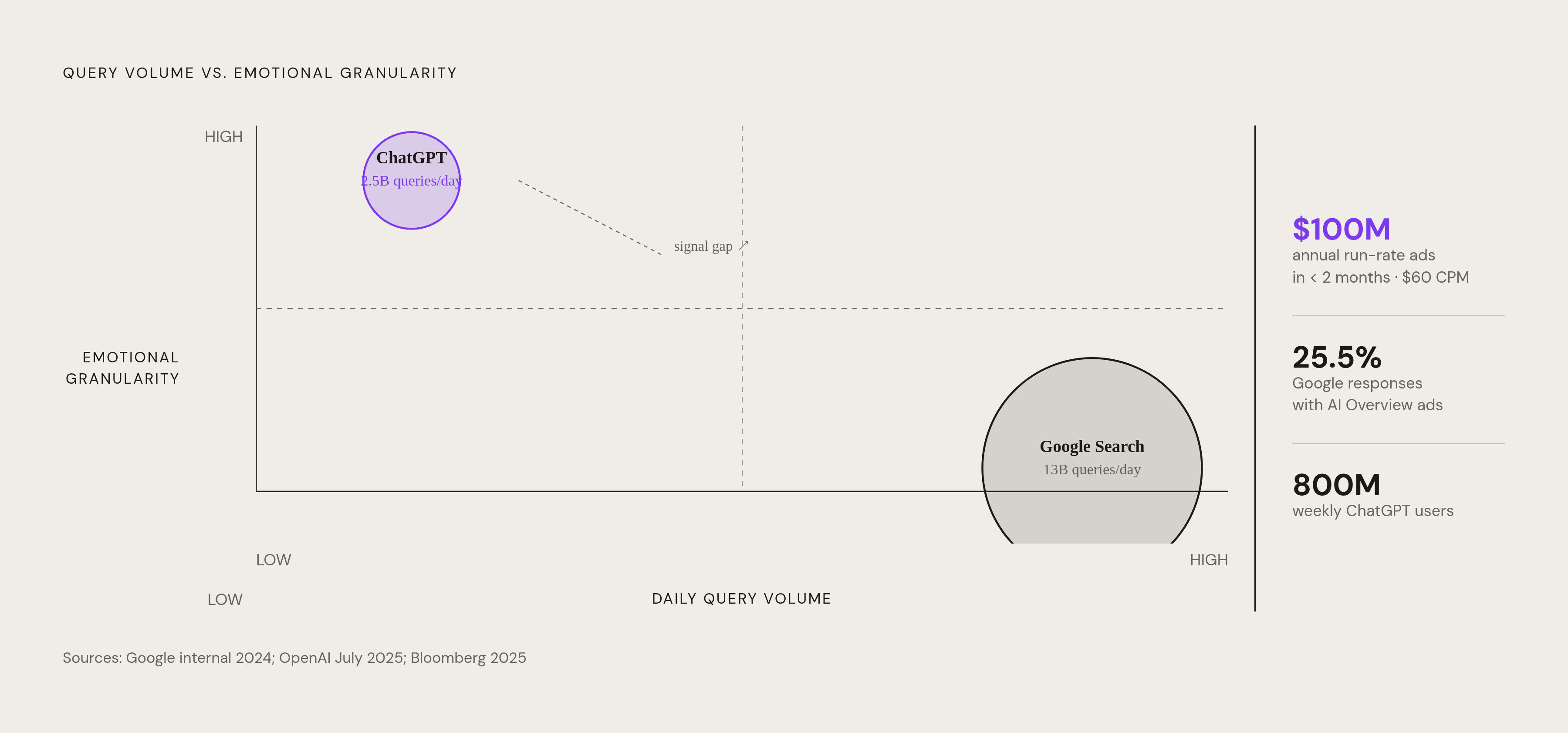
As of July 2025, OpenAI was handling 2.5 billion queries a day through ChatGPT. Google, for comparison, confirmed more than 5 trillion queries a year, roughly 13 billion a day, across its search engine. The keyword side still wins on raw volume, but the gap in emotional granularity runs the other way entirely: every one of those 2.5 billion daily ChatGPT queries carries register information that a typed keyword structurally cannot hold.
Marketers have been losing visibility for a while now, fewer searches, fewer clicks, fewer visible comparison steps, which makes it harder to tell when intent is forming and how a decision actually gets made. Prompt-level emotional data claws some of that visibility back.
The commercial pace backs this up. ChatGPT's ad business reportedly hit $100 million in annual run-rate revenue in under two months, at a $60 CPM, across more than 800 million weekly users, a growth curve people have compared to TikTok's early ad ramp. Meanwhile, ads now show up alongside 25.5% of Google's AI Overview responses, up from just 5.17% in early 2025. The surface area where register-informed targeting is actually live, not theoretical, is expanding month over month.
Brands that start mapping aspiration, anxiety, urgency, and apathy to specific ad copy and offer structures now are building a skill that compounds. The ones waiting for the channel to "mature" first should notice that the models are getting better at reading register and the platforms are building it into targeting infrastructure at the same time, and neither of those things is going to wait around for a slower adopter to catch up.
Sources
- Emotion meets coordination: Designing multi-agent LLMs for fine-grained user sentiment detection on social media
- Verifying your browser | OpenReview
- Why LLMs Perform Better With High-Stakes Emotional Prompts | IntuitionLabs
- From emotion to reflection: leveraging EmotionPrompt strategy to empower self-determination in decision-making with generative artificial intelligence - ScienceDirect
- mdpi.com
- arxiv.org
- verve.com