Conversational AI Advertising Platforms Compared
Platforms trade conversational depth for cross-surface reach in different ways.

Conversational AI advertising platforms let brands place sponsored content directly inside chatbot replies, on surfaces including ChatGPT, Microsoft Copilot, Perplexity, and Google's AI Mode and AI Overviews. These platforms differ from one another in two ways that matter more than total inventory: how deeply each one can read the conversation a user is having, and how many distinct AI surfaces it can actually place ads across. Those two capabilities rarely appear together in the same product, and understanding which one a given platform has is the real work of choosing between them.
Conversational AI advertising as a structurally different category from search and social advertising
Conversational AI advertising is a separate category from search, social, or display, because the context an ad sits inside is built differently from the ground up. A search query is a few words typed into a box, a guess at intent with no history behind it. A conversation inside ChatGPT or Copilot is something else: the user has already explained the problem, named the constraints, and shown how far along they are in deciding what to do about it, often across several back-and-forth turns.
That difference changes what a platform has to work with. An AI ad system reads a conversation state: what the user said, how the assistant answered, what thread is still open, and what goal the user appears to be working toward. That input is far richer than anything you get at the moment someone types a search query.
It also changes the posture of the person seeing the ad. When you scan a page of search results, you compare options that sit side by side. Someone talking to an AI assistant is reading a direct reply from a system they're treating as an advisor, and the ad shows up after that assistant has already given a complete, useful answer, not stacked in competition against it. That sequencing, answer first, sponsored content clearly after, is part of what makes the format distinct, and it's part of why Target's pilot with ChatGPT describes its ads as appearing "separately and distinctly" from the answer itself, serving ads based on keywords in a guest's prompt so that, as the company put it, a guest asking about countertop cooking appliances "may see an ad for an air fryer from a pilot participant embedded in the personalized response."
The structural axis that separates platforms: conversational context depth versus cross-surface reach
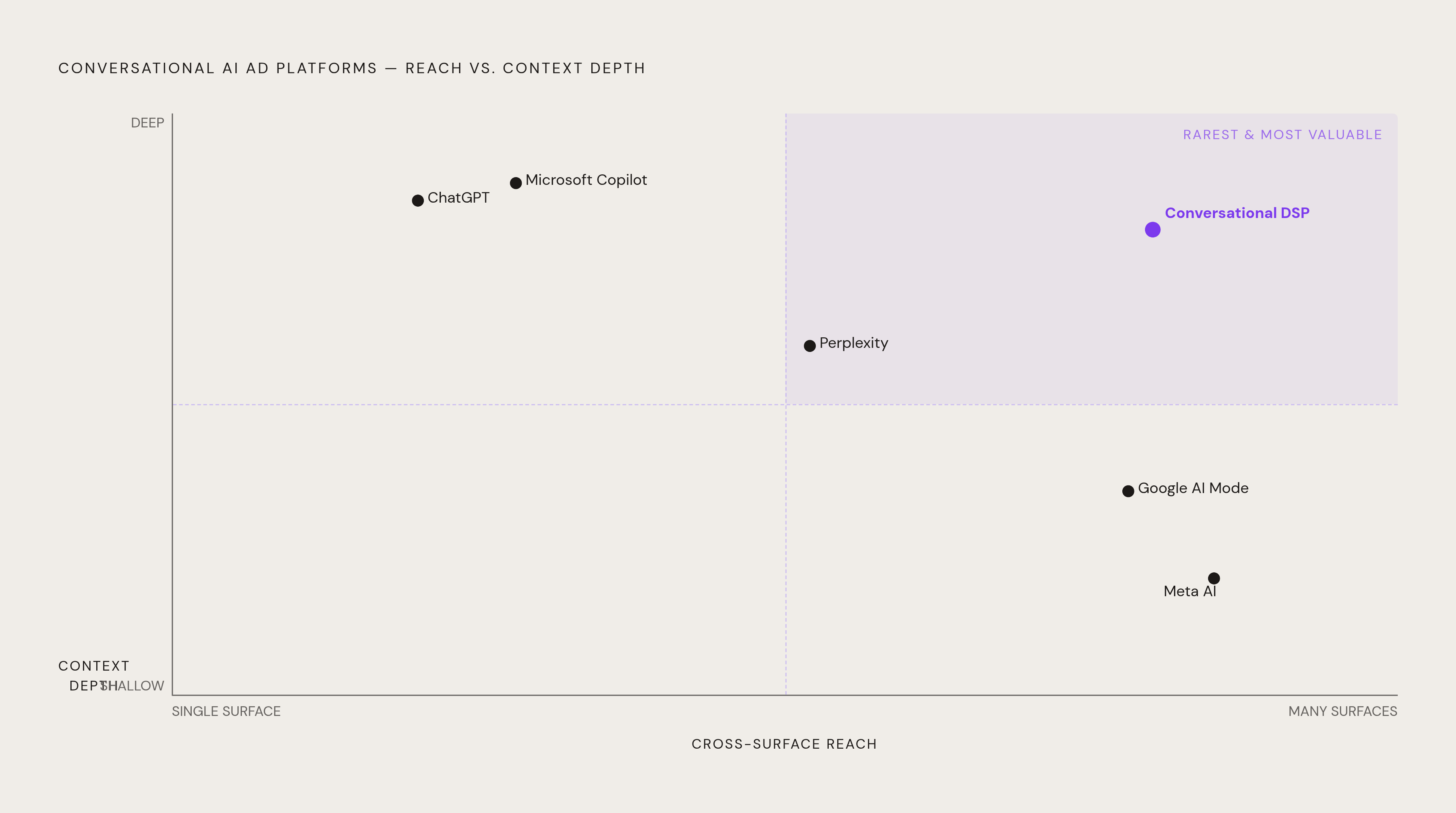
Two dimensions separate platforms in this category, and they rarely move together. The first is context depth: how well a platform can match an ad to an actual conversation state, drawing on the full thread, distinguishing an informational question from a comparative one from a transactional one, and judging how close the user is to a decision. The second is cross-surface reach: how many distinct AI interfaces a platform can actually place ads on, rather than being tied to one product or one publisher.
When a platform is strong on context depth but stuck on a single surface, an advertiser gets precision, not scale. If a generalist demand-side platform spans many surfaces but can't parse conversation state, you get scale, not precision, because it bids on surface-level topic matches the way a display network bids on page category. Neither trade-off is a flaw to be ashamed of. One is a product built for one assistant; the other is infrastructure built to span many.
Some platforms sit deliberately between those two poles. One example is a demand-side platform built specifically for conversational AI interfaces: it reads conversational context in depth, yet still reaches more than one AI surface, so it doesn't have to trade precision for scale or scale for precision. Platforms like Thrad, a programmatic ad infrastructure for AI chat environments that connects advertisers to inventory across multiple LLM-powered apps by matching bids to live conversation context, are built around exactly this structural position. An advertiser needs to know where a platform sits on both dimensions at once, but platform marketing pages rarely say so directly, because most describe reach or precision alone rather than placing themselves on both axes honestly.
How the major AI surfaces have opened to advertising
The access models vary sharply across surfaces, largely because each one has chosen a different way to monetize, and those choices shape who can actually buy, and how.
ChatGPT opened to ads on February 9, 2026, for U.S. users on the Free and ChatGPT Go tiers, so every paid tier stays ad-free. Self-serve access through OpenAI Ads Manager followed on May 5, 2026, with CPC and CPM bidding and a minimum daily budget, after a period when you could get access only through managed relationships or agency and technology partners. Targeting runs on contextual matching, built from the current conversation topic, past chat history where ads personalization is turned on, and prior ad interactions where that setting is also enabled. There's no keyword match type and no Quality Score, the two mechanics that have anchored search bidding for two decades. Major agency partners already working with the platform include Dentsu, Omnicom, Publicis, and WPP, alongside integrations with Adobe, Criteo, Kargo, Pacvue, and StackAdapt. Measurement runs through a tracking pixel for on-site conversions and a Conversions API for server-side attribution, but advertisers see only aggregated performance data; they never see conversation content. OpenAI's own rollout documentation states that "ChatGPT Ads has now launched in the United Kingdom, Mexico, Brazil, Japan, and South Korea," with Mexico and South Korea added in the same wave as the UK, Brazil, and Japan launch rather than as a later expansion. Target's pilot with its Roundel retail media business shows what this looks like in practice: sponsored, contextual, clearly labeled ads from Target and its retail partners appearing alongside shopping conversations, triggered by keywords in a guest's prompt, with Roundel describing the goal as helping brand partners "show up in relevant moments beyond traditional media placements."
Google's AI Mode and AI Overviews work on a different premise entirely: there's no opt-in or opt-out for advertisers. If campaigns already running in Google Search qualify, they just start appearing inside AI-generated answers. That makes it, in practical terms, the surface with the fastest path to access, since any advertiser already running Search campaigns is exposed to it without a separate setup step.
Microsoft Copilot has built a feature it calls "ad voice," a short transitional message that explains why a specific ad is relevant to the conversation before the sponsored content appears. Its contextual ads can draw on the full conversational session rather than just the most recent message, giving it a context window closer to ChatGPT's than to a single-query match.
Perplexity moved early, launching sponsored follow-up questions and ads placed beside an answer in 2024; the company's own announcement described the format as appearing "in the US to start" and formatted "as sponsored follow-up questions and paid media positioned to the side of an answer."
Anthropic's Claude has not launched advertising at all, and the company has said so in explicit terms. Anthropic's own statement said that "including ads in conversations with Claude would be incompatible with what we want Claude to be: a genuinely helpful assistant," and confirmed that "Claude will remain ad-free. It's an argument about incentives, about what a business model built on ad revenue would eventually pull the product toward, regardless of intent.
Meta AI rolled out its advertiser-facing beta to all advertisers and agencies globally in April 2026, though campaign planning and creation tools are still being built out; MediaPost reported the rollout as covering "advertisers and agencies of all sizes across major global markets and languages," which signals breadth of access well ahead of feature maturity.
How targeting works inside a conversational interface
With no keyword layer to bid against, the unit of targeting in conversational AI advertising becomes the conversation state itself, and that single shift changes how a campaign ought to be built from the first step.
A search query is a phrase, usually a handful of words, arriving with no memory of what came before. A multi-turn conversation gives a platform the full thread instead: the question the user opened with, how the assistant answered, what the user clarified next, and what goal seems to be driving the exchange. That's a signal that arrives earlier in the decision process than a search query ever does.
Conversation length itself sorts users by funnel stage. An early-thread message tends to point to a need for basic education. A later-thread question, something like "What's the difference between a Roth IRA and a traditional IRA?" or "How much should someone in their 30s allocate to stocks versus bonds?", signals consideration-stage intent, the point where product-specific messaging stops feeling like an interruption and starts feeling relevant. Bidding strategy built for this environment has to account for that depth directly: not just the topic under discussion, but how far into the exchange the user already is and which intent layer is active at that moment.
The practical consequence is that advertisers who map their targeting to the problems their product solves, rather than to a list of keywords, end up structurally better positioned on these surfaces. Campaigns that simply repurpose search ad copy tend to underperform, because the surrounding context is conversational rather than transactional, so copy written for a results page reads oddly when it's dropped into a dialogue. Conversational context is the actual targeting unit, not a keyword string, so platforms that can read a full thread and tell which intent layer is active, instead of treating each message as a standalone signal, can match ads to decision stage and problem framing rather than settle for surface-level topic matching. A platform able to parse multi-turn context this way is working with a fundamentally better signal than one matching only against a single query or a page topic, and that gap is the entire substance of the context-depth dimension described earlier.
Measurement and attribution limits in AI-mediated advertising
Attribution in this category remains genuinely unsettled, and no platform comparison that skips over this is giving an advertiser the full picture. The tools that exist today are useful, but they don't yet close the loop the way search advertising learned to.
When someone moves from an AI conversation toward an actual purchase, you often can't see that path as the advertiser. A conversational interface doesn't close the loop the way a search-ad click does, and no one yet has a dependable method for tracing a specific prompt to a specific transaction. The data marketers receive is aggregated and modeled probabilistically, with individual-level signal withheld for privacy reasons; advertisers on ChatGPT, for instance, get only aggregated performance data rather than anything tied to a single conversation.
The infrastructure that does exist helps with part of the problem. ChatGPT's tracking pixel and Conversions API can track server-side, post-click actions, which helps, but it only covers what happens after the click. It says nothing about the influence a conversation had on a purchase that happened somewhere else, days later, through a different channel. Conversational signals and search signals are complementary: search data shows where a consumer sits in the funnel, conversational data shows how they got there and what's shaping their consideration, and zero-party data captures what they've declared. None of these three, alone, produces the full picture.
The practical consequence for anyone evaluating these platforms: last-click attribution will undervalue conversational AI ads that assist a purchase without being the final touch before it. Branded search lift and CRM pipeline data become necessary complements to whatever a platform reports natively, not optional extras. A measurement approach that combines platform reporting, CRM data, and branded search trends holds up better than relying on any single source, so if a team cuts a channel because the platform dashboard shows zero direct conversions, it risks removing an upper-funnel assist that was actually working.
The compliance exposure regulated industries face on every AI surface
For advertisers in healthcare, financial services, and similarly regulated categories, the surface and targeting approach chosen carries legal exposure that doesn't exist in the same form on legacy channels, and that exposure belongs in the platform-selection decision itself, not as an afterthought.
In healthcare, ads shouldn't reference personal health conditions or use specific patient testimonials without proper consent, and if tracking technology captures protected health information and passes it to a non-compliant platform, that can trigger a HIPAA violation. The risk here is structural rather than creative: if a platform's contextual targeting draws on health-related signals that surface inside an AI response, the advertiser can end up exposed regardless of how careful their own creative was.
In financial services, the sharper risk is hallucination. AI systems can generate promissory language about returns or guarantees that violates FINRA rules even when the advertiser's own approved creative never contained anything like that language. An ad placed next to a hallucinated claim about a financial product exposes the brand attached to it, even when that ad, taken on its own, is fully compliant. Search advertising never had to account for this liability, because a static search result can't generate new promissory claims on the fly the way a language model can.
Brand safety in AI environments and legacy pre-bid filters
Keyword-based brand safety tools were built for a world of static pages and explicit or violent language, so they don't hold up in conversational AI environments, because the content that creates brand risk here is generated in ordinary prose, not in anything a blocklist was built to catch.
An AI-generated response can describe a competitor's product as superior, or a brand's own product as lesser, through subtle comparative framing, calling something "less exciting" or "offering lower upside," without a single flagged keyword appearing anywhere in the text. The risk appears in context rather than in specific words, so no list of banned terms will catch a sentence built entirely out of ordinary, unflagged words.
An ad no longer sits next to static publisher content that can be reviewed once and cleared. It sits next to dynamically generated text that can change with every conversation, so pre-bid blocking against a fixed content category can't anticipate what a model will generate in any given exchange. That's a different kind of brand safety problem from the one display and search advertising spent two decades solving, and it's one more reason platform selection in this category has to account for how a platform monitors generated content in real time, not just which keywords it refuses to bid against.