What Conversational AI Advertising Actually Is
Separating true conversational AI ads from three unrelated concepts costing marketers real money.

Conversational AI advertising is being named before anyone has settled what it is, and the confusion is costing marketers and engineers real money, not just clean terminology. A media buyer allocating budget and an engineer building a targeting stack are making structurally different decisions depending on which of several unrelated things they believe they are building toward. The channel arrived in a matter of months: ChatGPT launched ads in February 2026, Google and Microsoft were already serving ads through their existing campaign systems, and Amazon made Rufus ad placements generally available in March 2026. Three older ideas keep getting pulled into this new frame by mistake: chatbots built to sell things (a concept that goes back to 2016 under the label "conversational marketing"), AI tools that generate ad creative, and search ads that appear next to or around an AI-generated summary. Each of those three implies a different technical stack, a different way of measuring success, and a different competitive position, so treating them as interchangeable with the real channel leads directly to misfiled budgets and misread results.
Placement inside live dialogue, matched to conversational intent
Conversational AI advertising is the placement of a paid, clearly labeled commercial unit inside an AI assistant's response environment, where what triggers the ad is not a keyword and not a stored user profile but the meaning of the conversation happening right now. That targeting mechanism is the sharpest break from legacy digital advertising. No keyword layer exists. The main control available to an advertiser is a natural-language context hint, capped at 280 characters, matched against the live conversation through a relevance-weighted second-price auction that reads the hint alongside the ad copy and the landing page together.
The reason a conversation carries a stronger intent signal than a search query comes down to structure, not sophistication. A conversation tends to contain the budget a person has in mind, the constraint they're working around, the shortlist they've narrowed to, and what they've already ruled out, none of which a three-word search query can hold. Targeting systems built for this channel track the full dialogue across multiple turns, so a follow-up question gets understood in relation to everything said before it. The conversation itself, not any single message in it, becomes the signal the auction reads.
A user might spend an entire exchange describing team coordination problems and never type the words "project management software," yet a well-written context hint can surface a relevant ad at exactly that point in the conversation, without the product category ever being named.
The ad itself sits next to the assistant's answer, not inside it. A ChatGPT ad renders as a labeled sponsored card below the assistant's response, never stitched into the response text, and that separation is a deliberate design choice rather than an accident of layout. Every major deployment seen so far in this first generation of the channel shares that restraint: a visible, labeled boundary between the commercial unit and the organic answer. That boundary also carries a privacy property that will matter later when the channel is compared to its impostors. Relevance comes from the conversation happening in the moment, apart from a persistent user identifier or a history of browsing pulled in from elsewhere.
What it is not: the chatbot-that-sells confusion
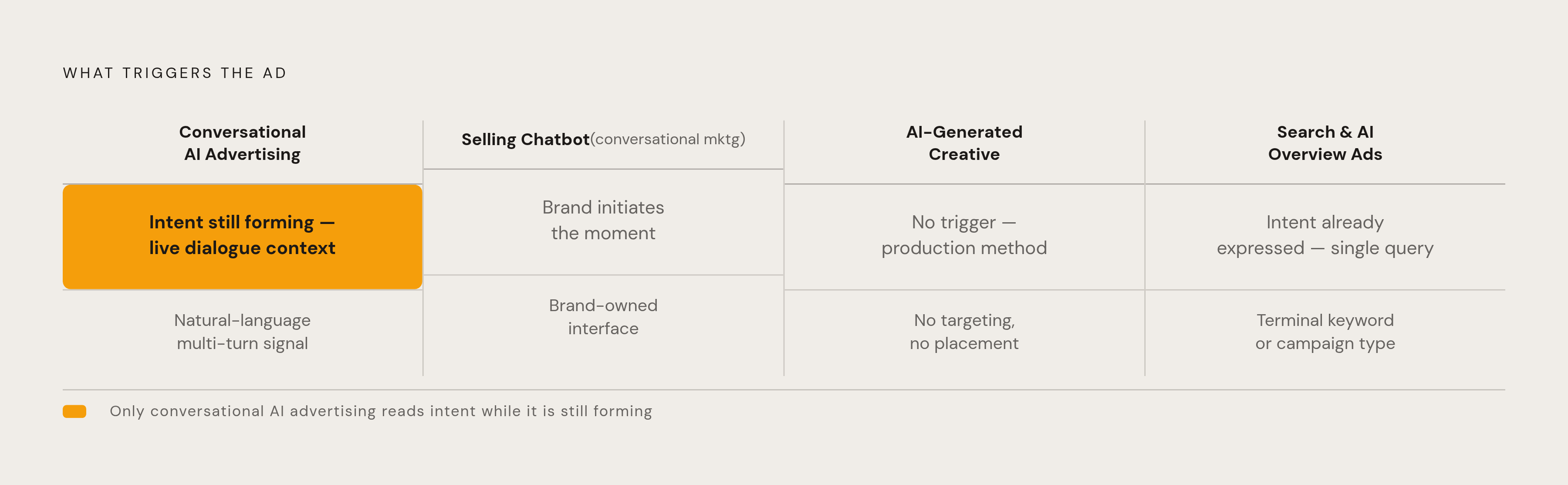
A chatbot built to walk someone through a purchase, answer product questions, or win back an abandoned cart is a sales automation tool, and calling it an advertising channel puts the commercial moment in the wrong place entirely. Who starts the commercial conversation in the first place determines the difference. With a selling chatbot, the brand owns the interface and writes the dialogue to push toward a transaction. With conversational AI advertising, the user is talking to a third-party assistant for their own reasons, and the ad appears as a labeled unit matched to whatever that conversation turns out to be about.
The mix-up has a clear historical root. The phrase "conversational marketing" entered common use around 2010 to describe exactly this kind of chatbot-led sales flow, and the word "conversational" simply carried over into descriptions of the newer ad channel even though the underlying setup has little in common with it. And the privacy property described above, relevance drawn from the live conversation rather than a stored identity, belongs to the advertising channel specifically. A brand-owned chatbot that already knows a customer's account history is working from an entirely different data foundation.
What it is not: the AI-generated creative confusion
Using an AI tool to write ad copy, generate images, or produce personalized variants is a decision about how an ad gets made, and it says nothing about where that ad ends up running or how it gets matched to a viewer. An AI-generated banner running in a social feed is not conversational AI advertising. A hand-written text ad matched to a live ChatGPT conversation counts too, because the channel is defined by placement and targeting, not by whether a machine or a copywriter drafted the words.
The two ideas get lumped together mostly because both carry the word "AI" and both are pulling in marketing budget at the same time, which makes it tempting to file them under a single "AI advertising" line on a plan that is actually funding two unconnected activities. The mix-up has a real operational cost. Creative production tools are built to improve the quality and speed of the ad artifact itself. Conversational AI advertising depends instead on the quality of the context match, and teams that write their context hints as a comma-separated list of topics, the way one might write keywords for a search campaign, get poor matching results, a failure that has nothing to do with how polished the creative looks.
An ad placed around or beneath an AI-generated summary of search results is still running on search logic underneath. The auction fires on a query, the targeting runs on keywords or campaign type, and the intent signal is a single search prompt rather than a conversation that develops over several turns. This confusion happens because both use the word "AI" and both are currently attracting marketing budget, making them easy to lump into a single "AI advertising" line item on a plan that is actually funding two unrelated things.
Google's AI Overviews and AI Mode monetize through a brand's existing Search, Shopping, and Performance Max campaigns, with no separate opt-in or opt-out available to the advertiser, and by May 2026 AI Overviews were triggering on roughly 48% of all tracked search queries. Microsoft Copilot works the same way, serving ads through campaigns already eligible in an advertiser's existing Microsoft Advertising account, with the added capability of generating new creative assets on its own.
Perplexity's experience shows what happens when a platform blurs that line on purpose rather than by default. Perplexity launched sponsored answers in 2024, then wound the program down, with its leadership citing the risk that a sponsored placement makes users suspicious of the entire answer surrounding it. An answer engine runs on a different trust architecture than a search results page, and treating the two as the same thing damaged the product badly enough to reverse course. For marketers, that points to two separate jobs that are currently being treated as one. Auditing existing Google and Microsoft campaigns for automatic AI placement exposure, which cannot be opted out of, is a different task from building a deliberate strategy for placing ads inside genuinely conversational AI surfaces, and a team handling both as a single effort ends up managing neither well.
The structural property that separates the real channel: reading intent as it forms
What separates the real channel from all three impostors is the targeting mechanism's access to intent while that intent is still being expressed, before it has hardened into a decision. The channel is defined by a targeting model that matches ads to the meaning of a conversation as it develops, catching the user at the point where they're still forming what they want and haven't yet committed to a brand or even a product category. Conversational intent signals surface earlier in the purchase journey than search intent does. Someone asking an AI assistant for product recommendations is typically still exploring, well before they've settled on a brand or category.
The vocabulary people use in these conversations, before they've committed to anything, reveals a consumer segment while it's still forming, giving a brand that can read those shifts in language access to a market before competitors even know it exists. A single conversation with an AI assistant can carry signals about preferences, constraints, past rejections, and situational needs that go well beyond what a traditional search query ever holds.
Laid against the three confusions cleared earlier, the contrast is direct. A selling chatbot reads intent inside a brand-owned interaction the user didn't choose to enter. AI-generated creative has no targeting model attached to it. Search ads sitting around an AI summary are reading a terminal query, a decision already made, rather than a conversation still being formed.
None of this should be mistaken for a solved measurement problem. A user can ask several follow-up questions inside an AI conversation, leave without clicking anything, and convert somewhere else days later. Last-click attribution models undercount that path consistently, and the measurement infrastructure built for search and social has not caught up to a targeting model built around forming intent rather than finished intent.
How brands should approach the channel
Getting this definition right changes three decisions a brand has to make, not just the vocabulary used to describe them. It changes where the channel sits on a media plan, since it is neither a search extension nor a social placement format. It changes how targeting gets built, since writing a context hint is a different skill than writing a keyword list or defining an audience segment. And it changes what gets measured, since last-click attribution will undercount conversions that start inside a conversation and finish somewhere else entirely.
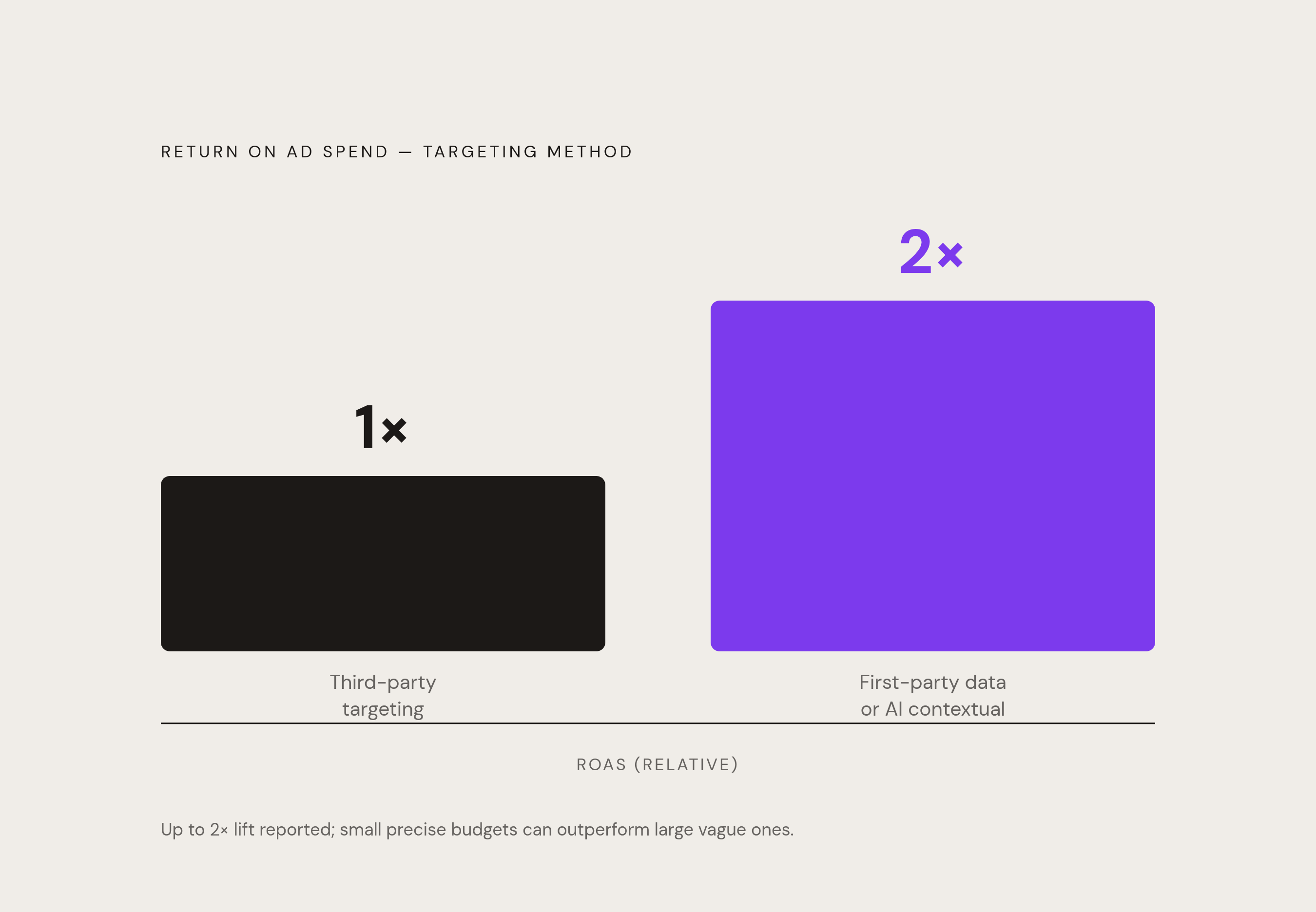
Writing context hints well is the single highest-leverage skill in this channel, and the gap it creates is unusually large for paid media. Advertisers using first-party data or AI-based contextual targeting can see up to 2X higher return on ad spend than advertisers relying on third-party targeting methods. A precise advertiser running a small budget can outcompete a vague advertiser running a large one, which is not how most paid media channels work once they mature, and it is a gap worth exploiting while the discipline around context hints is still new to most teams.
Brands that route spend into AI placements through their existing Google or Microsoft campaigns, without building a separate strategy for genuinely conversational surfaces, are buying search exposure delivered through a new interface. Both that spend and a deliberate conversational strategy have value, but they are not the same investment and shouldn't be budgeted as though they were.
Perplexity's retreat from sponsored answers raises a trust issue that is not a side issue. It goes to whether commercial influence inside a generative system can be made attributable, measurable, contestable, and aligned with what the user actually came there to do. A brand that treats disclosure and labeling as a compliance checkbox rather than a structural requirement is setting up the same kind of trust erosion that ended Perplexity's ad program.
The category is young enough that its own definition is still being argued out in public, and the brands willing to engage with the channel on its own terms, with its own targeting discipline and its own honest accounting of what attribution can and can't yet show, are the ones building operational knowledge now that will keep paying off as the channel grows.