Clickstream Data vs. Prompt Data for Purchase Path Analysis
Prompt data captures purchase intent before the first click, revealing why customers buy.
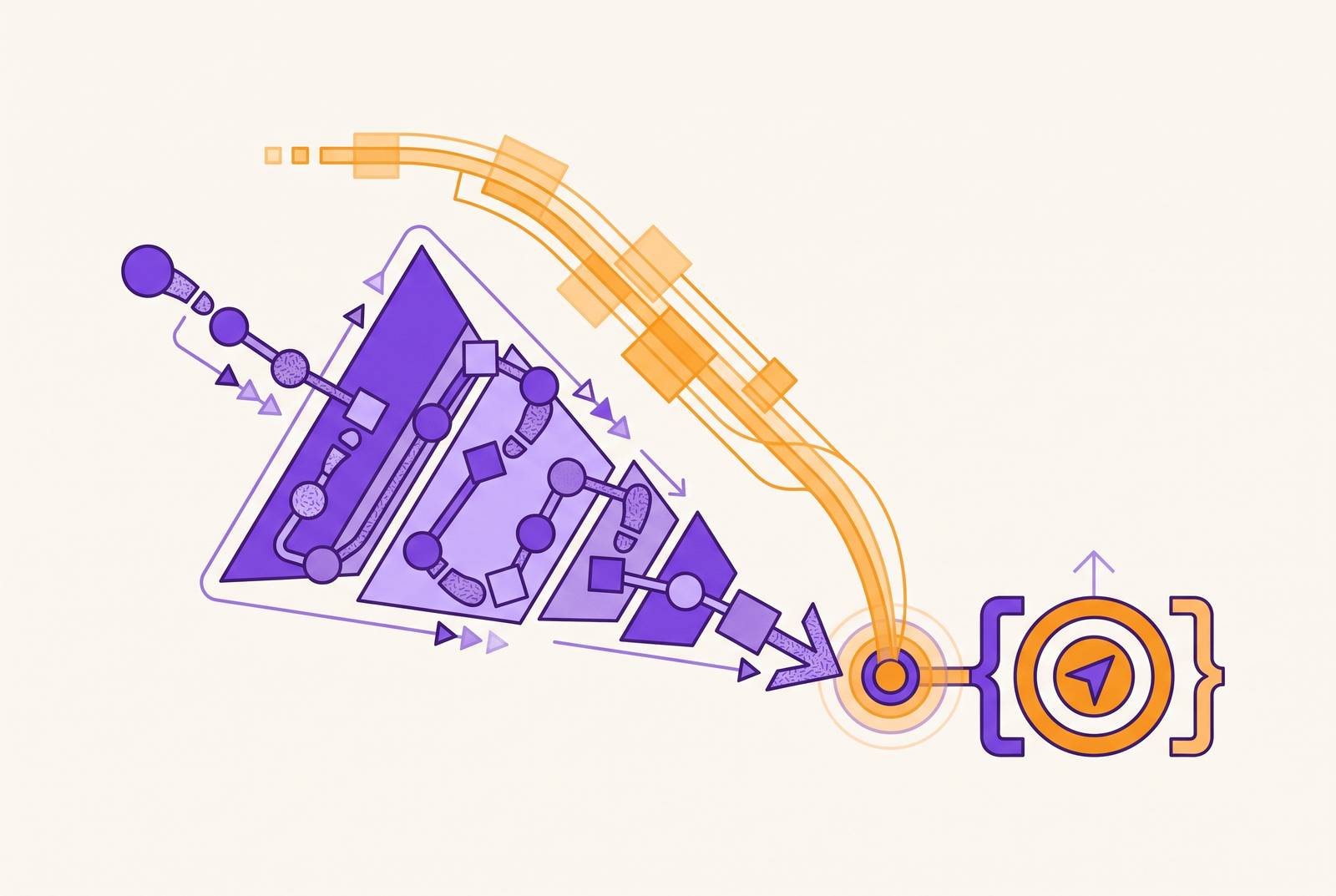
Purchase path analysis has always meant reconstructing what a customer did after the fact, piecing together clicks and page visits into something that looks like a story. Prompt data breaks that model: it captures intent as a user states it, before a single click occurs, and that distinction changes what marketers can actually know about why someone buys.
What clickstream data captures and what it cannot
Clickstream is a full behavioral record of what happened on a site: page URLs in the order visited, timestamps, referrer data, session identifiers, scroll depth, cart additions and removals, the exact point where a user exits. It logs actions, not the reasons behind them, and that single gap explains most of what clickstream cannot do.
The logic analysts build on top of this record is inferential. Because a purchase path encodes a sequence of events, the common practice is to work backward from a conversion and treat the path leading up to it as evidence of intent. The sequence itself is verifiable. What it meant to the person generating it has to be guessed.
Within that limit, clickstream does real work. It exposes friction with precision: a shopper who returns to the same product page three times without adding it to a cart, or who abandons checkout at the shipping-cost screen, leaves a trace that analysts can act on directly. It supports funnel optimization by showing which page categories lose the most users and at what step. And it enables behavioral segmentation that beats demographic guesswork: a user who lingers on product reviews or keeps revisiting a high-ticket item is showing purchase readiness that a simple age-and-location profile would miss.
The ceiling appears the moment you ask why. Clickstream can tell you a user moved from a landing page to a product detail page and then left. It cannot tell you whether that person was comparing prices, weighing two competing brands, or just not ready to decide that day. A study on consumer research found that the sequence of page categories alone leaves out what customers are actually doing during each individual view: two shoppers visiting the identical pages in the identical order can carry meaningfully different purchase tendencies depending on what happened within each page, something the click log never records. A May 2026 study in the International Journal of Engineering Research & Technology applied LightGBM, Random Forest, and Decision Tree models to real-world e-commerce clickstream data, improving purchase prediction accuracy over earlier methods. But the input feeding those models was still behavioral sequence. The models got better at pattern-matching actions, but they did not gain access to stated reasons, because clickstream never contained any.
How the purchase path has moved upstream of the first click
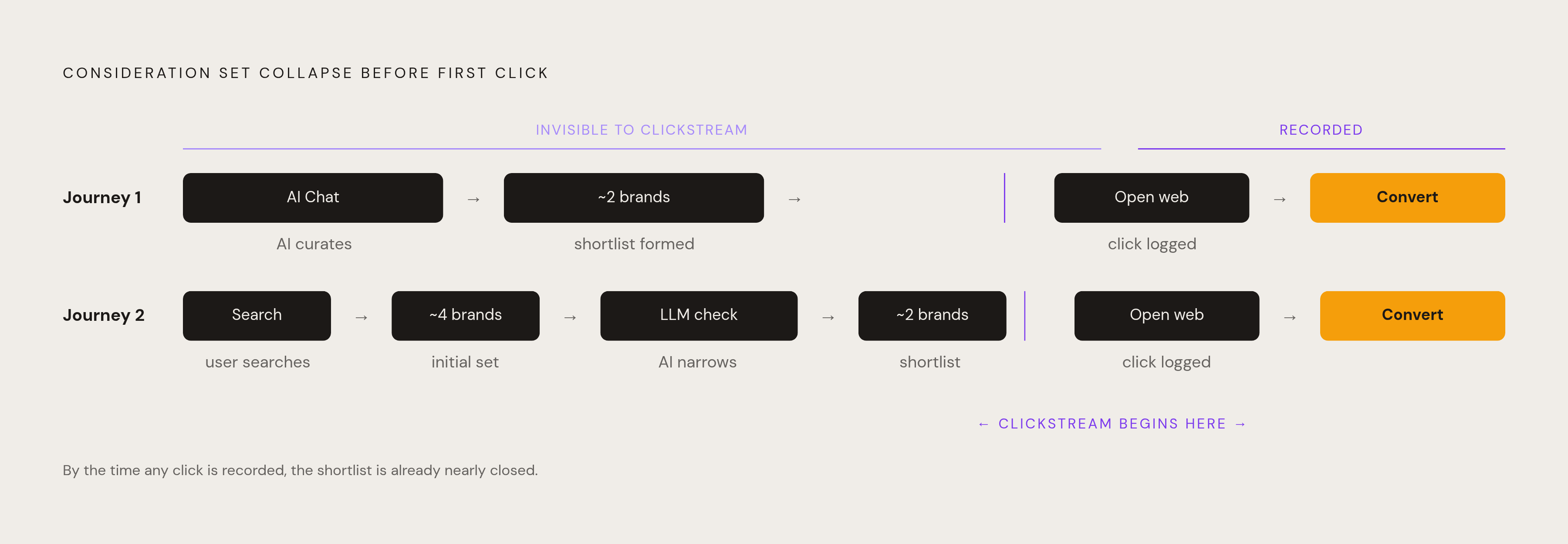
A growing share of consumers now start their purchase consideration inside an AI chat window, well before they open a search engine or land on a brand's site. That means the earliest, most formative part of the decision happens on a surface no click-based system can see.
Verve's 2026 analysis of more than a billion daily signals finds that the pre-purchase digital journey begins with AI chat for more than one in five users overall, and for more than a third of travel-related queries specifically. These early conversations tend to be unbranded. A consumer exploring a category is still working out the shape of the decision itself, what to even consider, what constraints matter, long before any vendor's name enters the exchange.
The consideration set narrows fast after that. A user who starts in chat arrives at the open web with roughly two brands already in mind, narrowing further from there. If a user starts in a search engine instead, they weigh roughly four brands before carrying a shorter shortlist into an LLM for a final check. Either way, by the time a brand-attributed click gets logged, much of the real decision has already happened somewhere the clickstream record never touches.
This produces what might be called the conversation gap in attribution. A user asks several follow-up questions inside a chat session, leaves without clicking on anything a platform can attribute, and then converts days later through a direct visit or a branded search. So last-click and multi-touch models built entirely on clickstream miss the one channel that shaped the outcome. Because these early AI conversations happen before any click is recorded, traditional clickstream-based attribution cannot see them, and this is precisely why platforms built specifically for conversational AI can access and act on prompt data in real time, capturing purchase intent at the moment it forms rather than reconstructing it from page sequences after the fact. Some infrastructure layers are designed to operate at exactly this upstream stage, placing programmatic ads inside AI chat interfaces by reading live conversational context.
What prompt data reveals that behavioral logs structurally cannot
A single prompt can carry intent, constraints, preferences, and a sense of where the user stands in the decision process, all at once, in a way no sequence of page visits can be made to yield after the fact. A conversation builds a trajectory that a click log simply has no place to record.
Consider a user who starts by asking how to begin running, mentions past trouble finding comfortable shoes, specifies the surfaces and terrain involved, names a budget ceiling, and finally asks for a recommendation. No keyword search captures that accumulation of context, and no click sequence reconstructs it either, because the reasoning behind each step was never translated into an action a tracking script could log. The value of a prompt isn't that it produces more data points than a click. Each prompt is a denser unit of evidence: it expresses the user's own reasoning, not just where the user happened to move next.
That density opens up analysis clickstream was never built to do. A single exchange can reveal what stage of the decision a user is in, without needing weeks of multi-session browsing history to infer the same thing statistically. It can surface hard constraints, a budget limit, a physical restriction, a location requirement, that a page visit sequence would never record, because those constraints live in language, not navigation. It lets an analyst read the actual frame of comparison: what categories or alternatives the user is weighing.
None of this is evenly accessible yet. Advertisers don't have the same visibility into, or control over, how conversational signals translate into ad placement that they've built up over two decades of clickstream tooling. Reporting infrastructure for prompt-based signal is still young by comparison, and that unevenness shapes a lot of what follows.
Brands Absent When the Consideration Set Forms in Chat
If a brand never appears inside the AI answer layer, it loses the sale before a single click gets recorded, because the shortlist a consumer carries onto the open web has already been curated down to almost nothing. The curation itself, not any failure downstream, is what decides the outcome.
The mechanism is the same collapse described above, viewed from the brand's side. A user starting in chat reaches the open web holding roughly two brands in mind. A user starting in search narrows an initial four down to a shortlist before handing it to an LLM for a final pass. Either path puts the AI surface in the role of active curator, not passive listing service, so a brand's presence or absence inside that curation step matters more now than its spot on page one of a search results list ever did.
The retailer that completes the transaction still captures the sale and the clickstream data describing it, but gets no visibility into what actually shaped the shopper's shortlist, because that reasoning happened somewhere upstream and invisible to the retailer's own analytics. Anudit Vikram, Chief Product and Technology Officer at Channel Factory, argues that the monetizable unit in this environment shifts away from pages and impressions toward intents, tasks, and decision moments formed inside conversations themselves; the performance event that matters becomes being recommended, shortlisted, chosen, or purchased, not click-through rate. That reframes what a purchase path model is even measuring. A model built entirely on clickstream is analyzing the second half of a journey and presenting it as the whole thing.
A related shift compounds the problem. Large language models increasingly synthesize answers directly rather than linking out to source pages, so the referral traffic publishers relied on, and that clickstream analytics depended on to trace the early journey, is thinning out as users get their questions answered without ever leaving the chat window.
How the Major AI Surfaces Handle Advertising
No two AI surfaces that have opened to advertising have made the same trade-off between signal quality, advertiser control, and how inventory gets structured, and these differences decide what purchase-path insight a buyer can actually get on any given platform.
Google built AI Overviews and AI Mode to keep its ad auction inside the LLM-augmented search results page, so no separate conversational channel can form elsewhere. Ads now show up alongside a substantial share of AI Overview responses, a share that grew sharply between early 2025 and mid-2026, and once a campaign becomes eligible for placement, advertisers get no opt-in or opt-out.
Microsoft's Copilot targets ads using the entire session's context, not just the most recent query, and that makes it the closest thing currently running to true conversational context matching. Microsoft has reported stronger click-through and conversion rates from this approach than from traditional search ad placements.
Perplexity moved the opposite way and wound its ad program down after it told the Financial Times that sponsored placement risks making users suspicious of an entire answer, not just the sponsored part of it. Its original format had Perplexity's own AI answer sponsored follow-up questions instead of the brand doing it directly, so brands had no control over how their message actually got delivered.
Meta has taken the broadest approach to data collection. Since December 2025, every conversation with Meta AI across WhatsApp, Messenger, Facebook, and Instagram feeds into advertising profiles, with no opt-out for most users globally; only users in the EU, UK, and South Korea are exempt. That affects more than a billion users and makes it the largest conversational dataset currently being applied to ad targeting anywhere, though it stays within a closed ecosystem and no conversational ad format has been announced on top of it yet.
Dappier has taken a publisher-side approach instead of a platform-side one: it announced a format called Sponsored Conversations that lets advertisers insert a custom brand agent directly into AI chat sessions running on publisher sites. The richness of a prompt, intent, constraints, decision stage, consideration frame, is exactly the signal that contextual ad placement inside AI conversations depends on, and real-time prompt analysis infrastructure built for that purpose is designed to read that same depth of conversational context that makes prompt data so much more precise than clickstream for understanding where a buyer actually stands. Taken together, these five approaches show a landscape with no shared standard: a marketer trying to read conversational intent has to contend with a different rulebook on every surface.
Why a cross-surface buying layer matters
No single AI surface sees the whole purchase path, so reading conversational intent at any meaningful scale requires infrastructure that can operate across surfaces at once rather than inside just one of them.
A mismatch in capability creates the structural problem. Generalist demand-side platforms can reach a wide range of surfaces, but they match against pages, keywords, or user profiles, not against the live intent sitting inside an actual prompt. AI ad networks built for a single surface can read that conversational context closely, but only within the one environment they were built for, with no reach beyond it. Neither type of platform, on its own, gives a marketer what prompt-based purchase path analysis actually calls for: context depth and cross-surface reach at the same time.
The conversation gap in attribution described earlier hasn't been fully closed by any platform operating today. If a user asks several follow-up questions, leaves a chat session without a trackable click, and converts later through a direct visit, they still go largely undercounted in any attribution model built on clickstream alone. Building an honest picture of the purchase path in this environment means combining prompt-level signal with downstream clickstream data, rather than treating either one as a complete account by itself.
Pressure is also building from the publisher side. A coalition of UK publishers, including the BBC, Financial Times, Guardian, Sky News, and Telegraph Media Group, is pushing for clearer standards on how AI platforms use publisher content to generate answers. Whatever transparency and attribution framework eventually comes out of that effort will shape how much conversational context signal buyers can actually get access to, and under what terms.
For marketers doing this work now, clickstream hasn't stopped mattering. It remains the clearest record of the downstream, on-site part of the journey, still the best tool for spotting friction, mapping funnel shape, and understanding conversion behavior once a user has landed somewhere trackable. But it needs to be read next to prompt-level signal from the upstream stage, where the consideration set actually forms, if the goal is to model the full path rather than just the half of it that happens to leave a clickable trace.