CPM vs. Cost-per-Conversation Pricing in AI Ad Channels
AI conversations reveal intent CPM was built to hide.
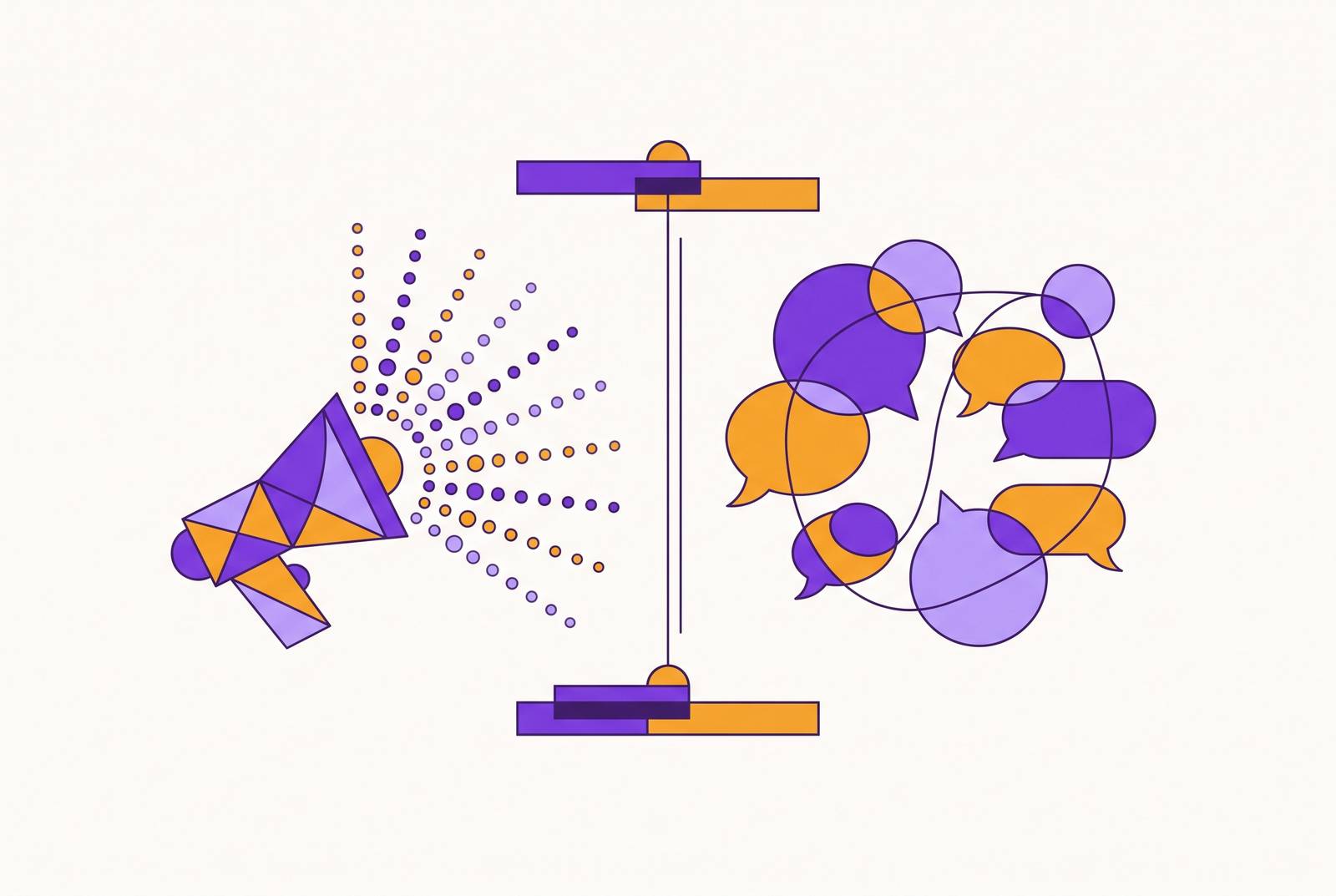
CPM was built to price exposure, not attention. It charges for a thousand ad loads on a screen, whether or not the person behind that screen ever looked up. That logic held up fine for banners, feed slots, and static pages, but it falls apart inside an AI conversation, where every exchange is a live, one-off thread built around something a user actually wants to know right now. Cost-per-conversation, not cost-per-thousand, is where AI ad pricing is headed. The industry just hasn't built the meter for it yet, and the platforms charging CPM rates for conversational inventory are pricing the wrong thing.
CPM assumes a static surface, such as a webpage sitting still, a feed slot cycling through content, or a banner waiting in the corner. It assumes a passive user scrolling rather than someone mid-thought. Under that model, attention accumulates through repetition. Show the ad enough times and awareness builds on its own, even when no single impression registers by itself. The publisher's job is to deliver eyeballs. The advertiser's job is to convert those eyeballs later, downstream, through retargeting or a landing page or a follow-up email.
Impressions have always stood in as a proxy, an "opportunity to see," not proof anyone actually saw anything. That trade-off makes sense in high-traffic environments where scale is the point: brand awareness campaigns, reach-first buys, static inventory sold in bulk. CPM does what it was built to do there. The trouble starts once that same pricing logic gets applied somewhere the underlying behavior doesn't match the assumptions baked into the unit, and a chat window is exactly that kind of place.
What an AI conversation is as an ad environment
A conversation with an AI system is active, temporary, and specific to that one exchange, a thread shaped entirely by whatever the user just typed and whatever came before it in that same session. There's no persistent surface to revisit, no feed to idly refresh. The user isn't browsing. The user is asking something, reading the answer, and often refining the question based on what came back.
A prompt reveals that difference in what it exposes about intent. A page visit tells you someone landed somewhere. A keyword tells you someone typed a phrase into a search box. A prompt tells you what someone actually wants, in their own words, often with the constraints attached. Ask an AI assistant to help plan a trip: the thread surfaces budget, dates, number of travelers, and preferences, all volunteered, all in context. That's stated intent, not inferred interest, and multi-turn conversations only sharpen it as the exchange continues and the system learns more about the need behind the question.
Over 20% of users now start pre-purchase research inside an AI chat interface rather than a traditional search engine. In travel, 37% of queries start in an LLM. In sportswear, prompt data shows 39% upper-funnel informational activity alongside a substantial share of transactional activity, spanning the full purchase funnel, from "what's a good running shoe for flat feet" to "buy the Pegasus in a 10.5," can play out inside a single channel.
That matters because someone reading a machine-generated answer to a question they just asked is paying close attention to that answer. That's a different state entirely from someone scrolling past an ad wedged between two posts on a social feed. One is passive exposure. The other is active reading, on a topic the user chose, at a moment the user chose. Pricing both the same way, by the thousand impressions, treats two distinct attention states as if they were interchangeable, and they aren't.
How ChatGPT's ad launch revealed the CPM problem in practice
OpenAI launched ads inside ChatGPT on February 9, 2026, priced on a CPM model with a minimum spend of $200,000 to $250,000 and a limited rollout. Early advertisers included Target, Ford, Adobe, Mrs. Meyer's, and Expedia, giving the launch real weight from major national brands rather than test budgets from smaller players.
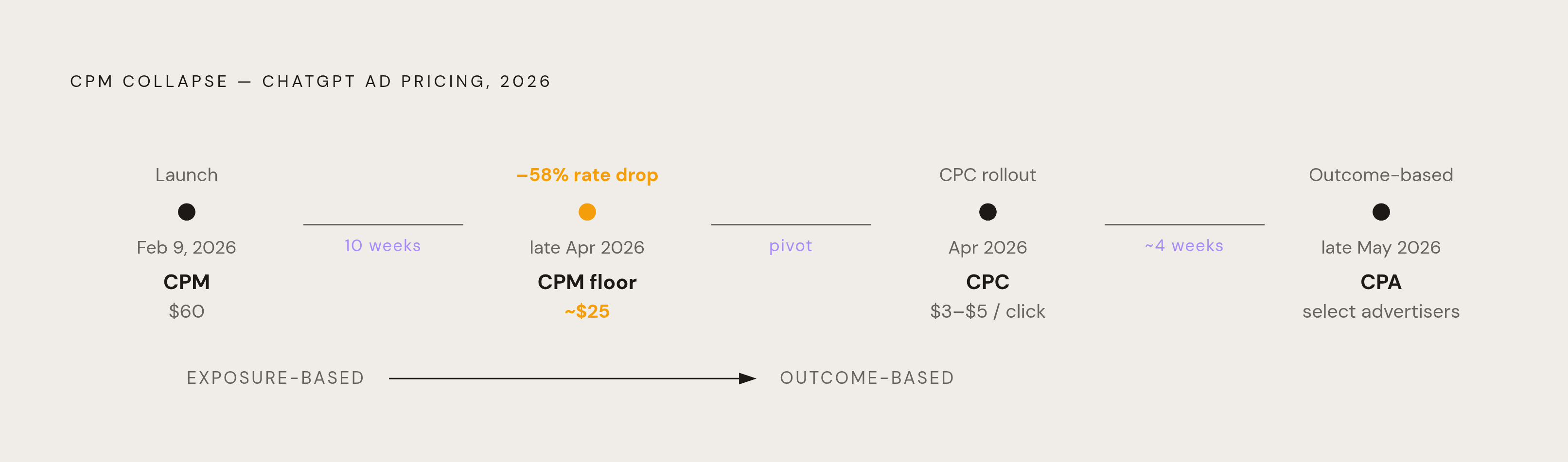
The launch CPM was $60. Within ten weeks, it had dropped as low as $25 in some categories, a compression of more than half the original rate. That kind of decline doesn't happen by accident. It points to something structural: impression volume inside a conversational interface doesn't scale the way it does on a display network. A banner network can serve millions of ad loads an hour across a sprawling web of publisher pages. A conversation-based product has far fewer moments to sell, but each one carries more signal. When OpenAI priced that inventory using a fixed-rate impressions model built for high-volume, low-signal display advertising, the rate couldn't hold. Trade coverage, including reporting cited in The Next Web, found that CPMs fell to roughly a quarter of the launch price within weeks.
OpenAI's response came in April 2026: a shift toward CPC, cost-per-click, with bids running between $3 and $5. That's a real pivot, away from paying for exposure and toward paying for a concrete action. It's also still not pricing the conversation itself. It's pricing what happens after the conversation, the click that follows it.
The current pricing menu: CPM, CPC, and the emerging CPA tier
As of mid-2026, advertisers buying ChatGPT ads choose between three approaches, each suited to a different goal. CPM, under the Reach objective, runs $25 to $60 per thousand impressions. It still makes sense for brand awareness campaigns, particularly where click-through rates signal that the audience is engaged enough to justify paying for exposure alone.
CPC, under the Clicks objective, runs $3 to $5 per click. Bids materially below $3 reportedly fail to clear delivery thresholds, so the auction won't serve the ad. This model fits performance goals and cost-per-acquisition targets better than CPM does, since it ties spend to an actual click instead of a passive load.
Both models run on a relevance-weighted second-price auction, and the highest bid doesn't automatically win. Contextual match to the conversation matters just as much: how well the ad fits what the user is asking about, how strong the landing page is, how closely the context lines up with intent. The privacy boundaries around what data advertisers can access shape what optimization even looks like in this channel.
The newest tier, CPA, began rolling out in late May 2026 for select advertisers. Under CPA, advertisers pay only when a user completes a defined conversion action, making this a gated, outcome-based model. Broader availability of the CPA tier has not been announced.
Why "cost-per-conversation" is the logical destination, even if it isn't a formal buying unit yet
No platform sells cost-per-conversation as a line item today. As a concept, it means paying for each qualified conversational moment where a brand shows up, matched to what the user actually said they wanted, instead of paying for a generic impression or a generic click. It's a more accurate description of what advertisers in this channel are actually trying to buy, and the fact that no one sells it yet is a gap in tooling, not a sign the idea is wrong.
The mismatch with today's units is straightforward. The impression inside a conversation isn't passive exposure, it's a moment of active research, exactly the kind of moment CPM was never built to price. The click, when it happens, is downstream of that. The value gets created earlier, inside the thread, the moment the AI system surfaces a brand in response to a stated need. CPC captures the click but misses everything that happened before it. A user who read a sponsored response carefully, weighed it against other options, and clicked nothing that day may still have had their eventual decision shaped by that exchange. CPC has no way to register that. Neither does CPM, and pretending otherwise is how advertisers end up misjudging which channel actually moved a sale.
Some early movement in the market already points this direction. AdMarketplace ran an AI Discover beta covering 2 million sponsored placements across roughly 700,000 AI queries, priced on CPC, an approach that pushes AI chat advertising toward paying for intent and outcome rather than raw sponsorship exposure. OpenAI's CPA rollout does something structurally similar: it pays for outcomes triggered inside a conversation. Neither product calls itself "conversation-level buying." Functionally, both are edging toward it anyway.
What makes conversation-level targeting workable at all is the density of signal packed into a single prompt thread. Users reveal category, preference, constraint, and timeline, often within one exchange, and multi-turn conversations only add detail as they go. McKinsey research finds that half of consumers now use AI-powered search to research and discover products and services. AI chatbots are projected to help 63.3 million US shoppers in 2026. These are users actively mid-decision, and the pricing model that wins in this channel will be the one built to reflect that.
What CPM comparison benchmarks hide
Setting the raw numbers side by side makes ChatGPT look expensive. Its CPM runs $25 to $60. Meta's average CPM runs roughly $7 to $20. LinkedIn's runs around $39. On paper, ChatGPT costs two to three times more than Meta for the same thousand impressions, and a media buyer looking only at that table will walk away thinking ChatGPT is overpriced.
That reading is wrong, because it treats an impression as a fixed unit of value. A Meta impression reaches a user mid-scroll in a social feed, attention split across a dozen competing posts, intent unknown to the platform. A ChatGPT impression reaches a user in the middle of deciding which product to buy, attention fully on the screen, intent stated in plain language moments earlier. Comparing the two CPMs directly is a bit like comparing the price of a billboard to the price of sitting down with a customer who just told you what they're shopping for. The two aren't the same product, and pricing them as if they were is the actual mistake, not the $25-to-$60 number itself.
Legacy search advertising adds useful context here. Google Ads CPCs rose across 87% of industries, with conversion rates declining in 13 of 14 industries tracked. Crowded results pages and heavier competition drive much of that, and AI Overviews are a contributing factor: those same AI Overviews cut organic click-through rates by 18% on average, a drop that reaches as high as 47% for purely informational queries. Search traffic that used to be free and reliable is getting harder to earn, which raises the cost of everything downstream of it.
None of that makes CPM a fair unit for comparing display and conversational ad inventory. What actually matters is the cost of reaching a user who is deciding something in your category, right now, in their own words, and that's a number none of these benchmark tables capture.
How the DSP layer fits into conversation-level buying
The buying infrastructure hasn't caught up, and the gap sits squarely at the DSP layer. Generalist demand-side platforms offer reach across many surfaces, but they're built on cookies, audience segments, and page-level signals. They have no mechanism for reading what's happening inside a live conversation. Single-surface AI ad networks solve half the problem: they can read conversational context, but only within one publisher's walls. Neither kind of platform can currently match ads to conversation context while also buying across more than one AI surface at once, and that's the actual bottleneck, not a lack of advertiser demand.
That gap matters more as the market fragments rather than consolidates around one winner. ChatGPT, Google Gemini, and DeepSeek together accounted for nearly 90% of total time spent across AI assistant apps in the first quarter of 2026, but that's three products splitting the bulk of usage, not one. ChatGPT crossed 1 billion monthly active users in May 2026. Microsoft Copilot and Google's AI Mode are scaling at the same time, each pulling in distinct user bases with different intent patterns. Perplexity exited advertising entirely in February 2026, pulling its inventory out of the pool altogether, a reminder that the map of where conversational ad moments even exist is still being redrawn.
A DSP built for this environment needs to work differently from what came before it. It has to match ads to conversation topic and stated intent in real time, not to a stored user profile or a static keyword list. It needs direct supply relationships with multiple AI publishers, rather than routing repurposed display inventory through a conversational wrapper. And it needs to support the pricing models this market is actually converging on: CPC now, with conversation-level and CPA models arriving next, not CPM bought the way it's always been bought on the open web.
That points to a deeper infrastructure gap. AI publishers need an ad stack built for conversational interfaces from the ground up, not legacy adtech retrofitted to fit a context it was never designed for. A demand-side platform that sits on top of its own exchange and its own direct publisher relationships is the structure that closes this gap, from the supply side and the demand side at once.
What advertisers should optimize for while the formal model catches up
Cost-per-conversation is the right conceptual frame for this channel. It just isn't a line item any platform sells yet. Today's menu offers CPM, CPC, and an early, gated version of CPA, and advertisers need to operate inside that gap instead of waiting for the industry to formalize a unit that matches what they're actually buying.
CPC is the sensible default for performance goals right now. It ties spend to a concrete action, sits within a bid range the auction will actually clear, and avoids paying flat rates for impressions whose value swings wildly depending on where in the funnel the conversation happens to land. CPM still earns its place for pure brand awareness plays, particularly where click-through rates signal genuine audience engagement, signaling the exposure itself is doing real work. Accounts already set up with conversion tracking through the pixel or Conversions API should move fast to qualify for CPA access as it widens, since payment tied strictly to outcome is the closest thing the current toolkit offers to conversation-level pricing.
None of these are perfect substitutes for a pricing unit built around the conversation itself. They're bridges, nothing more. Advertisers who treat them that way, watching auction dynamics, tracking where in the funnel their prompts are landing, and staying ready to move budget as CPA access expands, will be the ones positioned well once the formal model finally arrives. The ones who keep buying CPM out of habit will be paying banner-ad prices for something that was never a banner ad.
Sources
- How Much Do OpenAI Ads Cost? CPC, CPM, and Budget Guide for 2026
- OpenAI shifts ChatGPT ads to cost-per-click as $60 CPM erodes in ten weeks and ad revenue targets hit $2.5 billion
- openai.com
- ChatGPT Ads CPC vs CPM: Which Bidding Strategy Maximizes Your ROI (2026) | Lapis
- ChatGPT Ads Cost 2026: CPM, CPC & Budget Guide
- emarketer.com
- directiveconsulting.com
- bir.ch