Task-Oriented Prompts vs. Exploratory Prompts in Demand Modeling
Exploratory prompts signal early demand; task-oriented ones signal intent to buy.

Advertising has always modeled demand from the outside in: a click, a landing page, a demographic bucket assigned by a cookie. AI assistants change that. The user hands over their own words, in their own syntax, describing what they actually want at the exact moment they want it. Most advertisers still treat all of that conversational traffic as one bucket and bid on it the way they'd bid on a keyword. That model misreads the medium, and the gap between how prompts actually work and how they're priced is where budget gets wasted or wins get missed.
What makes a prompt task-oriented or exploratory — and why the line matters
An exploratory prompt is open-ended. It's a person framing a topic, not yet choosing between options: "what should I look for in a running shoe?" or "how does a HELOC work?" A task-oriented prompt has already picked a lane. It wants an outcome: "compare these two credit cards for travel rewards," "which running shoe is best for overpronation under $150?"
The syntax gives it away most of the time. Exploratory prompts open with "what," "how," "explain," "tell me about." Task-oriented ones open with "find," "compare," "recommend," "which," "help me choose." The pattern is a spectrum rather than a binary category, and a single user often slides along it within one sitting, starting broad and narrowing as the session goes.
Here's why the distinction actually matters for anyone spending media dollars: each type reflects a different relationship to the purchase itself. One is a person building a mental frame for the decision. The other is a person evaluating options inside a frame that's already built. Exploratory prompts are upstream demand. Task-oriented prompts are proximate demand. Both are usable, just on different timelines and with different creative.
The session as the unit of demand — what sequential prompts reveal that a single query cannot
Search advertising was built to catch a moment. One query, one signal, one auction, done. A conversational AI session runs as a trajectory instead. The questions shift, narrow, and pick up detail as the person works through what they're actually trying to decide.
Available research suggests consumers run through multiple prompts before moving toward a purchase destination, and in high-involvement categories, sessions can stretch considerably longer, with users volunteering personal context alongside straight product questions. That's a level of self-disclosure a search box never gets.
What a multi-turn session hands an advertiser that a single search query cannot: which features the person has already crossed off the list, what price range they've named out loud, what adjacent needs are sitting next to the main one (the marathon runner asking about shoes who also mentions a dietary restriction or an injury history), and timing cues, whether the purchase is happening this week or sometime next spring.
The real signal, then, is the accumulated intent sitting in the session up to that point, more than the single prompt that happens to trigger an ad. Contextual conversation targeting, serving based on the whole dialogue rather than just the latest line typed in, is the piece of infrastructure that makes any of this usable at scale.
How prompt type maps to purchase-journey stage — the four-zone intent framework
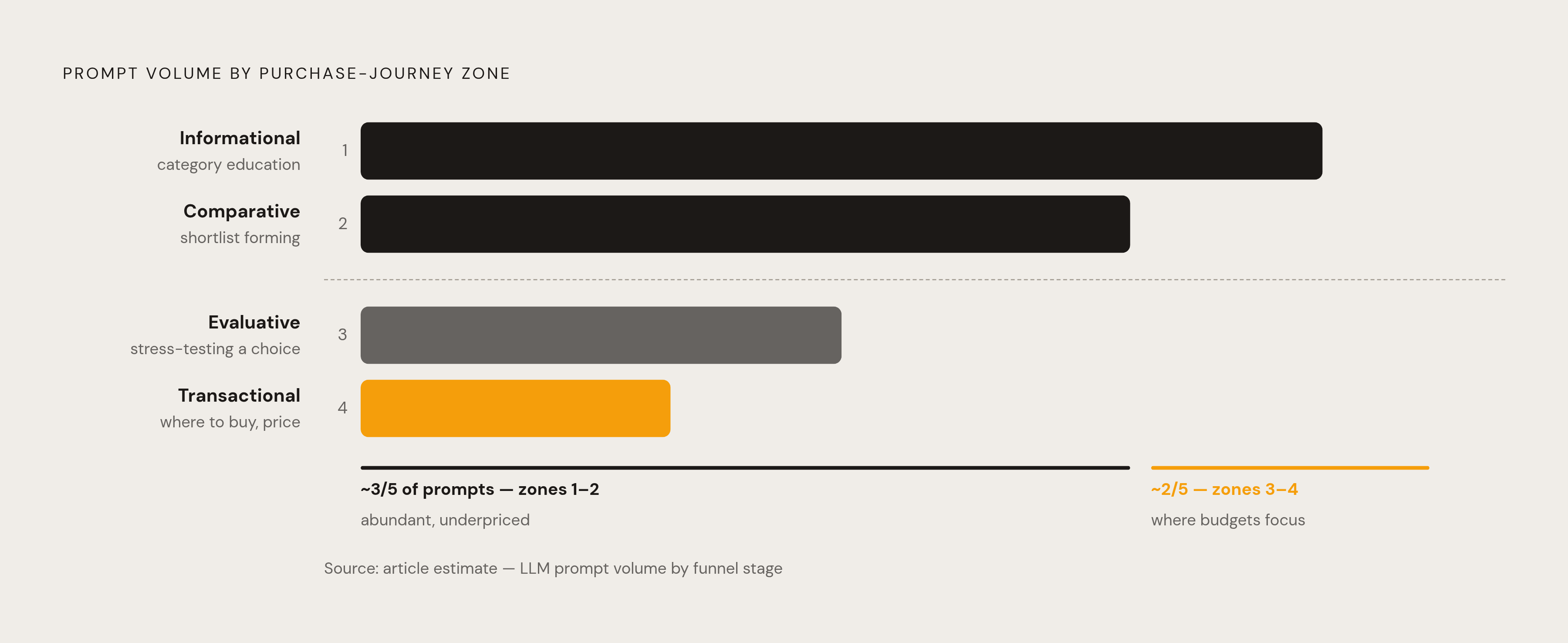
Some practitioners are already building what amount to Conversational Intent Matrices: a grid of question types against product categories, a more granular cousin of the journey maps search marketers have used for years. Four zones tend to show up, running from earliest to latest.
Informational and exploratory prompts sit at the start: category education, topic research, a person building a mental model with no specific option in hand yet. Comparative prompts come next, once a shortlist exists and the question turns to how the options differ; brand insertion starts paying off here. Evaluative prompts follow, where someone is stress-testing a near-decision and looking for the objection that talks them out of it, or the reassurance that doesn't. Transactional prompts close the loop: "where can I buy," "what's the price," "how do I get started," the closest cousin to a high-value search keyword.
Research analysis puts roughly three-fifths of LLM prompts in the informational and exploratory zone, with about two-fifths landing as transactional. Most of the conversational inventory, in other words, sits earlier in the funnel than advertisers are used to bidding for. That shape is worth building around: early-stage inventory is abundant and cheap right now, and late-stage inventory is scarce and should cost more. The mix shifts by category, too. Higher-consideration categories tend to run longer and more exploratory; lower-consideration categories tend to compress the journey into fewer turns.
Why AI search ads inherited the wrong bidding logic from keyword search
Search advertising grew up around a results page: a query lands, keywords fire an auction, someone wins a slot, a click gets logged. That whole system assumes a surface, a keyword, and a clean exit point to measure.
Conversation doesn't offer any of that. Run that same logic there and the demand signal flattens out: a keyword match treats "best running shoes" identically whether it's the opening line of a research session or the last line before checkout. The result is a set of predictable failures. Advertisers overbid on early exploratory queries where the odds of a near-term purchase are low. They underbid on evaluative and transactional turns where the user has already done the hard work of narrowing the field. And creative gets served flat across every stage, so someone one question away from buying sees an awareness message, while someone still learning the category basics gets hit with a hard sell.
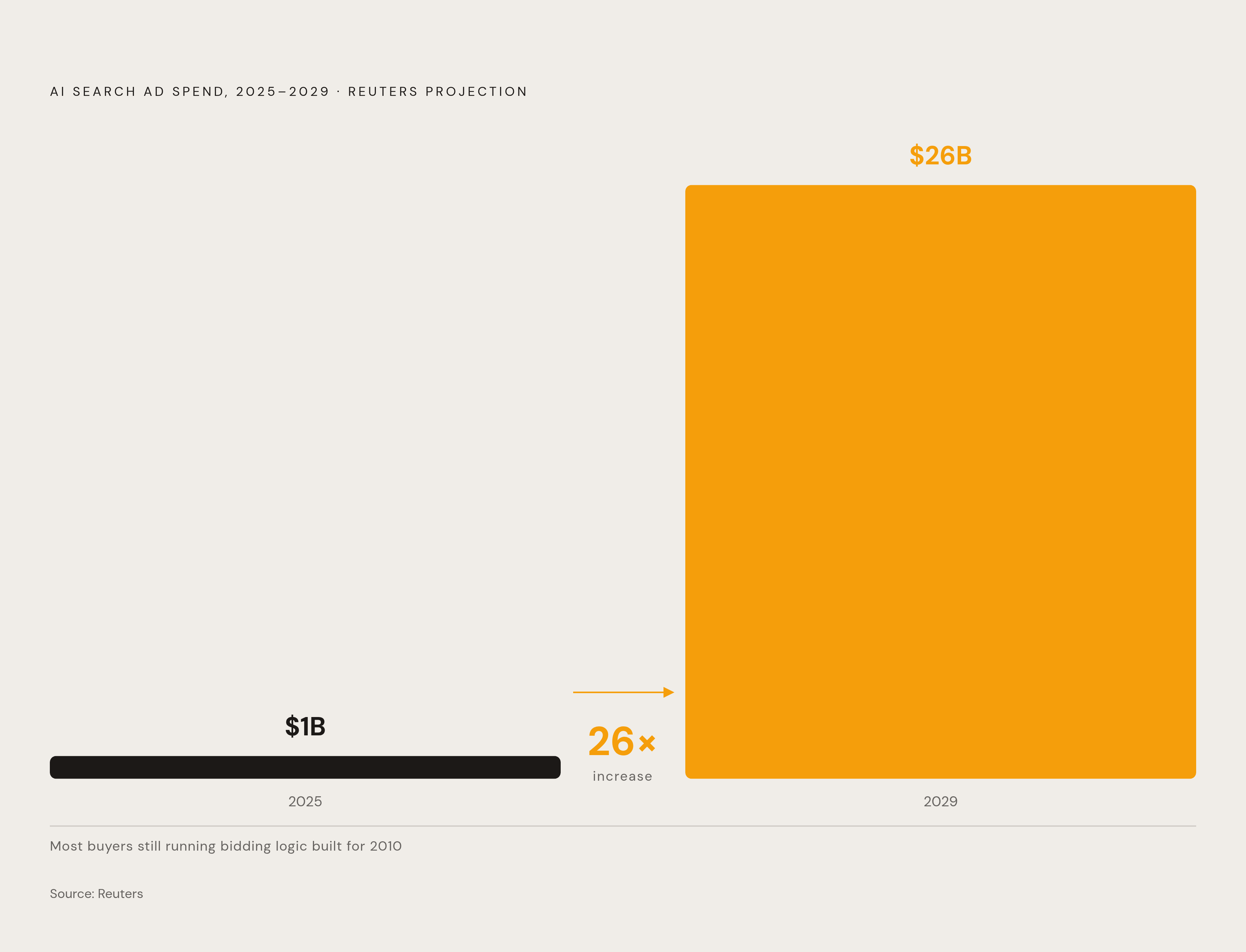
The deeper issue is structural: there's no keyword to bid on in a native LLM environment. The unit worth targeting is conversational context, and that's a different infrastructure problem than keyword matching was ever built to solve. Reuters projects AI search ad spend growing from around $1 billion in 2025 to roughly $26 billion by 2029, a 26x jump into a channel where most buyers are still running bidding logic built for 2010.
What precision bidding on conversational intent actually requires
Campaigns need to be built around intent territories, not keywords and not audience segments. A campaign should correspond to a type of conversation, early research, comparative shopping, transactional closing, and the creative running in it should be written for that specific conversational moment, not pulled over from a display banner or a search ad and lightly reworded.
The targeting inputs look different, too. Full session context matters more than the single triggering prompt; the publisher or surface where the conversation is happening sets a baseline intent prior; the position of the prompt within the session, early turn or late turn, proxies where the person sits in the journey. None of this needs a cookie. The conversation itself is the signal.
Auction mechanics inside LLM environments are still being worked out in the research literature. Frameworks under study explore how bid signals and relevance together might shape where an ad appears within a response, though no dominant auction standard has yet emerged. Bid modifiers should follow the intent zone: evaluative and transactional conversations justify aggressive bids, while informational conversations call for lighter, awareness-level bids paired with brand-building copy instead of a conversion pitch. The buying layer that can actually execute this reads full conversational context rather than matching a keyword, and it sits in a specific gap: generalist platforms have the reach but can't parse conversational intent, and single-surface AI ad networks can read the context but can't offer scale across surfaces.
How exploratory prompts function as upstream demand — and why ignoring them costs brands later
The obvious move is to pile budget onto transactional prompts, since they sit closest to the sale, and write off exploratory traffic as unreachable. That approach overlooks how influence actually builds: inside a conversation, whichever brand shows up during the exploratory stage helps shape the mental model the person carries into the evaluative stage later.
The marathon runner spending ten prompts learning about running gear isn't in-market yet in the keyword sense of the term. But that runner is forming category preferences, brand associations, and a list of features that matter, all of which will define what "good" looks like by the time a transactional prompt finally gets typed.
AI assistants are turning into the first stop for category education, not a side channel. Sensor Tower data published with EMARKETER shows AI assistant traffic up 86% and time spent up 101% year over year, while traditional browser and search traffic slid the other way. Exploratory conversation is migrating to AI surfaces at real scale, and brand absence there isn't a neutral outcome; a competitor cited or explained during that early research earns a reference point the buyer measures everything else against later.
The practical answer is to give exploratory prompts their own creative, category-educational rather than promotional, and their own bidding logic, lower CPM targets and broader reach rather than exclusion from the plan entirely. Attribution here is genuinely harder than last-touch measurement; that's a real limitation, not a reason to walk away from the spend. It's the same problem upper-funnel marketing has always posed, and the fix is the same one marketers have always reached for: model it instead of ignoring it.
Building a demand model that uses prompt type as a bidding variable
Start by mapping the category's conversational journey. What does a typical prompt sequence look like for someone buying in this category, and where does exploration give way to evaluation?
From there, assign intent zones to campaign tiers. An awareness tier covers exploratory and informational conversations, with brand presence and category framing doing the work. A consideration tier covers comparative conversations, where product differentiation and a light call-to-action fit. A decision tier covers evaluative and transactional conversations, where bids should run highest and creative should push straight toward conversion.
Bid logic follows the tier: decision-tier conversations justify search-equivalent bids or higher, given how much self-qualification the session has already done, while awareness-tier conversations run on reach-optimized CPMs instead. Session signals, not single-prompt signals, should drive targeting throughout; a transactional-sounding prompt that opens a session means something different than the identical prompt showing up on turn six of a long research conversation. Measurement needs to run by tier as well, since conversion rate alone misreads what the exploratory spend is doing; pairing it with brand-citation rate, consideration lift, and how much the session-to-purchase window shrinks over time gives a fuller picture.
The advantage of building demand this way is that it matches how buyers actually behave: across a conversation, not inside a single query. As AI search ad spend climbs toward the levels Reuters is projecting for 2029, the advertisers running prompt-type-aware demand models now will hold a structural lead over everyone still bidding on a flattened intent signal.