Which Ad Platforms Have Real Access to Live AI Conversation Inventory Right Now
Only ChatGPT lets advertisers reach users inside live AI conversations today.

A handful of platforms let brands place ads inside live AI chatbot conversations today, most notably ChatGPT, while others, like Perplexity, have walked away from advertising, and still others, like Anthropic's Claude, have never allowed it. The market sounds unified because every major AI company is racing to build conversational products, but the advertising access behind those products splits into three distinct categories: open and buyable, incentivized but closed, and deliberately refused. A buyer evaluating this space needs to know which category a given surface falls into before any other question gets asked.
This distinction matters more here than in traditional digital advertising because of where the ad actually sits. A search ad or a banner shows up before a user has committed to a line of thinking, while a conversational ad shows up inside a dialogue the user already trusts and has already used to frame a specific problem in their own words. That's a mid-decision placement rather than a pre-discovery one, which raises the cost of misjudging access to it. A buyer who allocates budget against inventory that turns out to be paused, closed to a pilot group, or simply rumored wastes money and loses time in a channel that is moving fast enough to punish that kind of mistake.
This piece sorts the major conversational AI surfaces into those three groups: confirmed open inventory, incentive without access, and explicit refusal. Each carries a different instruction for a media plan. Knowing which bucket a platform belongs in has to come before any conversation about targeting mechanics, creative formats, or measurement, because that work is wasted if the inventory it depends on doesn't exist.
The one surface with confirmed, open, buyable inventory: ChatGPT
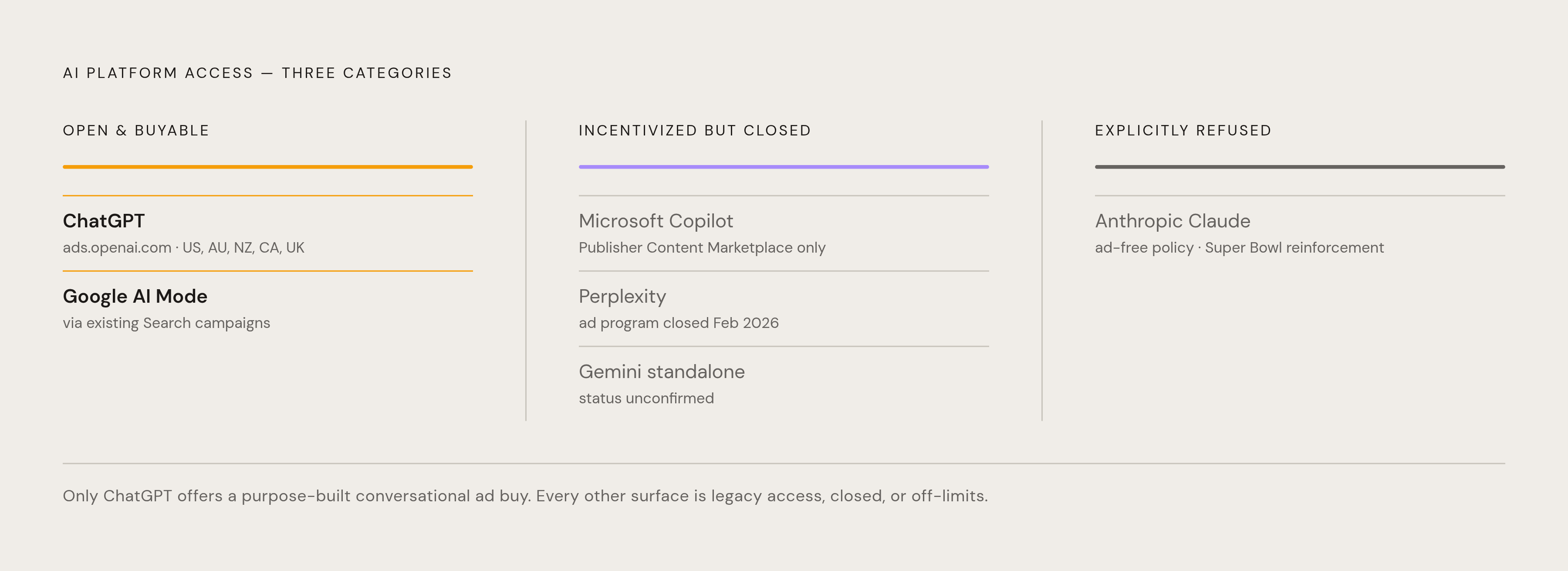
ChatGPT is the clearest starting point for anyone trying to run paid placements that appear inside live AI conversations, because it is one of the only surfaces where that inventory is confirmed, open, and buyable right now. Access runs through ads.openai.com, marketed under the banner "Advertise in ChatGPT," and the placement logic breaks from search advertising in one basic way: ads are matched to what the conversation is actually about, not to keywords a buyer has bid on in advance.
The reach has real limits that any plan needs to account for. Ads appear only to logged-in adult users on the Free and Go tiers, launched in the US and later extended to Australia, New Zealand, Canada, and the UK. Anyone on Plus, Pro, Business, Enterprise, Edu, or Team plans sees no ad. That's a hard ceiling on scale, so ChatGPT's ad inventory reaches a specific slice of the user base, not the platform's full population, and a buyer needs to size expectations against that before committing budget.
The auction mechanics depart from keyword bidding just as sharply. OpenAI runs a relevance-weighted, second-price auction: an ad that fits the conversation more precisely can beat a higher bid, and whoever wins pays just above the next-highest competing bid rather than their own full bid amount. There's no keyword list to build here. Eligibility gets decided by the full conversation thread, meaning topic, user intent, the ad copy itself, contextual hints, and even the landing page all factor into which advertisers are even in the running. This kind of real-time, whole-conversation evaluation is the model that purpose-built conversational ad infrastructure is designed to run: matching against the shape of an unfolding conversation rather than against a static search query or a page's keyword density. For a buyer who can only test one AI surface this quarter, ChatGPT is the one with a live, functioning market behind it.
Google's AI surfaces: real reach, but access runs through existing Search infrastructure
Google's AI products carry real advertising today, but the path to that inventory is less a new conversational buying channel and more an extension of the Search infrastructure buyers already use. AI Mode and AI Overviews both surface ads, and because Google's footprint is already so large, the reach is substantial. You still access it through existing Search campaigns, not a dedicated conversational buy, which caps what a buyer can target to whatever Search already exposes.
Google Marketing Live 2026 laid out several AI-native formats, and they are now built into AI-driven search results. Conversational Discovery ads, Highlighted Answers, and AI-powered Shopping ads all appear inside AI-generated responses, surfacing products as contextual recommendations when a user phrases a question conversationally rather than as a string of search terms. A newer format, Business Agents for Leads, embeds a conversational chat agent built on one underlying model directly into an ad unit, so a user can ask questions about a company or product instead of filling out a static lead form. That format is rolling out first to the automotive, education, and real estate verticals. Google also introduced AI Brief at the same event, a tool that lets advertisers steer AI Max campaigns with a plain-language description of the brand instead of a settings panel full of toggles, so you can manage campaigns conversationally even where the ad placement itself isn't.
An ad that appears on an AI-assisted search results page and an ad that appears inside a standalone conversational interface occupy different positions in the user's experience. Google's formats sit on a results page that happens to be generated by AI. ChatGPT's ad appears inside the back-and-forth of a chat itself, with no results page framing it. Both are legitimate advertising surfaces with real reach, but they are not the same access pattern, so a media plan that treats them interchangeably will misjudge what each buy actually delivers. So the gap between a search-adjacent AI feature and a native conversational buy is the structural line that separates platforms retrofitting legacy ad tech onto new surfaces from ones built from the ground up for conversational placement.
Microsoft Copilot and Perplexity: incentive is clear, general inventory is not open
Microsoft and Perplexity both have obvious reasons to monetize their conversational traffic, and neither has opened general ad inventory to buyers in a way that matches what ChatGPT offers. Microsoft sits inside one of the largest ad businesses in the world, with Copilot acting as a natural extension of that business, yet general conversational ad inventory on Copilot has not opened to advertisers. Perplexity went the opposite direction: it shut down its ad program entirely in February 2026, stepping away from advertising rather than expanding it.
Microsoft's monetization signal so far comes through its Publisher Content Marketplace, which licenses premium content from outlets including Business Insider, Condé Nast, Hearst, AP, USA TODAY, People, and Vox Media into Microsoft's AI products. That's a compensation structure for publishers whose content trains or feeds these systems, and it shows Microsoft is building a business layer that generates revenue from Copilot directly. It is not, however, an open ad-buying channel, and a buyer looking for placements inside Copilot conversations will not find one yet.
Perplexity's posture is different in kind rather than degree. Its users tend to show up in research mode, comparing options and building conviction before committing to a decision, which makes the platform a high-intent audience for comparison content and category education once any inventory does open. Until that happens, the right way to treat Perplexity is as a platform for earned visibility. The instruction for both platforms is the same: build the plan so it can move the moment either one opens general inventory, but do not commit budget against access that does not currently exist.
Gemini as a standalone conversational surface: inventory status is unconfirmed
Gemini as a standalone conversational assistant needs to be kept separate from the AI ad formats Google has confirmed inside Search, covered above. Those Search-integrated formats, including Conversational Discovery ads and Business Agents for Leads, are confirmed, and they are live. Gemini's own status as a buyable conversational ad surface in its own right is unconfirmed. The two should not be treated as one access point in a media plan simply because both sit under Google. A buyer should keep this surface on the radar and ready to move quickly if confirmed inventory appears there, but no budget should be committed against it until that confirmation exists.
Claude and other explicitly ad-free surfaces: no inventory exists and none is expected
Claude represents the cleanest category in this entire landscape: no ad inventory exists, and Anthropic has made clear none is planned. Anthropic didn't leave this ambiguous. It reinforced Claude's ad-free position with a Super Bowl advertisement, timed as a direct response when OpenAI announced its plan to run ads inside ChatGPT. Spending Super Bowl-level money to announce an absence of advertising is a strategic signal that the policy will hold even when the business could use the revenue.
Anthropic has argued publicly that because an AI assistant relationship is personal and conversational, advertising feels insincere in a way that ad placement next to search results never quite does. That's a structural claim about the product category, and it won't change with the next funding round. Richard Raddon, co-founder and co-CEO of Zefr, has framed the underlying tension well: users are already forming relationships with large language models that feel "way more intimate" than their relationship with a search engine, which raises the stakes on safety and suitability considerably. That same intimacy is what makes an ad-free stance credible to users who share Raddon's concern, and it is likely part of why Anthropic is willing to spend heavily to signal the position rather than quietly maintain it.
For a media buyer, the instruction here is straightforward: treat Claude and any platform taking the same public stance as a target for earned visibility rather than paid placement. The route onto these surfaces runs through getting cited organically inside an AI-generated answer, not through a media buy, and that's not going to change because the position is built into how these companies describe their product to users, not into a feature roadmap.
Why conversational intent signals change what targeting can do
The reason any of this access mapping is worth the effort comes down to what a live conversation reveals about a user that no keyword ever could. A person typing three words into a search box is giving an advertiser a fragment. A person four turns into describing a scheduling conflict, a team coordination problem, or a budget constraint is giving an advertiser something closer to a full diagnosis, offered in their own language, ahead of any search for a product category.
That shift changes what gets measured and sold. A user who never types "project management software" but spends several conversational turns describing missed deadlines, remote team friction, and unclear ownership of tasks is expressing purchase intent that a search engine would never see, because no search term captures it. What gets monetized is the moment inside a conversation where a brand gets recommended, shortlisted, or chosen, not the page view or the impression. That's a different success metric than click-through rate, and it's one that only exists where the underlying conversation itself is visible to the ad system.
A buyer needs to know whether a surface's inventory is open, closed, or paused before committing budget. On a surface where inventory is closed, paused, or simply unconfirmed, this richer intent signal is sitting there, generated every time a user talks to the assistant, and entirely unavailable to any paid buyer no matter how aggressive their bid. The signal exists. It just cannot be acted on until the platform decides to open a market around it. That gap is the entire reason the taxonomy in this piece matters more than it might in a channel where every platform's inventory looks roughly the same.
Brand safety complications specific to live conversational inventory
Open inventory does not guarantee safety, a distinction that carries more weight in conversational AI advertising than it ever did in display. The risk here is not limited to an ad appearing next to an offensive article or a flagged video. An ad can appear to endorse, or sit beside, an AI-generated response that is inaccurate, harmful, or simply misleading, in a format where the user has been trained to trust the assistant's judgment.
Traditional pre-bid filtering was built to catch explicit language, violent content, and other keyword-level red flags, and it still does that job reasonably well. What it was never built to catch is a model describing a competitor's product as "less exciting" or framing a brand as "offering lower upside" compared to an alternative, phrasing that triggers no blocked word and no flagged term, while still steering a user away from a brand through pure framing rather than vocabulary. A brand can be positioned unfavorably by an AI system without a single word that any existing filter would catch, and that's a different category of risk than anything legacy brand safety tooling was designed to solve. New fraud vectors tied to this same mechanic remain unresolved across the industry. Any buyer moving into confirmed, open inventory, on ChatGPT or wherever else it opens next, has to treat this as a live operational question rather than a solved problem, because the tools that solved it for display have not yet caught up to what a generative response can do with framing alone.