How Conversational AI Ad Placements Are Priced and Bought
Measurement challenges, not media costs, will determine whether campaigns succeed.

Conversational AI ad placements run on a different targeting signal, a different auction logic, and a different ad format than search or social ever did, and buying this channel well means understanding those mechanics before touching a bid field. This piece covers how the auction actually prices attention, what the three buying models do, what placements cost as of mid-2026, and why measurement, not media cost, is the variable most likely to make or break a campaign.
A different mental model for conversational AI ad placements
A keyword typed into a search box is a single, static unit of intent. Conversational AI advertising is a distinct channel where the targeting signal, the auction logic, and the ad format all work differently from search or social inventory. That difference is not cosmetic. It changes what "targeting" even means, because the unit being evaluated is a moving conversation state rather than a fixed phrase.
The format break matters just as much as the signal break. Social advertising works by interruption: a feed scrolls, an ad occupies a slot in that scroll, and the user's attention was elsewhere a half-second earlier. In ChatGPT, the ad appears only after the model has finished answering, labeled "Sponsored" and visually separated from the response itself, so the person seeing it has just finished reading something they asked for. That is a fundamentally more attentive moment than a scroll interruption, and a poorly matched ad in that moment reads as a breach of trust rather than background noise.
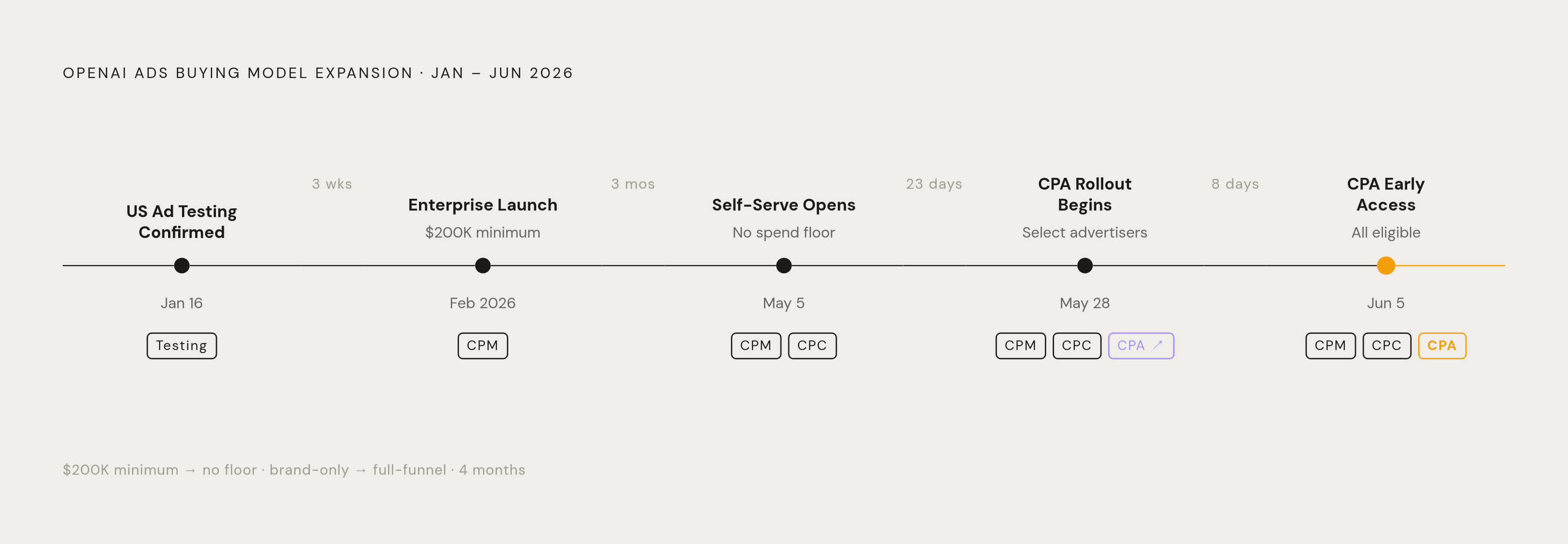
None of this happened slowly. OpenAI confirmed it was testing advertising in the US on January 16, 2026, launched with enterprise-only minimums the following month, and by May 5, 2026 had opened a self-serve Ads Manager to any US business, with no spend floor at all. A thinner auction usually means a cheaper and more forgiving one, at least for now.
The auction: context signals replace keywords and demographics
The auction that determines which ad appears in conversational AI advertising is relevance-weighted and runs on a second-price structure, so the highest bid does not automatically win the slot. A tightly relevant ad bidding low can beat a generic ad bidding high, because contextual fit to the conversation is doing more of the selection work than raw bid size. That is a meaningfully different mechanic than a straightforward highest-bidder auction, and it rewards precision over budget in a way advertisers accustomed to Google Ads may not expect.
Google Ads bidding revolves around specific search terms an advertiser chooses in advance. ChatGPT bidding revolves around intent categories and conversation states instead, so the system is evaluating what a user appears to be trying to accomplish, not simply which words appeared in a query box. Because the model reads the full thread rather than a single message, the same person can produce very different auction outcomes purely based on where they sit in a research or purchase journey at that moment.
None of that context, however, flows back to the advertiser as raw data. OpenAI matches ads using the topic of a conversation, a user's past chats, and past ad interactions, but advertisers never receive access to the underlying user data itself. The platform gets rich signal, the buyer gets a matched impression and little else, and that asymmetry makes it hard for advertisers to measure which conversations actually drove results, an issue covered later in this piece.
adMarketplace offers the clearest working illustration of how this kind of infrastructure gets built to support a chat interface. Its AI Discover product launched an alpha on Opera AI in October 2025, described as the first large-scale deployment of cost-per-click paid ads inside an AI chat interface, and it runs on two proprietary layers: a Context & Intent Vector that extracts commercial intent from a query, and an Arena matching engine that ranks sponsored results in real time against a large indexed catalog of product listings. adMarketplace has also stated publicly that AI Discover operates separately from the model's underlying reasoning process, a distinction the company frames as central to preserving user trust. That separation is a technical signal as much as a trust signal: it shows serious infrastructure providers treating the line between what a model reasons about and what an advertiser pays to place as a hard boundary, not a blurred one.
None of that context evaluation, on its own, produces a working ad business. A monetization stack needs a stable session identifier, attribution that survives from a click through to a downstream purchase, frequency caps per user, and budget pacing, and none of those functions can live inside the language model itself. They have to sit in a deterministic system running above and around the model, because a model generating text one token at a time has no natural place to store a persistent ledger of who saw what and when.
The three buying models and what each is for
OpenAI Ads currently runs three buying models, and each one answers a different campaign objective rather than competing to be the "best" one. Getting the model wrong for the goal is the most common structural mistake early buyers make, and it appears weeks later as confused performance data rather than an obvious error at launch.
CPM, sold as a Reach objective, charges per thousand impressions and optimizes for visibility. It suits brands entering a category or building awareness among users who are actively researching a space, even when those users never click through on that particular session. CPC, sold as a Clicks objective, charges per valid click and gives the advertiser bid, budget, and pacing controls, making it the natural choice for performance campaigns aimed at driving site visits from people who have already signaled purchase intent inside the conversation.
CPA arrived later and works differently again. Conversion-optimized buying began rolling out to select advertisers on May 28, 2026, charging only when a user clicks through, signs up, or completes a purchase, and it opened in early access on June 5, 2026 to accounts that had already configured conversions through the pixel or Conversions API by June 1, 2026. The platform launched in February 2026 with only CPM buying at the $200,000 enterprise minimum, then added CPC alongside self-serve access on May 5, 2026, and CPA in late May, a rapid maturation that moved the channel from brand-only to full-funnel within months.
adMarketplace's approach has stayed simpler and more consistent throughout. Its AI chat ad program has run on cost-per-click since the beginning, and its October 2025 alpha with Opera AI was specifically framed as the first large-scale CPC deployment inside an AI chat interface. Which model an advertiser picks is not just a bidding decision, either. Which model an advertiser picks determines what kind of measurement infrastructure needs to exist behind the campaign before the first dollar goes out, a point that becomes unavoidable once attribution enters the picture.
What conversational AI ad placements cost in mid-2026
Conversational AI placements cost more than comparable display inventory, and that premium is real rather than a sign OpenAI is pricing without discipline. It reflects a genuinely different attention environment: a person reading a direct answer to their own question is not the same audience as a person scrolling past a banner, and the price difference tracks that difference in attention quality.
CPMs on conversational AI placements as of mid-2026 run substantially above rates on established display and social inventory such as Google Display Network or Meta, with the most competitive categories commanding the highest premiums. Travel and education run somewhat above that baseline. SaaS and software run meaningfully higher than most other verticals, and legal services run high enough to sit broadly on par with finance. Bidding well under the platform's delivery floor tends not to produce cheap savings, since the algorithm enforces a minimum regardless of how tight the targeting looks on paper, and underbidding mostly produces non-delivery rather than a bargain.
Set against Google Search, the numbers land closer together than the sticker price on CPMs might suggest. Cross-industry average CPC on Google Search in Q1 2026, reported in the Silverback Marketing 2026 Paid Media Benchmark Report, was just below the ChatGPT CPC range, putting ChatGPT's CPC at rough parity with Google Search, though buyer-intent quality and lower ad density differentiate the impression type. What differs is the impression itself: lower ad density and higher buyer-intent quality inside ChatGPT change what that click is worth, even when the price tag looks similar. And none of this is fixed. Pricing moves month to month as more advertisers enter the auction, and CPMs are expected to ease down gradually as OpenAI scales inventory to meet demand, making the pricing window available right now a temporary one.
Market structure: OpenAI, adMarketplace, and the platform divergence
Conversational AI advertising has not settled into one channel with one buying path. Different AI surfaces have made openly different decisions about whether to run ads at all, and the result is a fragmented buying landscape rather than a unified one.
OpenAI's self-serve Ads Manager has been open to all US businesses since May 5, 2026, with three buying models spanning CPM, CPC, and CPA, Sponsored slots clearly separated from model responses, and roughly 300 million weekly users. Single-surface challengers have entered this space too. Koah, an AI-native ad network built to insert contextual native units directly into generative AI conversations, raised a Series A and reports having processed well over a hundred million queries and delivered tens of millions of native ad impressions in just over a year of operation.
Other major AI surfaces have gone the opposite direction, and the split is stark. Anthropic has stated officially that Claude will remain ad-free. Perplexity tested sponsored follow-up questions and then pulled the feature entirely in February 2026 over trust concerns. Gemini and Grok have each signaled some future intent around advertising, but neither has shipped a mature ad product. That divergence is a genuine split in how AI companies weigh monetization against user trust, and a buyer planning a strategy across surfaces has to treat each platform as its own decision rather than assuming today's leaders define the category.
That fragmentation produces a specific structural gap. Generalist buying platforms cannot read conversational context the way a purpose-built system can, while single-surface AI ad networks can read that context but offer no reach beyond their one surface; a DSP that operates across AI surfaces while maintaining direct publisher supply relationships addresses both constraints simultaneously.
The attribution problem that determines whether any of this spend is judged correctly
The most common reason conversational AI ad spend looks expensive traces back to broken conversion measurement, not to the channel underperforming. That distinction matters enormously for how a buyer should read early results, because a campaign judged on incomplete data will look worse than it is, and decisions made on that misread compound the problem rather than correcting it.
Clicks from ChatGPT frequently land inside in-app browsers, where client-side pixels lose a meaningful share of conversions before they ever get logged. When a real portion of actual purchases never makes it back into OpenAI's reporting, measured cost-per-acquisition looks materially worse than the true number, and the delivery algorithm then optimizes against that partial signal, which makes delivery genuinely worse over time rather than just appearing worse on a dashboard. It is a feedback loop: bad measurement produces bad optimization, and bad optimization produces worse delivery, and the buyer sees all of that as "the channel doesn't work" when the actual fault sits in the tracking setup.
The signal asymmetry noted earlier compounds this. OpenAI does not share raw user data with advertisers, so the richness of context that drives ad matching on the platform's side never reaches the buyer's side of the ledger. Any AI conversation surface faces the same underlying requirement: a monetization stack needs a stable session identifier, attribution that survives from click through to purchase, frequency capping, and budget pacing, and all of that has to run in a deterministic layer sitting outside the model itself. This reflects that the tooling built for the page-and-click web was not designed for conversation-mediated discovery, where a purchase path can wind through several AI turns, a browser handoff, and a broken session before it ever resolves.
Debra Aho Williamson, founder and chief analyst at Sonata Insights, said at Cannes Lions 2026: "The companies that own that path toward intent and can mine that intent and can understand that intent, whether it's a conversational environment or whether it's following the path back and forth from AI to other destinations, that's where the future lies". Correct setup, in principle, means wiring server-side conversion tracking before launch and treating early performance numbers as provisional until that tracking is verified against actual downstream purchases.
Brand safety and ad suitability inside AI responses: the open infrastructure gap
Brand safety in conversational AI advertising is an infrastructure problem, not a sign of careless or malicious design, and the distinction matters for how a cautious buyer should weigh the risk. Two decades of programmatic tooling were built around a specific assumption: that the content surrounding an ad already exists before the impression is served, so verification tools could scan and score it in advance. A generative AI interface breaks that assumption completely, because the content adjacent to an ad is produced in real time, in response to a specific prompt, and no existing verification infrastructure was ever built to cover a context window that does not exist until the moment it is generated.
Some safeguards exist already, even without mature third-party verification tooling. OpenAI limits ad density to protect the user experience, labels every ad "Sponsored" and separates it visually from the model's answer, and runs the relevance-weighted auction in a way that creates a quality floor, since an ad has to clear a contextual-fit bar before it can serve at all. adMarketplace's decision to run AI Discover separately from the model's own reasoning process functions the same way: framed as a trust measure, it doubles as a safety mechanism by keeping paid placement mechanically separate from generated answer content.
Real gaps remain open, and naming them matters more than downplaying them. Hallucination risk at the ad-adjacent content layer has no mature mitigation yet. Advertisers have limited visibility into the full range of conversational contexts an ad might end up appearing next to, and compliance review tooling for regulated verticals, finance, health, and pharmaceuticals among them, has not caught up to the pace the buying infrastructure has moved at. OpenAI's own initial test period reflects that gap directly: ads during this window are concentrated in consumer categories like lifestyle and household goods, local services, travel and experiences, and digital products or education, while regulated categories stay closed, which functions as a guardrail in itself. Safe, transparent advertising inside AI interfaces is both an ethical baseline and a competitive edge, and platforms and buyers that build out verification infrastructure early will hold a structural advantage once regulatory scrutiny of AI advertising intensifies.
Building a first buying strategy across AI conversation surfaces
A first campaign in this channel succeeds or fails on sequencing. Measurement setup has to precede bidding, bidding has to precede creative optimization, and surface selection has to precede any attempt to scale, and skipping that order is how buyers end up drawing conclusions from data that was never trustworthy in the first place.
Server-side conversion tracking needs to go live before a single dollar is spent. Client-side pixels lose a meaningful share of conversions through in-app browsers, and a channel judged on broken tracking gets abandoned for the wrong reasons or scaled up on a false signal, either of which wastes budget in a different but equally costly way.
Surface selection should follow the audience. ChatGPT through OpenAI's Ads Manager offers the broadest reach of any AI surface available, runs self-serve with no minimum spend as of May 5, 2026, and fits e-commerce and direct-to-consumer brands aiming at buyers already deep in a research phase. Other surfaces will suit other objectives as their ad products mature, but the discipline that matters most right now has nothing to do with which platform gets chosen first. Refusing to bid, optimize, or scale before the measurement layer behind the campaign can actually be trusted is what that discipline requires.