Ranking Purchase Intent Signals Across Digital Ad Channels
Different purchase signals predict buying readiness better than reach alone.

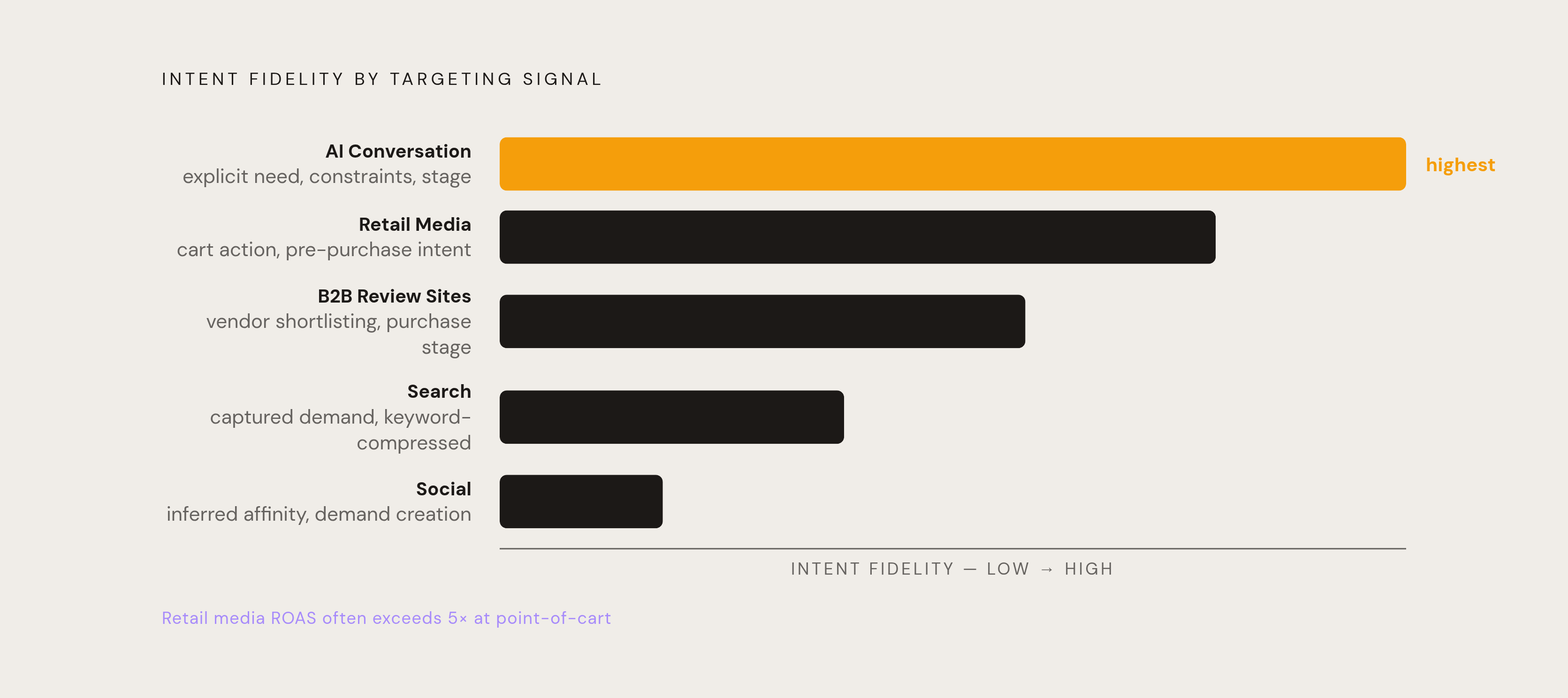
Real-time prompt intent analysis for programmatic advertising means matching an ad to the need, constraints, and decision stage expressed in a live AI conversation. Ranking purchase intent signals across digital ad channels puts purchase-relevant conversations highest for richness, with cart-building and vendor comparison providing strong behavioral confirmation. The planning implication is to judge the targeting signal’s proximity to a buying decision alongside the reach available around it.
Why the unit of targeting determines ad effectiveness, not just reach
Media plans are often judged by reach, CPM, and coverage, with less attention paid to the signal that triggers each placement. That leaves a crucial distinction out of the calculation. Two ads can reach the same person at the same cost, yet one follows a demographic match and the other follows an explicit description of purchase constraints. Their signal proximity to decision is very different.
Intent fidelity names the quality of that connection between a targeting signal and an active buying decision. A lower-reach channel with a stronger signal can outperform a larger channel built on weaker inference. Reach describes the available audience, but it does not establish how ready that audience is to act.
What makes a purchase intent signal high-fidelity
Intent fidelity depends on explicitness, specificity, and proximity to action. Explicitness distinguishes a stated need, such as asking for running shoes, from an inferred preference, such as resembling people who buy them. Specificity distinguishes a broad category from a need bounded by cost, use case, or competing options. Proximity to action distinguishes discovery from a purchase session, with cart-building providing stronger evidence of readiness than general interest.
These dimensions form a spectrum. A signal can reveal a clear category without revealing urgency, or show a late-stage action without explaining the buyer’s reasoning. A signal that is explicit, specific, and pre-purchase provides the fullest account of an active decision. The channel comparisons therefore turn on what each targeting unit reveals, rather than on whether a format is generally considered effective.
Social advertising: demand creation on inferred interest
Social feed advertising starts with inferred affinity. Behavioral and demographic data help a platform predict whether someone might respond to a product category, but that prediction is not an individual declaration of need. The advertiser reaches someone whose profile looks like those of buyers, but who may or may not be looking to buy now. That distinction places social at the lower end of the intent-proximity spectrum.
TikTok can introduce products to people who have not searched for them, making the format well suited to generating interest and purchase impulses. The placement buys attention in a non-purchase context. Evaluating it as though it were a pre-purchase signal confuses the job of the channel with the quality of its execution.
Search advertising: captured demand, but only what a keyword can carry
A person who enters a product query has asked about a product, going beyond a match with a platform’s audience model. Search therefore captures existing demand. This gives it a stronger basis for lower-funnel objectives than social.
Yet the keyword compresses the underlying need. “Project management software” could come from a freelancer concerned about monthly cost, an IT director assessing enterprise security compliance, or a team lead seeking a second opinion on an existing vendor. The category is clear, but the purchase problem is not.
Search advertisers compensate through landing page testing, negative keyword lists, and audience layering. The limitation is not a lack of expressed interest, but the loss of detail when a complex need becomes a short string. That compression leaves room for signals that reveal either firmer behavioral commitment or more of the buyer’s reasoning.
Retail media at the point of cart: intent confirmed by action, not declaration
A shopper selecting items and managing a shopping list is participating in a transaction. The behavior itself indicates pre-purchase commitment. For transactional categories, that makes point-of-cart retail media a genuine competitor to search on intent proximity.
Instacart shows sponsored products during this kind of grocery shopping session. The best grocery retail media ROAS often tops 5.0x at point-of-cart, where the ad reaches someone who is in the process of buying. But the signal depends on the session and is strongest in grocery, CPG, and e-commerce. It does not explain the constraints or priorities behind the cart.
B2B review-site signals: purchase-stage confirmation from competitive comparison behavior
Comparing two specific vendors reveals a narrowed decision. On G2 or TrustRadius, side-by-side comparison indicates that a buyer has moved beyond broad category awareness and is gathering information about shortlisted options. The signal’s strength comes from the stage that this behavior reveals. It does not require the buyer to state a purchase intention.
Second-party review-site intent data consequently provides some of the strongest purchase-stage evidence available for off-site targeting in B2B software and services. Like cart-building, competitive comparison grounds the signal in an action close to a transaction or contract. Within the category, advertisers receive evidence limited to stage and interest, leaving the particular objections, constraints, or reasoning the buyer is working through in the reviews unobserved.
How can live AI prompts become ad signals richer than keywords?
A purchase-relevant conversational prompt can expose what a keyword leaves out. The user can describe constraints, priorities, use-case context, competing options, and progress toward a decision in their own words. That changes the contents of the targeting unit. Instead of identifying only a topic, the signal can describe a problem that an offer might solve.
A conversational thread adds a further distinction. Multiple turns can reveal how a decision develops, rather than presenting each query as an isolated expression of interest. Where keyword targeting requires advertisers to resolve ambiguity after the match, conversational context can supply the relevant constraints at the moment of matching. This is why purchase-relevant conversation sits at the top of the hierarchy for signal richness, though not every conversation expresses purchase intent.
ChatGPT Ads use a natural-language context hint, a freeform description of the conversations in which an ad belongs, matched against the live conversation in real time. Microsoft Copilot uses the context of the whole session, including more than the latest query. These approaches illustrate context-matching rather than keyword matching. Their value lies in the decision detail available to the targeting system.
Advertiser access is a separate question from richness. Advertisers cannot inspect the exact conversation as they would a search term report, and descriptive targeting inputs offer less familiar control than keywords. Reduced visibility creates a real transparency and measurement constraint while the underlying signal remains just as specific.
Why conversational AI intent is still opaque to most advertisers, and what that means for strategy
The context that triggers a conversational placement is not returned to advertisers in the form of a matched query. There is no equivalent search term report or keyword auction to reverse-engineer. The system can use a rich signal while the advertiser sees only a limited account of why a match occurred. This asymmetry changes the work required to target effectively.
Advertisers can respond by writing context hints that describe the problem and the decision stage, in place of comma-separated topic lists. Topic lists produce poor matching because they omit what the person is trying to accomplish and when the offer would help. The skill is closer to programmatic contextual targeting than conventional keyword selection.
That learning gap creates a temporary early-mover advantage. In a relevance-weighted auction, a precise advertiser with a smaller budget can outcompete a vague advertiser with a larger one. The opportunity also extends beyond the immediate placement. Adidas saw a measurable lift in branded search after appearing in LLM conversations, showing that these appearances can bring value through another channel.
How industry categories sit differently on the intent spectrum, and which face the sharpest channel-shift pressure
Pressure to shift channels depends on how much spending goes to search and how much buyers use AI for pre-purchase research. Travel is exposed on both sides of that relationship. A large share of its digital spend goes to search, while visitors arriving at travel sites after using AI platforms have materially lower bounce rates than visitors from non-AI sources. That pattern is consistent with buyers arriving further into a decision.
Technology and electronics face a particularly direct shift. Consumer AI usage is higher in this category than in any other, putting conversational interfaces close to the start of many purchase journeys. Planning therefore needs to account for both the availability of another placement format and whether the most detailed account of the buyer’s need is being generated outside the channels around which existing plans were built.
Healthcare and pharma devote a majority of digital ad spend to search, but their exposure comes with distinct constraints. Inadvertent PHI disclosure concerns and FDA and HIPAA obligations limit what conversational advertising can run and how. Financial advertisers face their own regulatory obligations, with FINRA rules governing broker-dealers and securities firms. These limits make the work harder, but buyers are still changing where they express their needs.
Brand safety and signal quality inside AI interfaces are connected, not separate problems
A brand appearing during an active, specific decision can suffer more reputational damage from harmful context than from a misplaced passive banner. The same engagement that strengthens the commercial signal also makes an inappropriate placement more consequential.
Traditional keyword-adjacency filters do not cover the whole risk. AI-generated prose can describe a product misleadingly or frame a competitor unfavorably without using any blocked term. A filter built to catch explicit or violent language may miss those distortions.
OpenAI places ads below the answer and labels them as sponsored. OpenAI states that ads do not influence ChatGPT’s responses and that conversation content is not shared with advertisers. These boundaries separate commercial placement from the answer itself. The IAB’s first AI Transparency and Disclosure Framework, released in January 2026, recommends consumer-facing disclosures backed by machine-readable metadata using C2PA standards. Each platform and agency can choose whether to put the framework into use.
What the intent hierarchy means for how media plans should be built and evaluated
The planning implication is to evaluate decision proximity before treating impression volume as evidence of value. A plan organized around intent fidelity can justify higher CPMs for moments of greater readiness because a better match reduces waste. Each channel still has a distinct job. Social creates demand, search captures it, retail media and review-site targeting show how people act late in the buying process, and purchase-relevant conversations give the fullest account of the decision.
Generalist DSPs offer reach across channels but cannot read conversational context, while single-surface AI ad networks can read that context within one interface. A DSP built for AI assistant inventory can meet both needs by using conversational context-matching across multiple AI surfaces and working directly with publishers for supply. The capability test is semantic and intent-stage matching in live conversations.
Attribution inside AI-mediated discovery is still unsolved, and the placement’s last click will not show all the value that comes through another channel. Evaluation therefore needs to account for cross-channel effects while distinguishing signal richness from observable performance. The strongest targeting unit provides a better basis for relevance, but its commercial value still has to be measured.