Reconciliation and Invoicing Challenges Specific to AI Ad Channel Spend
AI ad platforms lack the billing infrastructure search and social built over decades.
How conversational AI ad delivery differs structurally from search or display
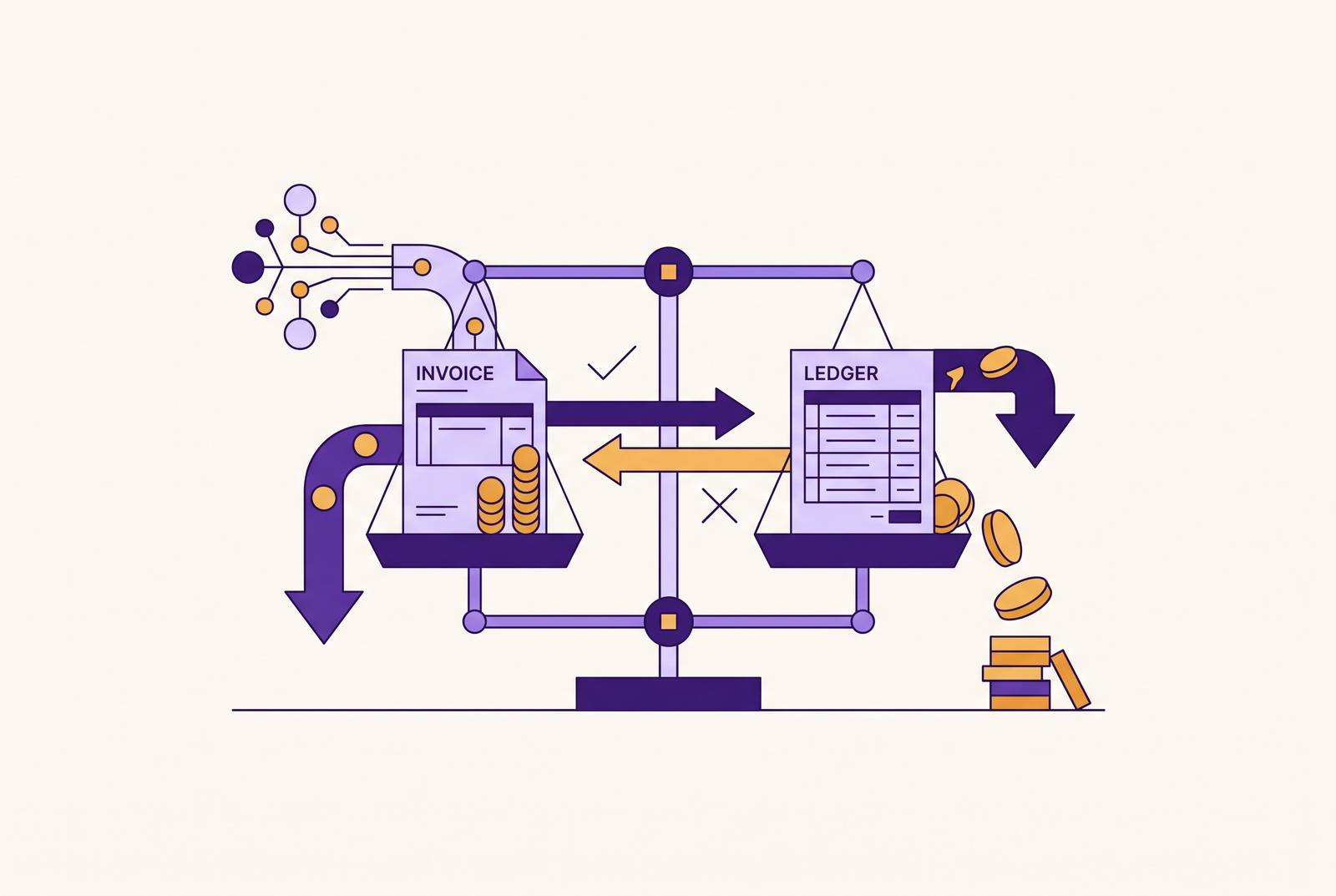
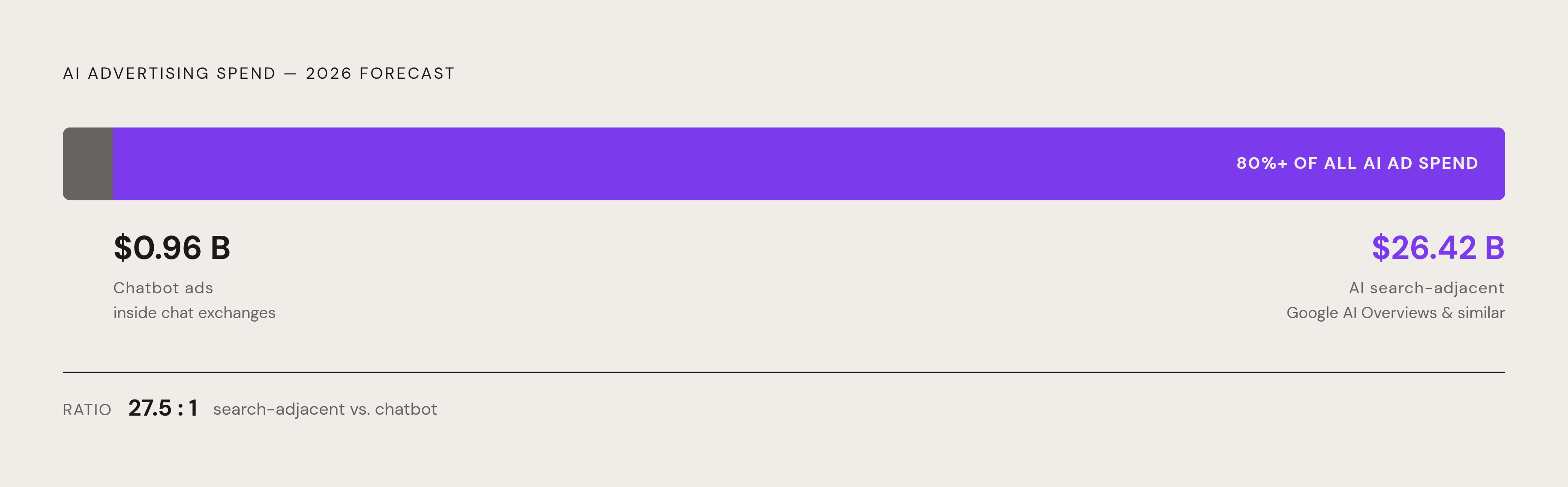
Standalone chatbot ad spending is set to hit $0.96 billion in 2026, up more than 1,600% year over year. AI search-adjacent advertising, the kind embedded in Google AI Overviews and similar surfaces, is forecast to grow 152% to $26.42 billion over the same period. That larger figure carries the real weight: over 80% of AI ad spending in 2026 lands adjacent to AI-generated content rather than inside a pure chatbot exchange, and that split determines what the invoice looks like when it arrives. Billing and reconciliation systems built for search and social were never built for either surface. That mismatch is the reason a gap now exists between what agencies can verify and what platforms report, a gap that appears in the invoices themselves, produced by billing and reconciliation systems never built for either surface.
By 2026, ChatGPT runs at least two ad formats in production: an inline card that appears after the model finishes answering and a product spotlight unit, with additional placements still being reported and disputed. Perplexity's sponsored follow-up chip, a suggested next question a user could tap, shipped in late 2024 and got retired in early 2026. A "response-grounded brand mention," where a sponsor's product gets folded into the model's own answer, isn't a confirmed purchasable format anywhere as of this writing, whatever the speculation around it.
Each format carries its own latency budget, revenue ceiling, and UX cost. Picking among them is not the same problem as picking a banner size or a keyword match type, and treating it that way is where agency planning goes wrong first. The after-answer inline card is the format ChatGPT chose to lead with, and it launched priced at roughly $60 CPM before dropping to roughly $25 within weeks. That swing is, on its own, a reconciliation variable: a campaign running across that window billed at two very different effective rates, and someone on the agency side has to explain the blended number to a client who saw one rate card at the start of the quarter.
Perplexity's decision to phase out its advertising program in early 2026 is the clearest case of what this instability costs. A billing relationship went live, ran, and ended, leaving any active campaigns tied to that surface to absorb the operational complexity a mid-flight shutdown carries. OpenAI's own timeline compounds the point. Testing began February 9, 2026 for logged-in adult users in the US on Free and Go tiers, and ads didn't reach wide availability until spring. Any insertion order signed before wide availability was written against a delivery environment that hadn't been proven out, on a placement structure still moving underneath it.
The meaning of targeting opacity at the platform level for an advertiser's ability to verify spend
ChatGPT matches ads to a conversation's topic, a user's past chats, and past ad interactions. OpenAI has been explicit that advertisers get none of that underlying data: no exportable log, no user-level detail, nothing to check the match against. Call this what it is: opacity by design, not a gap waiting on a future patch. The platform holds the targeting logic, runs the auction, and keeps the delivery record, then hands the advertiser back only what it decides to aggregate.
Walled garden advertising has always put the platform in an odd dual role, participant in the auction and scorekeeper of the result at once. Meta and Google already set the attribution windows, the conversion logic, and the reporting frameworks their advertisers live inside, and advertisers have made an uneasy peace with that arrangement because at least a keyword report exists to pull and check line by line. AI channels take that same structure and strip out the checks that survived it. There's no URL, no placement ID, nothing that functions as an independent audit trail. The advertiser is left taking the platform's number on faith, and that is a worse position than search or social ever put anyone in. Agencies that keep applying search-era verification habits to this channel are applying a checklist to a system that has none of the items on it.
The impression definition problem: what counts as a delivered ad inside a conversation
Web advertising solved impression definition decades ago. IAB standards define a viewable impression as a creative rendering in a visible area for a set duration, and third-party measurement firms verify that count independently of the publisher's own figures. None of that machinery exists for a conversational interface, because the thing being measured doesn't exist until a user types a prompt.
There's no static URL, no DOM element in the traditional sense, no placement ID mapping to a log outside the platform's own systems. The page, if it deserves the word, gets generated fresh, on the spot, for one person, one time, and then it's gone.
Brand safety adjacency makes the stakes concrete. A traditional publisher's page is static and reviewable, so a domain exclusion list actually does something: an agency can confirm an ad didn't run next to flagged content. ChatGPT generates a unique response to every prompt, so an ad could in principle surface underneath a conversation about nearly anything, and no post-buy audit mechanism exists to check where it actually landed. Perplexity's own decision to phase out ads in early 2026 suggests the platforms themselves hadn't settled on a stable definition of a safe, auditable delivery event, not when the content surrounding the ad gets generated rather than fixed.
Rapidly changing platform policies creating moving billing targets mid-flight
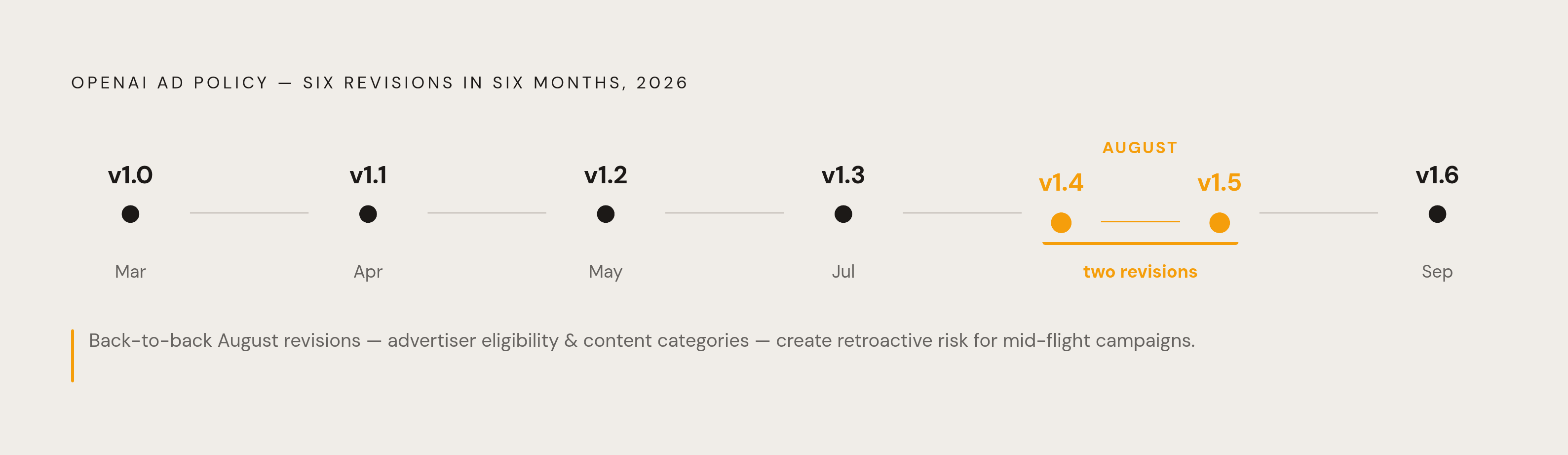
OpenAI published its first Ad Policies in March 2026 and revised them six separate times over the following six months: v1.1 in April, v1.2 later that spring, v1.3 in July, v1.4 and v1.5 in August, v1.6 in September. Several of those revisions touched advertiser eligibility and content category rules, which happen to govern the exact categories where agencies run their higher-value, longer-flight campaigns.
An agency running a multi-month insertion order now has to track which policy version governed which billing period, because a category deliverable in June may not be deliverable in August. That kind of mid-flight restriction creates a delivery shortfall, and someone has to reconcile it against the original IO terms, usually after the fact and usually without a clean process for doing it.
More established platforms have historically offered more predictable policy-change timelines than this channel has demonstrated so far. The pace of change here makes retroactive applicability a live risk rather than a hypothetical one, and no established workflow, on the finance or legal side, answers a question as basic as which version of a platform's terms governed a given delivery period. Invoice review systems weren't built to ask that question, let alone answer it, and agencies that assume their existing audit process covers it are going to find out the hard way.
Retroactive credits, timing mismatches, and the modeled-data problem in AI channel invoices
Even in established platforms adjacent to this space, the billing calendar doesn't line up with the delivery calendar. On Amazon Ads, credits often land outside the billing period they relate to, so a campaign report showing one spend level can get restated once a later period's adjustment comes through. AI ad channels, with billing infrastructure this new, run the same way at minimum, and there's no reason to expect better.
Signal loss compounds it. Privacy regulation and App Tracking Transparency have already cut into how much user behavior platforms can observe directly, and platforms have filled the gap with modeled estimates presented in the dashboard with the same formatting and the same confidence as measured data. An impression count that's partly modeled can't be disputed, because no separate measured number sits next to it to check against.
Then there's the CPM compression. ChatGPT's rate dropped from roughly $60 to roughly $25 within weeks of launch, so a campaign spanning that window billed against a moving average rather than a fixed rate. Reconciling the line items means reconciling against a benchmark that changed because the price itself changed mid-flight. Finance teams already spend an average of 41% of their time gathering and processing data rather than analyzing it, and roughly half take six or more business days to close the books each month. A channel with opaque, non-exportable billing data doesn't ease that bottleneck. It sits directly on top of it.
The agency operational load these mismatches create on top of an already strained workflow
More than a third of full-service and media agencies, 36.8% by recent count, now run ten or more separate tools just to manage client campaigns, a figure that signals how fragmented agency tooling has become. Agency operations leads point to inefficient processes (44.1%) and systems that don't talk to each other (40.4%) as the drag on their workflow. AI channels are arriving into that environment, not into a clean slate, and pretending otherwise is how a rollout plan turns into a quarter of unbillable hours.
Reconciliation for existing, established channels already eats 6 to 12 hours at a mid-sized agency, and agencies reconciling manually across twenty or more clients miss an estimated 15 to 20% of discrepancies. Every complication specific to AI channels, missing exportable data, no placement-level log, retroactive credits, policy-version tracking, adds another manual exception a human has to catch, on top of a process already dropping one discrepancy in five or six before AI spend ever hit the invoice.
Walled garden advertising has always meant accepting the platform's own measurement as the record of truth. AI channels remove even the partial checks agencies used to lean on inside a walled garden, stripping out the third-party pixel, the domain-level verification tag, and the export that let someone cross-check the platform's number against something outside it. Once those checks are stripped away, nothing remains to verify against but the platform's own dashboard, and no amount of added headcount fixes a problem that's structural rather than a matter of hours worked.
What adequate reconciliation and invoicing infrastructure for this channel requires
More manual effort layered onto the existing workflow will not close this gap. Agencies treating it as a staffing problem, adding reviewers, adding hours, are solving a different problem than the one that exists. The root causes sit one level down: no placement-level log, modeled data presented as measured data, policy versions that shift mid-flight, credits landing a month late. Those are structural defects, and structural defects call for new data standards and new verification architecture, not more people staring at dashboards.
On the publisher side, reconciliation needs a per-turn delivery log: a timestamp, a prompt-category classification (not the raw prompt itself, which raises its own privacy questions), and an ad unit identifier. That's the conversational equivalent of an impression log, and it belongs in the ad integration from day one, not bolted on after advertisers start asking where their money went.
On the agency side, an insertion order for an AI channel needs terms most templates don't have yet. It needs explicit anchoring to a named policy version, so both sides know which rules governed the flight. It needs clear credit treatment terms, so a retroactive adjustment follows a defined process instead of a phone call. And it needs a definition of deliverable impression specific to whatever conversational surface is actually being bought, one written for that surface rather than carried over from display.
Any platform reporting AI channel delivery should also have to disclose which numbers are directly observed and which are modeled, by line item, the same way Meta discloses estimated versus reported reach in narrower contexts already. That disclosure belongs in the platform agreement before the first dollar goes out the door, so an agency has the terms in hand rather than discovering them during a dispute six months into the flight.