Audit Trail Requirements for AI Ad Campaign Data Shared With Clients
Agencies must now build audit trails into AI ad campaigns, not assemble them after regulators ask.

Three regulatory events crossed a line in 2026, and together they mean that sharing AI-driven ad campaign data with a client is no longer just a reporting exercise. It's a documentation obligation with specific fields, specific retention windows, and specific penalties attached to getting it wrong. Agencies and platforms that still treat audit trails as something you assemble after a complaint arrives are already behind.
Start with the calendar. On February 23, 2026, COSO published its guidance on internal control over generative AI, and it did something regulators had previously left vague: it specified that effective monitoring of AI-driven processes requires a full audit trail, capturing prompts, inputs, outputs, model and configuration versions, and evidence that a human actually reviewed the output. On March 31, a national regulator announced a dedicated enforcement group under a major financial-reporting oversight law aimed squarely at audit firm misconduct, with AI-touched controls named as in scope. Then, on August 2, the EU AI Act hit a major enforcement milestone: Article 12 logging requirements and transparency rules for high-risk AI systems became active, while other obligations continue to phase in on staggered timelines. Read separately, these look like three bureaucratic updates. Read together, they describe a shift from guidance to enforcement, and advertising, because it now runs through generative models at almost every stage, sits directly in the blast radius.
The cost of ignoring this isn't abstract. Reconstructing an audit trail after the fact, once a regulator or an aggrieved client has already asked for one, is a costly and time-consuming process, and even then the record often comes back incomplete. Reconstructing an audit trail after the fact is a real operational and legal risk rather than a compliance inconvenience, and the record often comes back incomplete regardless of the effort spent. Having that record means being able to rebut an enforcement narrative; lacking it leaves nothing to rebut with.
The 12-field minimum schema every AI ad audit trail must capture
Treat this as a floor. Any AI-influenced decision in an ad campaign, including a targeting call, a creative variant selection, or a bid adjustment, needs a record containing at least these twelve fields. It needs an NTP-synced UTC timestamp (clock drift is no longer an acceptable excuse to auditors), a unique decision ID that lets a specific decision be reconstructed on demand, an authenticated human user identity rather than a service account or API key, the AI system's identity and version, the specific model identity and version (pinned, not just "GPT-4" with no build number), the inputs received along with their source, the specific policy or prompt invoked, a human-readable explanation of the reasoning (a confidence score is not an explanation), the output produced, the downstream action taken, evidence of human review with the reviewer's identity where applicable, and a tamper-evident integrity proof, usually a cryptographic hash.
The field most often missing is authenticated human identity. AI systems routinely touch regulated data under a service account or shared API key, and no log records which person actually directed that access. This is where HIPAA's unique user identification rule, GDPR's accountability principle, and SOX's audit trail requirements converge on the same demand: attribution to an individual. Finance teams, when they go looking, tend to find the same three gaps first: service-account attribution standing in for a person, confidence scores standing in for reasoning, and retention windows shorter than what the relevant framework actually requires.
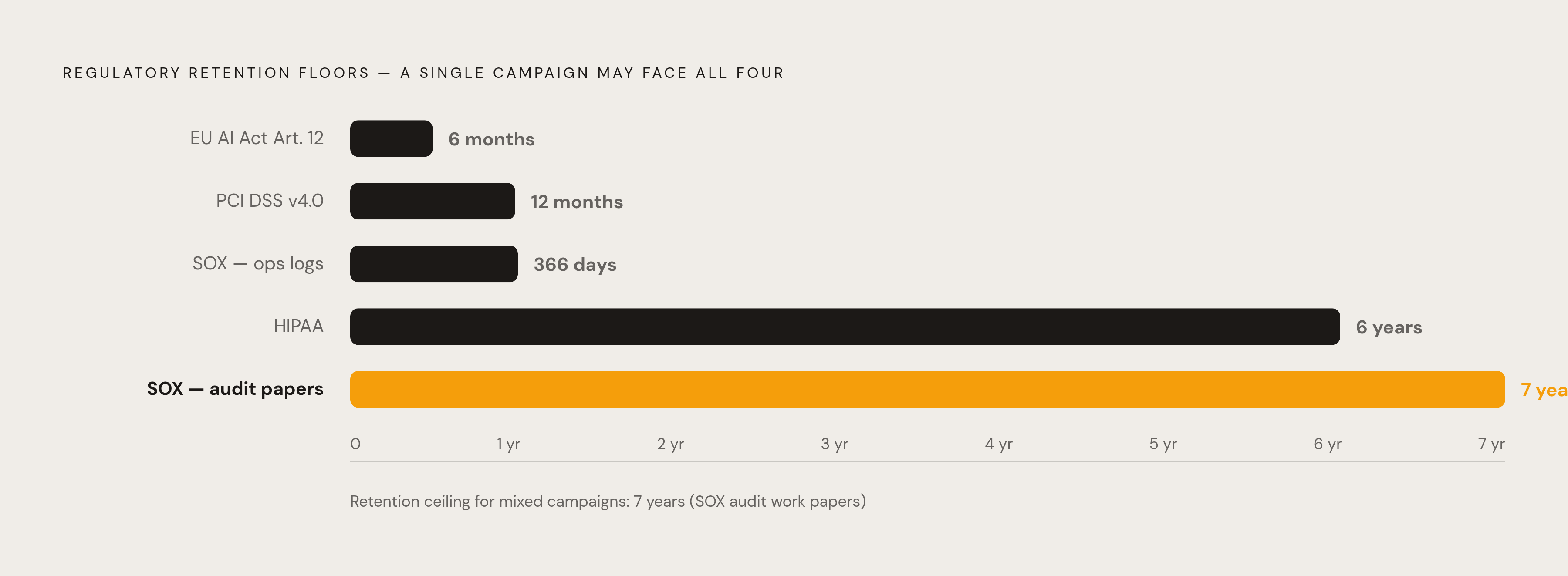
Retention floors vary by framework, and they don't harmonize neatly. SOX requires at least 366 days of operational logs and seven years of audit work papers. HIPAA sets six years. PCI DSS v4.0 wants twelve months of records with the most recent three months immediately retrievable. The EU AI Act's Article 12 sets a floor of six months for high-risk AI systems. An agency running a single campaign across a fintech client and a healthcare client is, in effect, satisfying four different clocks at once, and the shortest one doesn't excuse the others.
Multi-regulation overlap in AI ad campaign documentation
A single fintech email campaign can touch GDPR consent requirements, CAN-SPAM header rules, CCPA opt-out obligations, and FTC truthful advertising standards, all at once, all inside one send. Add in that as of mid-2025 nineteen states in one country. states had passed comprehensive privacy laws, each with its own variation on opt-out rights for targeted advertising, and the manual-tracking approach that many agencies still rely on becomes structurally impossible to sustain. No spreadsheet tracks nineteen state-level opt-out regimes across a live campaign roster in real time.
The EU AI Act's Article 50 adds two obligations that apply regardless of whether an agency has any physical presence in Europe. Providers of generative AI systems must mark their outputs in a machine-readable format that identifies the content as artificially generated. Deployers, separately, must disclose when a user is looking at AI-generated or manipulated content published to inform the public on matters of public interest. The penalty for skipping either one runs up to €15 million or 3% of global annual turnover, whichever is higher, and that "whichever is higher" clause matters: for a large enough company, the percentage figure dwarfs the flat one. Under the AI Omnibus provisional agreement from May 2026, systems already on the market before August 2, 2026 get a grace period, until December 2, 2026, to meet the machine-readable marking requirement. That's a near-term deadline, not a distant one, and it's still open for a lot of agencies running generative ad creative today.
New York's AI Disclosure Law took effect in June 2026, adding another entry to the state-level patchwork. None of these frameworks were written with the others in mind. They just overlap, and the overlap is where the documentation burden actually lives.
The audit obligations conversational AI advertising adds beyond legacy ad reporting
Attention has shifted, at scale, toward AI assistants, and platforms including ChatGPT, Microsoft Copilot, Google AI Mode, and Perplexity have all started serving ads inside conversational sessions. Chatbot-native ad spend is still a small slice of the market, but it's growing fast, and it introduces an audit problem that page-based ad serving never had to solve.
An LLM, on its own, in a single call, faces structural limitations around real-time catalog grounding, tracked click attribution, publisher account routing, and per-user frequency enforcement across what are, technically, stateless calls. A model trained months earlier and running stateless on every request has no built-in mechanism for any of that. Which means the audit trail has to do the work the model architecturally cannot: it has to compensate, in the record, for capabilities the model simply doesn't have.
That compensation adds requirements on top of the twelve-field schema, not instead of it. The audit record for a conversational placement needs the actual prompt or conversational turn that triggered the ad, not a keyword and not a page URL, but what the user actually expressed. The absence of a documented targeting rationale in language a person can read creates a meaningful gap under GDPR's accountability obligations on a surface that didn't exist when that rule was written; it requires the model's interpretation of that intent, written so a person can read it. It needs the version of the context-matching logic in effect at the moment of placement, tracked separately from the version of the creative itself. It needs evidence that the conversation didn't touch sensitive categories, health, finance, legal, that would trigger heavier disclosure obligations. And it needs documentation that the ad was actually marked as an ad inside the conversation, satisfying the EU AI Act's machine-readable marking requirement for AI-generated content at the point where the user actually sees it.
Content approval workflows as audit infrastructure
Approval workflows get treated, in most agencies, as an editorial checkpoint: someone signs off on the copy before it goes live. That framing undersells what the workflow is actually doing. A compliance-grade approval process is the mechanism that builds the audit trail as the campaign runs, in real time, so nobody has to reconstruct it later from memory and email threads.
To do that job, the workflow has to capture, at every stage, who approved the content and when, tied to an authenticated identity rather than a name typed into a form. It has to record which version of the content was actually reviewed, because production assisted by one model generates iterations fast enough that without version control, nobody can say with confidence that the version that got approved is the version that got published. It has to log which compliance rules the content was checked against and what the result of each check was. And it has to capture whether an escalation path got triggered, and why.
The pace at which AI lets a team produce ad copy and creative variants makes this urgent rather than optional. AI lets a team produce ad copy and creative variants at a pace that makes manual, spot-check review structurally inadequate: the same speed that makes AI valuable for output is the speed that breaks the old review model. Compliance-grade systems solve this by logging every rule check, every flag, every approval, and every enforcement action into an immutable, timestamped trail from the moment the system deploys, rather than waiting for a request to trigger reconstruction. Having that record means handing a regulator a complete record; lacking it means spending weeks piecing one together from scattered spreadsheets, with gaps in exactly the places that matter most.
What client-facing audit trail delivery requires, the reporting layer agencies routinely skip
Most agency reporting to clients still stops at performance: impressions, clicks, spend, maybe a conversion curve. It rarely covers the AI decision trail that actually produced those numbers. Regulators are starting to ask for that trail, and sophisticated clients, particularly in regulated industries, are starting to ask for it too.
A client-facing audit record needs to let the client do four specific things. Reconstruct which AI system and version made a given placement decision, and when. Verify that human review actually happened at the checkpoints the agency claims it happened. Confirm that the targeting logic disclosed to the client matches the actual context-matching rationale the system used, not a simplified summary of it. And demonstrate, to the client's own auditors or regulators, that the agency's AI systems operated inside the parameters the two parties agreed on.
A provenance obligation connects all four of those: every piece of content should carry a documented history of when it was created, by what process, who reviewed it, and what approvals it received, so that when a question comes up, the full history can be pulled quickly and accurately rather than assembled under deadline pressure. Clients in financial services or healthcare face their own auditors asking about AI-driven decisions the agency made on their behalf, and the agency's audit trail is the only thing that answers those questions. A gap in the agency's records isn't just the agency's problem at that point. It becomes a gap in the client's own compliance posture, inherited without the client ever having touched the system that created it.
Building audit trail infrastructure that is purpose-built for conversational AI ad environments
Legacy ad tech logging was built for a page-based, session-based serving world, where the record consists of a URL, a placement ID, a creative ID, and a timestamp. That's a coherent schema for banner ads and search results pages. It has almost nothing to offer a conversational placement.
Conversational ad placements don't have a URL. They don't have a persistent session in the way a browser session is persistent. They don't have a static creative asset sitting in an ad server waiting to be logged. What they have instead is conversational context, a prompt-level signal of intent, and a model's interpretation of that context, none of which fit into the fields a legacy ad platform was built to capture. Trying to force a conversational placement through a page-based logging schema doesn't just lose detail. It loses the entire category of information a regulator or a client would actually need to reconstruct the decision.
Building for this environment means the audit infrastructure has to be designed around conversational primitives from the start, not retrofitted onto systems built for display and search. That means capturing the prompt, the model version doing the interpreting, the targeting rationale in readable language, and the disclosure marking, as native fields in the log, built into a schema designed for conversational primitives rather than one built for a URL that no longer exists in this context. The frameworks converging in 2026, COSO's guidance, the SEC's dedicated enforcement group, the EU AI Act's transparency rules, all point the same direction: the record has to be built as the decision happens, because reconstructing it later carries serious operational and legal risk.
Sources
- Explainable AI in Marketing: Build Your Audit Trail
- influencers-time.com
- Audit Trails and Explainability for Compliance: Building the Transparency Layer Financial Services Cannot Ignore | by Lawrence Emenike | Medium
- AI Decision Audit Trails: Regulator Rules June 2026
- AI Model Audit Trail Documentation Requirements: Regulatory Compliance & Automation Analysis 2025
- charlesrussellspeechlys.com
- billo.app
- finrep.ai