White-Label Reporting Configurations for AI Ad Campaigns
Old ad metrics fail when ChatGPT becomes your channel.

What the conversational AI ad channel produces as raw signal
Most white-label agencies still build client dashboards around the same four fields they've used for years: impressions, clicks, CTR, and ROAS. That works fine for search and social. It falls apart the moment an agency starts running ads inside ChatGPT, because a conversational placement generates a different kind of signal entirely, one built on prompt context, conversation stage, and topic match. None of those has a home column in DashThis or AgencyAnalytics, and no amount of custom labeling fixes that.
Three things get lumped together under "AI reporting" right now, and agencies that conflate them end up with dashboards that look sharper but say nothing new. Reporting on actual AI ad campaigns is one thing. Tracking brand visibility inside AI search results is another service category entirely, the kind of work tools like LLM Pulse or Ayzeo are built for. Using a model like Claude to write up legacy ad reports faster is a third, and it's the one agencies default to because it's easiest. That last shortcut saves time, but the output stays impressions-era metrics dressed in cleaner prose. None of it tells a client why a conversational placement actually worked, and treating any of the three as a substitute for the others is a mistake.
Take ChatGPT's ad inventory as the reference case, since it's the most documented surface right now. Ads appear as a labeled "Sponsored" block underneath the organic answer, not woven into the response text itself. In search, a single keyword triggers a placement. In a conversational surface, it's the prompt and the shape of the dialogue thread leading up to that point. The same product can trigger an ad in one conversation and not another, depending entirely on how the user framed the question three turns earlier.
At least one confirmed placement surface exists, an inline sponsored card after the answer, and additional formats have been reported, though not all have been officially confirmed by OpenAI. Each carries its own UX cost and its own revenue ceiling. OpenAI has also committed to what it calls "Answer Independence," meaning the ad can't shape the model's actual answer. The answer stays unbiased. The ad sits next to it, not inside it.
That mechanic produces a signal set with four real components. Prompt-level context captures the topic and intent active in the conversation at the moment the ad displays. Conversation stage tells you whether the person was exploring a problem cold, comparing named options, or already down to a shortlist. Topic match measures how well the ad category actually fit the conversation. And a depth signal tied to multi-turn retargeting, which has been reported as a planned capability, will start separating users who had a long, substantive exchange about a product category from someone who glanced at one answer and moved on.
Page content, time of day, device type, anonymized interaction logs: these feed the ad system, but they're inputs, not outputs. A report that lists them as targeting checkboxes is reporting on the machine instead of the result it produced. Report what the machine produced.
On cost, the after-answer sponsored card runs CPM in the tens of dollars, a useful anchor for any client budget conversation. A four-part pipeline no LLM runs on its own produces all of it: live catalog grounding, tracked click identifiers, attribution routing, and frequency caps. That matters for reporting accuracy, because the number landing in an agency's dashboard came from a specific layer of that pipeline, and getting the layer wrong means mislabeling the metric that lands in front of a client.
This isn't a niche curiosity to file away for later. ChatGPT ads showed up in 51% of US replies as of early July 2026, and the placement had expanded to more than 40 countries by August 2026. Solving the reporting problem is this year's task, not next year's roadmap item.
The reporting fields legacy templates are missing and their replacements
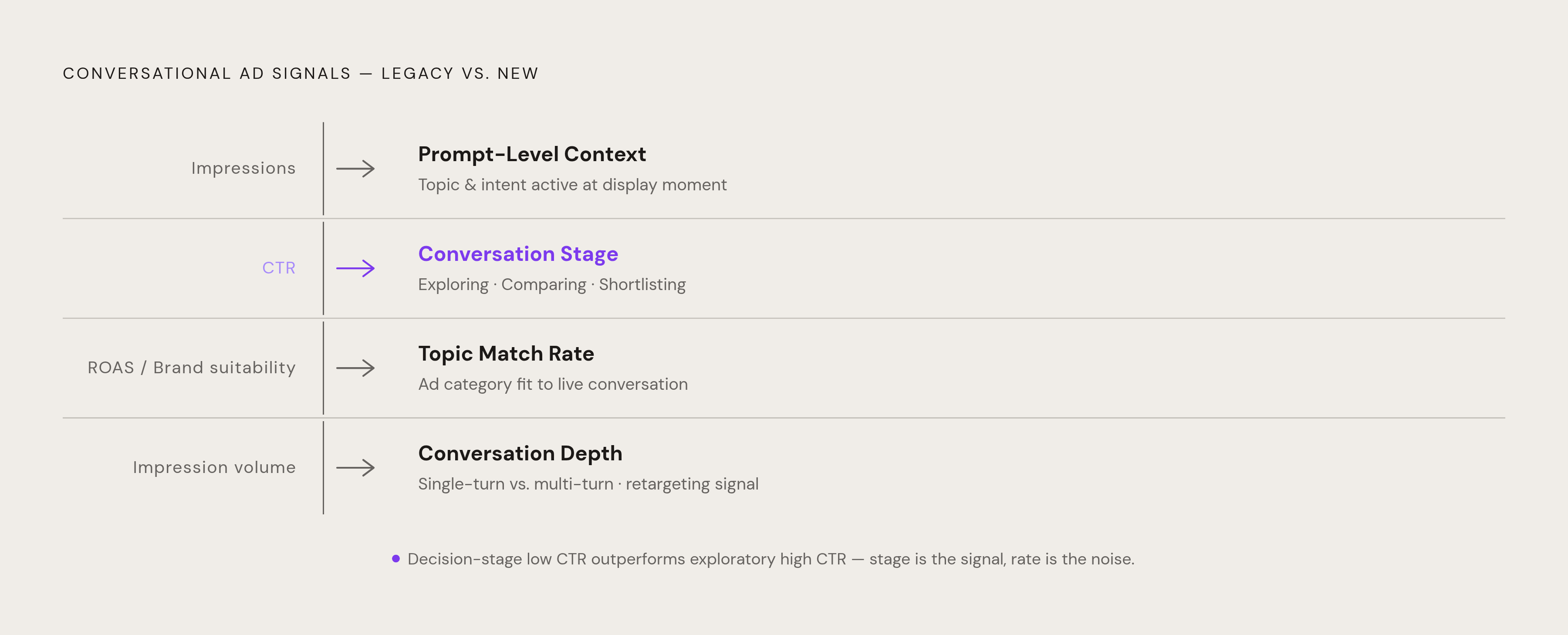
Impressions count how often an ad displayed. They say nothing about whether the conversation around it mattered. An impression served during a casual cooking question and one served during a serious product comparison look identical in the export, even though they're worth nothing alike to a client trying to close deals.
CTR has the same blind spot. It measures reaction to the ad unit and ignores where the user stood in the conversation. A low CTR on a decision-stage query can outperform a high CTR on an exploratory one once you look at what happens downstream. ROAS still matters as an end-of-line metric, but on its own it stays disconnected from the conversational signals that actually explain why it moved.
The fix is not cosmetic. Slapping a logo and a custom domain on the old template solves nothing, and neither does adding new fields alongside the old ones without retiring anything. The old fields need replacing, not company.
An intent-tier breakdown segments impressions and clicks by conversation stage, exploratory, comparative, or decision-ready, pulled from prompt classification. A topic match rate reports the percentage of served impressions where the ad category actually lined up with the conversation subject, functioning as both a brand-suitability check and a targeting-quality check. A conversation depth distribution shows the split between single-turn and multi-turn sessions where the ad appeared, a rough proxy for how far along the user was in a purchase decision. A high-intent impression share, the portion of total impressions landing inside decision-stage conversations, should replace raw impression volume as the number a client actually watches.
Placement surface breakdown matters just as much. Blend confirmed and unconfirmed placement formats into a single CTR figure, and the number stops meaning anything, because each surface carries a different UX cost and a different baseline expectation. CPM and frequency carry over from the old template, but they need tighter definitions. CPM should get reported per surface, not blended across placement types. Frequency needs to account for caps enforced at the pipeline level rather than getting inferred from raw impression counts, which will misstate it every time.
None of these terms are self-explanatory to a client who's spent years reading Google Ads reports. Each one needs a one-line definition sitting right in the report. Skipping that step means the new fields just read as jargon nobody asked for.
Dashboard architecture decisions before the first client report is built
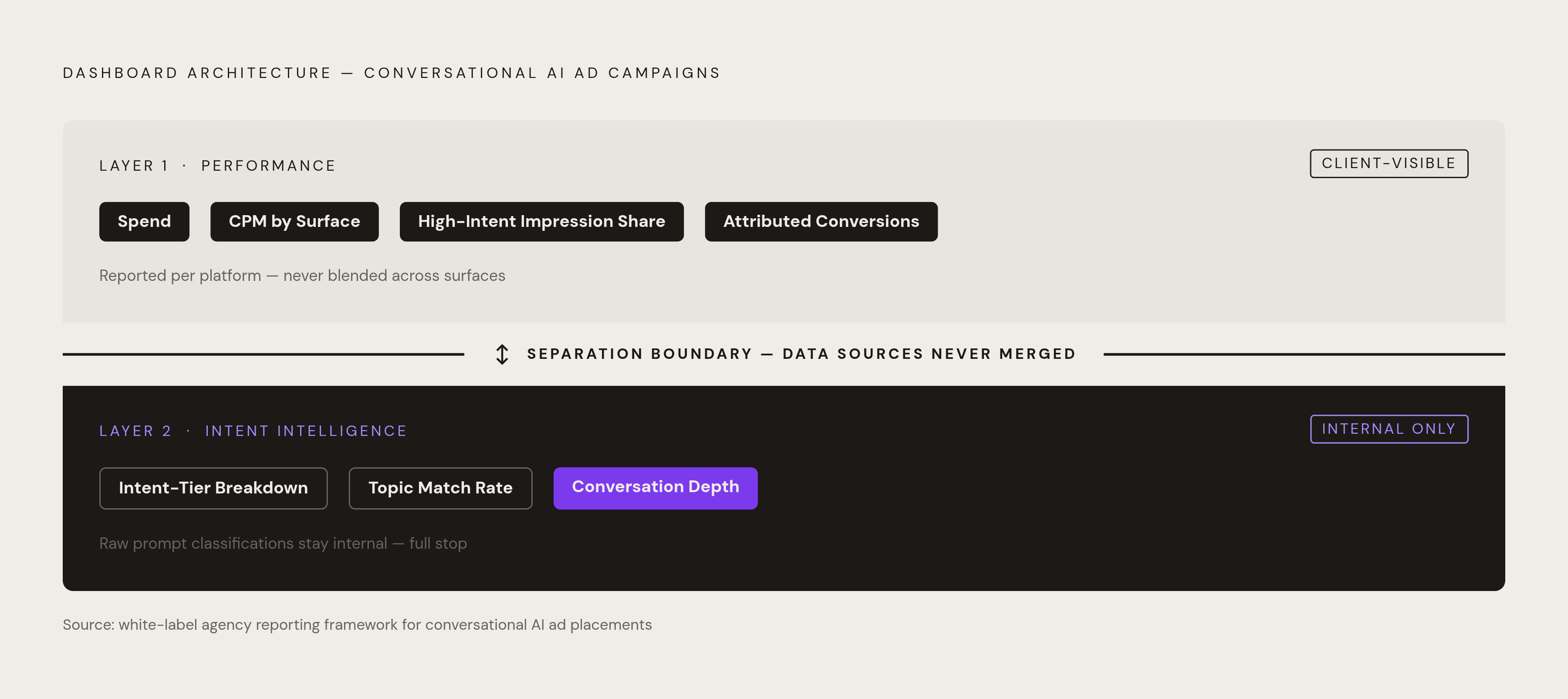
A white-label dashboard built for Google and Meta schema has no native place for conversational signals. That gets solved at the architecture level before the first report goes out, not patched in after a client asks a question the dashboard can't answer.
A two-layer structure handles it cleanly. Layer one is the performance layer, the numbers a client actually watches: spend, CPM by surface, high-intent impression share, attributed conversions. Layer two is the intent intelligence layer, the conversational data explaining why layer one looks the way it does: intent-tier breakdown, topic match rate, conversation depth.
Keep conversational AI data as its own source inside the dashboard. Don't merge it with Google or Meta campaign data. A blended CPM across a search platform and a conversational surface is a meaningless number, and merging the sources erases the intent-signal story that's the reason for building this.
On tooling, general-purpose platforms like DashThis, running $49 a month for three dashboards or $149 a month for ten, offer custom-domain white-labeling on the higher-tier plans and flexible custom fields. But conversational AI signals won't arrive as native integrations. An agency has to map those fields by hand. That's a real cost up front, and it only has to happen once: the documentation from that mapping work becomes something the agency owns, a genuine asset rather than a sunk cost.
Refresh cadence needs rethinking too. Weekly reporting cycles carried over from SEO work, or monthly cycles from traditional media buying, move too slowly for a channel that's real-time by nature. Daily data refresh, with weekly narrative summaries layered on top, is the minimum that keeps pace with how fast intent shifts inside a conversation-driven channel.
Access control deserves a hard line. Conversation-depth data and topic-match detail sit closer to proprietary intelligence than to a standard metric, and treating them as public-facing dashboard fields gives it away for free. Client-facing views should show the conclusions drawn from that data. The raw prompt classifications stay internal, full stop.
Configuring the client-facing narrative layer on top of the data
Pulling campaign data across multiple surfaces and writing it up in plain language used to take two to four hours per client. AI-assisted synthesis has cut that down to somewhere between five and fifteen minutes per account. That speed only pays off if the narrative layer gets fed the right inputs, and most agencies skip straight to the speed gain without first feeding the narrative layer the right inputs.
A conversational AI report has to do work a search report never had to. It needs to translate an intent-tier breakdown into something a client can actually read: your ads reached people who were actively comparing vendors, not idly browsing. That is why CPM ran higher and CTR ran lower than the Google benchmark, and why the conversions that did happen converted better downstream. It needs to explain what the available ad surfaces are and why CTR expectations differ across them, since the client has no prior reference point for any. And it needs to translate conversation depth into language the client already uses internally, awareness, consideration, decision, instead of making them learn a new vocabulary from scratch.
The model writing the narrative can't take raw impression exports as its input. Feeding it legacy metrics only produces output that reads fluently while saying nothing the channel actually produced. It needs the intent-tier breakdown and the topic match rate already structured and already labeled before it starts generating sentences.
Custom domain, logo, color palette: table stakes at this point, and platforms like DashThis already handle that infrastructure well. What's configured underneath it drives the differentiation, not how it's skinned.
A standing glossary block inside the report template itself, covering intent tier, topic match rate, conversation depth, and high-intent impression share, is one more piece worth building once and reusing forever. Setting it up once means it never needs rewriting month to month.
Positioning this reporting capability when pitching and retaining clients
The channel remains early-stage, and the space is getting filled by challenger brands willing to move first; the agencies that can actually report on conversational AI performance are the ones equipped to serve them.
The pitch is the ability to read purchase intent at the level of an individual conversation, something no legacy reporting stack touches. The dashboard is the evidence for that claim. An agency that can't show intent-tier breakdown or topic match rate in a client meeting is making the same pitch as everyone else running Google Ads exports through a template.
On retention, intent-tier and conversation-depth data gives a client visibility into their own buyers that Google Analytics or Meta Ads Manager simply doesn't offer. Whoever configured that reporting infrastructure owns that view of the client's audience, and once a client relies on it, walking away from it carries a real switching cost, not a hypothetical one.
Pricing tracks with that value. ALM Corp reports that agencies running AI-powered service packages see SMB pricing in the $800 to $2,500 a month range, with enterprise arrangements reaching $5,000 to $10,000 a month. Conversational AI reporting with a real intent intelligence layer earns a place at the top of that range. Agencies that treat it as a bolt-on to their existing search package belong at the bottom of it, and pricing should reflect which one they're actually offering.
What agencies shouldn't do is promise a specific CTR lift or a guaranteed ROAS improvement for conversational placements without signed campaign data behind it. That promise doesn't hold up, because the channel is too new and too variable by surface for anyone to benchmark it against search or social with a straight face. The honest pitch is better visibility into intent and earlier access to high-intent buyers.
Category framing shapes how a client interprets every metric that follows it. Conversational AI advertising isn't search advertising, isn't social advertising, and isn't a chatbot that closes sales on its own. Reporting infrastructure should reinforce that distinction instead of flattening it by forcing every conversational metric into a Google Ads equivalent. Clients who understand the channel on its own terms are the ones who buy into it and stay past the first renewal.
Whether the agency's supply relationships cover more than one AI surface, or whether the entire reporting story runs on a single assistant's user base, is a differentiator worth raising directly in a pitch. Single-surface reporting locks a client's intelligence to whatever slice of the market that one assistant reaches, and that's a technical limitation with a direct business consequence: the client's view of their own buyers is only as wide as the surface the agency happens to have a deal with.
Sources
- AI Ad Optimization Platform White-Label | RapidDev
- Best White Label AI SEO Software for Agencies and SaaS in 2026 - LLM Pulse
- White Label AI Marketing Services for Agencies: The 2026 Guide to Scaling Revenue Without Expanding Headcount | ALM Corp
- White-Label AI Visibility Reports - Branded PDF Reports for Agencies | Ayzeo