The Builders Who Coined Conversational AI Advertising Before the Category Had a Name
Early builders shaped conversational AI advertising before platforms existed to validate it.

A conversational AI advertising platform places paid messages inside live AI conversations by matching offers to the user’s context and intent, rather than simply adding a chatbot to a brand’s website. ChatGPT and Microsoft Copilot provide such placements, while Perplexity wound down its sponsored-answer program. The category’s defining achievement was the logic its early builders established before platform validation, namely context over keywords, conversation as signal, and intent over impression.
Why the founding logic of a category matters more than its founding moment
Conversational AI advertising presents an unusual sequence of events. The category has a name and live ad auctions on major platforms, yet its operating assumptions were worked out before those advertising systems existed. Its builders had to decide what an advertiser was buying before they had a settled mechanism for selling it. Infrastructure followed an argument about how conversations create commercial value.
Early choices become the defaults that later entrants use for targeting controls, auction rules, and how they define performance. What begins as a provisional judgment can become a platform requirement. The history is therefore less about who arrived first than about which assumptions practitioners now build into their systems.
What the old architecture assumed, and why those assumptions do not survive in a conversation
Traditional digital advertising was organized around pages, keywords, cookies, feeds, and clicks. Legacy contextual targeting reads a webpage’s headline, body text, and metadata, then maps that static content to a predefined category. A conversation generates its content in real time, and each turn can change what the exchange is about. A classification made at the start can lose relevance before an ad appears.
Keyword bidding introduces a different mismatch because it treats an externalized string as the targeting input. A user asking “what about vegetarian options?” has supplied words, but not enough context to interpret them. What came earlier in the conversation gives the question its meaning. Targeting must therefore keep discourse coherence by linking the latest turn to the discussion so far.
Cookie-based targeting instead reconstructs behavior across sessions through persistent identifiers. The conversational model works from the discussion happening now, without needing that cross-session reconstruction. There may also be no feed of separate items where another item can be added. The assistant’s answer belongs to an unfolding exchange, so a placement must relate to that exchange without being mistaken for the answer itself.
Even the expected outcome changes its form. An ad adjacent to an answer may alter which brands a user considers without producing a click. That creates a break between exposure and the standard unit of performance accountability. The incompatibility lies in older systems’ inputs and outputs, which do not map cleanly onto conversation.
The three ideas the category's founders had to invent before any platform validated them
Context over keywords required a new description of relevance. Its primary targeting control is a natural-language context hint, a freeform account of the conversations in which an offer belongs. A keyword asks which string a person typed. A context hint asks what that person is trying to accomplish and whether the offer helps at that point.
That distinction becomes concrete when someone discusses team coordination and remote collaboration without mentioning “project management software.” A contextual reading can recognize the underlying need across the exchange. The inventive step was to make that inferred situation the targeting input, rather than require the user to name the product category first.
Conversation as signal then changed the unit being interpreted. The relevant object is the conversation state, including the user’s statements, the assistant’s responses, the active topic thread, and the apparent goal. A conversation also has a trajectory with targeting value. What the user has ruled out or asked next can change the relevance of an offer even when the broad subject stays the same.
This required more than a larger keyword field. The transformer architecture underlying modern LLMs does not natively maintain conversational state. Applications achieve coherence by re-injecting prior turns into the context window. The founding insight was that the representation used to sustain an answer could also support an assessment of advertising relevance. Microsoft Copilot’s whole-session triggering puts that principle into practice, while its separate “ad voice” presentation explains the connection to users.
Intent over impression extended the same reasoning into buying. Rather than treating every exposure as equivalent, the conversational model distinguishes research mode, comparison mode, and decision mode. Early exchanges can draw awareness-level advertising, while threads that go deeper can support conversion-focused placements.
The relevance-weighted, second-price auction expresses this choice in allocation. A more relevant ad can beat a higher bid, allowing precise context-matching to compete with budget scale. That ordering was a choice to let relevance help decide who wins the opportunity. The three ideas thus required new representations of the user’s situation, the targeting unit, and the value being purchased.
How four platform decisions in 2024 and 2026 put the founding logic to the test
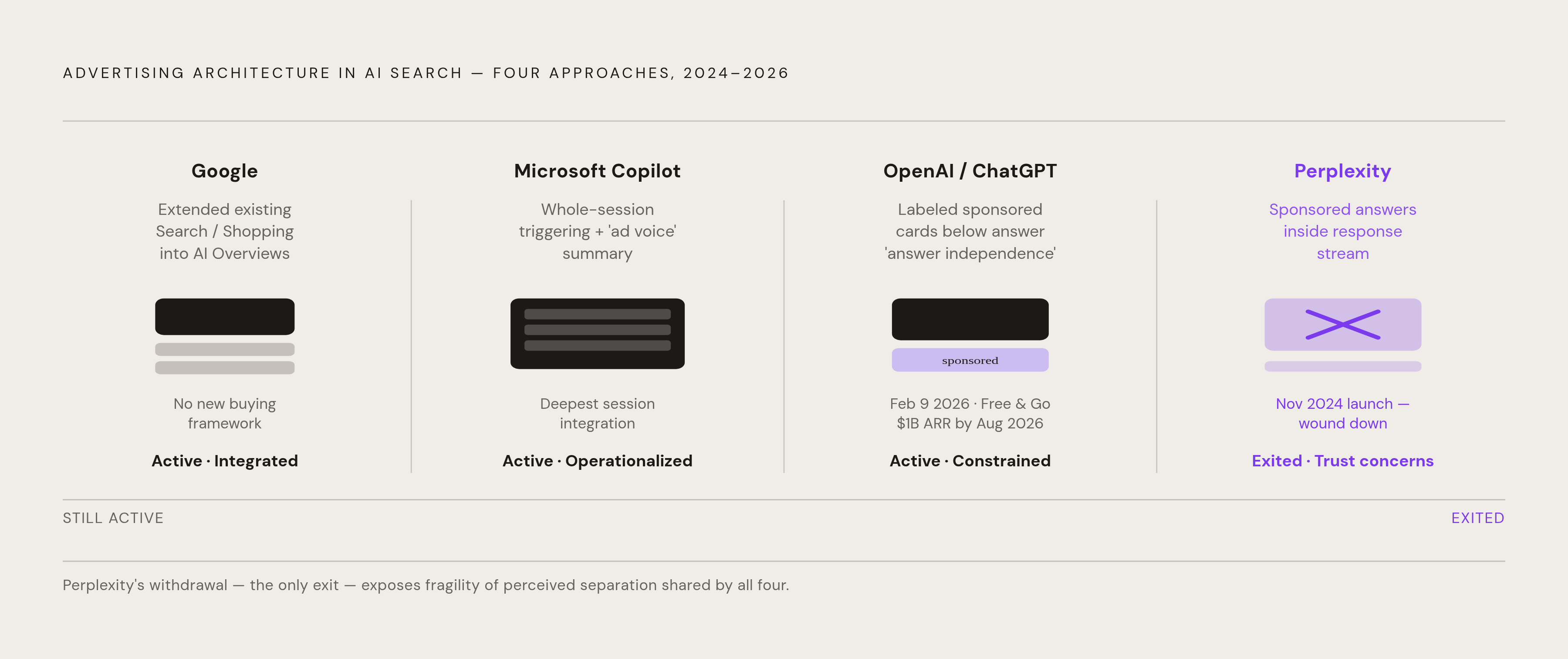
OpenAI launched ChatGPT ads on February 9, 2026, after three years of saying the service would not include advertising. Its format makes the boundary explicit. Labeled sponsored cards appear below the assistant’s answer and are never part of the answer text. OpenAI’s design, which it calls “answer independence” and describes as keeping the answers ChatGPT gives users independent of ads, tests whether conversational relevance can support advertising while preserving that independence.
OpenAI reported that ChatGPT Ads had reached $1 billion in annualized revenue run rate by August 31, 2026, with ads expanded to dozens of countries. Reach nevertheless has a tier boundary. Ads reach Free and Go users, while Plus, Pro, Business, Enterprise, and Education remain ad-free. The scale validates demand for the surface, but the tier restriction means its available audience is not the entire ChatGPT user base.
Google made a different architectural choice by extending existing campaigns into AI Overviews and AI Mode. Campaigns that qualify include Search using broad match or AI Max, Performance Max, and Shopping, and smart bidding is recommended. There is no opt-in or opt-out for qualifying campaigns. Shopping ads with Direct Offers also run in AI Mode. Google’s approach tests whether existing campaign infrastructure can serve conversational surfaces without making advertisers learn a whole new way to buy ads.
Microsoft operationalizes the session-level interpretation more explicitly in Copilot. Ads are triggered by the whole conversation within a single session. Its “ad voice” is a user-facing summary that acknowledges the organic response and introduces advertisers’ messages. Eligible campaign and ad types are automatically opted in, placements are assembled from existing account assets, and display is not guaranteed.
Perplexity tested the trust premise from another direction. It launched sponsored answers in November 2024 as the first major LLM to integrate advertising, then wound the program down over concerns that sponsored placement could make users suspicious of the whole answer. It therefore does not represent the same deployment option as ChatGPT or Copilot. Its withdrawal suggests that even when ads fit the context and have labels, users may still doubt that the ads and answers are kept separate.
Google calls into question the need for a whole new campaign framework, while Microsoft shows how session-level relevance can work in an existing advertising business. OpenAI gives answer independence a visible format, but Perplexity exposes the fragility of perceived separation. None of those outcomes, by itself, validates every founding assumption.
What prompt-level intent data reveals that no prior signal could
A prompt is not merely a longer keyword. It can disclose the reasoning behind a purchase before the user has formed a brand preference. Someone moving homes may talk about budget limits and sustainability priorities over several exchanges, without any one query giving the whole picture. The commercial signal lies in the relationship between those constraints, revealing how the person is forming a preference.
AI chat already begins the pre-purchase digital journey for a meaningful share of users in some categories, with travel among the prominent examples. Initial prompts are often unbranded. An advertiser can therefore become relevant while category-level preferences are still taking shape, rather than only after the user has selected familiar options to compare.
A keyword records what someone asked, while a cookie-based history holds traces of what they did earlier. A conversation can make the current trade-offs explicit and show how they develop within the session. Its value comes from the structure of that reasoning.
The privacy consequences follow from the same distinction. Explicit session context does not depend on cross-site identifiers, so its usefulness does not erode through the same losses of cookie consent and signal. Yet systems still have to protect the privacy of the intimate details in conversational context. Signals also arrive in real time, allowing brands to see emerging interest as it surfaces rather than only through later aggregated behavioral reports. That immediacy gives the founding preference for intent a practical basis without settling how such intent should be valued.
Why the founding logic produced a structurally different kind of platform
A conversational AI advertising platform needs more than available inventory. It must interpret multi-turn context, identify an intent stage, and connect a placement to the active discussion. That separates the category from adding a chatbot to a company website. A site chatbot provides a conversational interface, but that function alone does not create a system through which brands buy paid placements across live AI conversations.
The market’s infrastructure gap has two distinct sides. Generalist DSPs offer cross-surface reach, but their page-level foundations do not provide discourse coherence or bidding on conversational intent stage. Single-surface AI ad networks can read the conversations on their own surface, but cannot reach users in other conversational environments. Contextual capability and distribution are therefore separate requirements. Possessing one does not establish the other.
Relevance-weighted allocation needs a way to judge how well an offer fits the conversation before bid size can decide the outcome. A buying interface alone cannot supply that judgment. The infrastructure must connect the advertiser’s context hint with the conversation representation on which relevance depends.
Publishers’ page-oriented ad servers, SSPs, and measurement frameworks were built for a different unit of content and a different account of performance. Conversational monetization requires infrastructure that understands the interface it serves. Google’s extension of existing campaigns shows that familiar advertiser controls can remain in use, but it does not remove the underlying need to interpret conversational context.
What the category's founding assumptions still leave unsettled
Measurement remains the first unresolved bet in this model. A changed consideration set, a remembered brand, or a newly formed preference may produce no click that current attribution systems can capture. Agency executives running early ChatGPT campaigns have said there is little evidence so far of business results they can measure. That does not prove the channel has failed, and a strong intent signal does not prove it has brought business success. The framework for valuing those moments does not yet fully exist.
Trust is the second unresolved bet behind the category. Platforms entering conversational advertising have committed to separating ads from answers and making that boundary visible. Perplexity’s exit shows why the commitment is not self-enforcing. Users must believe that the assistant’s reasoning remains independent.
Performance evidence also resists a simple conclusion at this stage. Microsoft reports strong conversational ad performance, while early ChatGPT clickthrough data from some advertisers has fallen well below Google Search benchmarks. Those outcomes leave the claim of more effective, less disruptive contextual advertising under test. Safe, transparent advertising remains both an ethical obligation and a competitive necessity, but the industry has yet to prove that its trust architecture can sustain that role at scale. The frontier is whether advertising at the moment of deliberation can be measured credibly without undermining the confidence that makes the conversation useful.