Monetization Models Available to AI App Developers
Developers must balance inference costs against five competing monetization models.
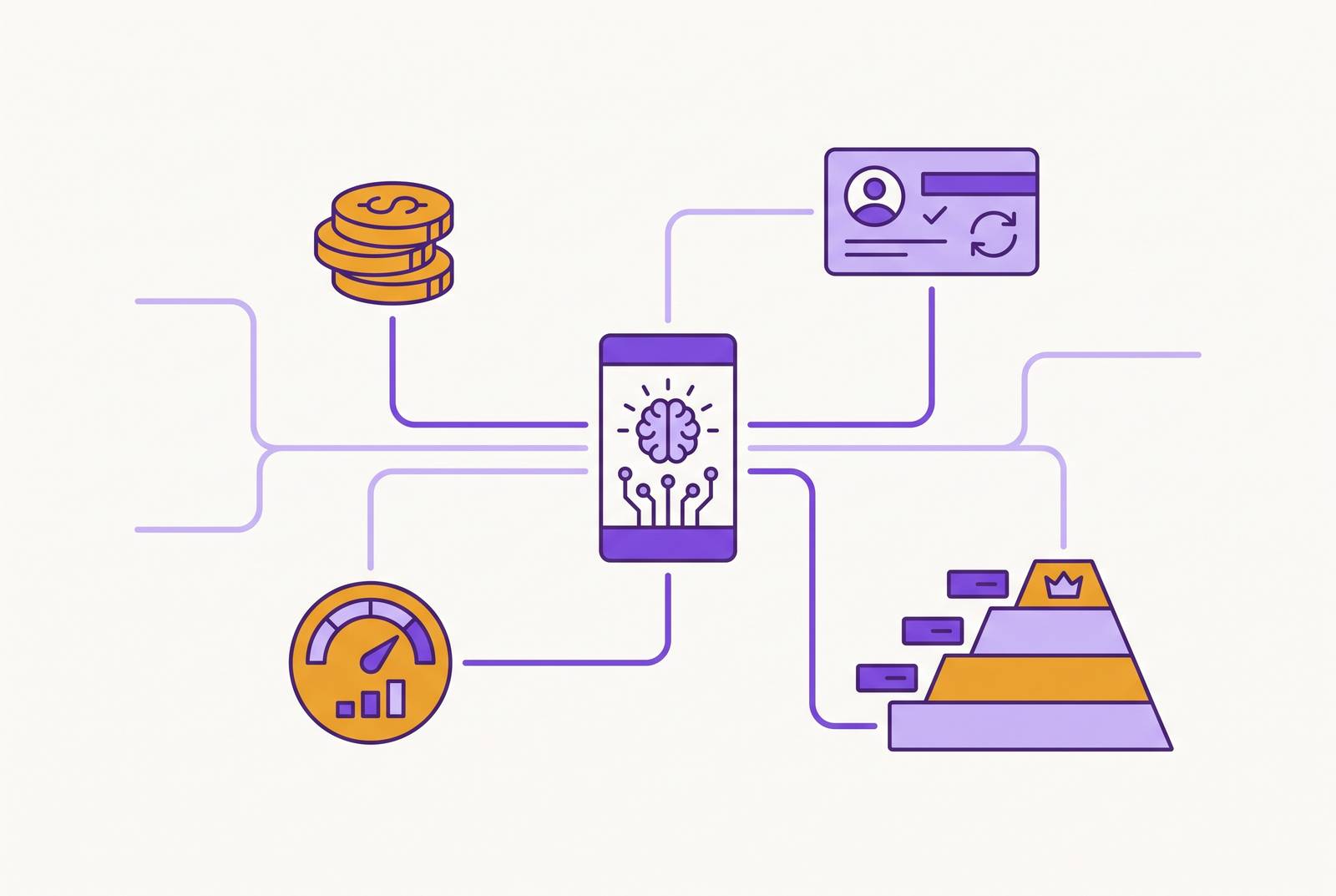
AI app developers have five core monetization models, namely native in-chat advertising, subscriptions, usage-based billing, affiliate integration, and hybrids. Sustainable revenue comes from combining them around user intent and inference cost. For publishers running conversational ads, publisher-side ad platforms and exchanges such as Thrad are built to handle contextual matching and auctions without relying on legacy display networks.
Why AI app revenue is harder to sustain than it looks
Inference costs rise with every user interaction, so engagement does not automatically improve an AI app’s margins. A user who returns more often creates more opportunities to earn revenue but also consumes more compute. If revenue stays flat while consumption grows, the product’s success can weaken its economics. That makes the relationship between price and use more consequential than it is in software without this per-interaction cost.
AI-powered apps also earn more from each paying user but have faster paying-user churn. High spending at first can therefore hide how weak revenue may be in the second year. Developers are responding by shortening trials, reducing free-tier generosity, and adding higher-priced tiers to cover inference costs. Choosing a monetization model is a structural bet on whether the unit economics survive at scale.
The five models and what each one is actually charging for
The five models charge for different things, including attention, access, consumption, referrals, and combinations of those sources. Native in-chat advertising earns on a CPM basis through relevant recommendations, cards, or suggestions inside AI conversations. Revenue accrues per impression, regardless of whether the user clicks or buys. The advertiser pays for attention, while the user receives access without a direct charge.
Subscriptions and premium tiers instead charge a recurring monthly fee for access. That access can include faster models, higher token limits, or features unavailable on the free tier. Usage-based billing charges per API call, token, or completed task, and each call costs more or less depending on how complex it is. Credit models package consumption as a balance that users purchase in advance. Both forms tie revenue to what the user consumes rather than solely to the passage of another billing month.
Affiliate integration earns a commission when a user completes a purchase through a link inserted when the AI mentions a product. Unlike advertising, it produces no revenue merely because the recommendation appeared. Hybrid stacking combines two or more models, typically advertising for free users and subscriptions for power users. It can also include credits for heavy consumption and affiliate links in purchase-oriented conversations.
How subscriptions and usage-based billing pull in opposite directions
Subscriptions let users know what they will spend, but developers must cover costs that vary with use. A flat monthly payment produces the same revenue from a subscriber who barely uses the app as from one who uses it heavily. The developer absorbs the latter’s higher inference costs, while the former may cancel once the novelty fades.
Usage-based billing reverses that pressure by allowing revenue to rise with consumption. However, variable bills can create budget anxiety for users who would pay more for guaranteed, predictable access. Those users may prefer a competitor’s flat price or seek an enterprise agreement that limits uncertainty. Intercom’s Fin shows the broader shift toward charging for outcomes as well as access.
For consumer developers, the practical answer is to serve these different preferences through different tiers. A subscription captures users who value simplicity and predictable access. Usage-based tiers or credit packs capture consumption that would otherwise erode the subscription’s margin. The distinction is not between ordinary and valuable users, but between relationships with the product that generate different costs. A tier structure can accommodate those relationships without forcing one price mechanism to cover all of them.
What native in-chat advertising requires to work — and where it breaks down
Native in-chat advertising depends on matching an ad to a conversational moment. Its targeting control is a context hint, a freeform natural-language description of the conversations where an ad belongs. Written at the ad group level and capped at 280 characters, that hint is matched against the live conversation. It is not a keyword, demographic, or page category. The relevant signal is the conversation state, including intent stage, query specificity, and conversation depth.
Placement uses a relevance-weighted, second-price auction, so a precisely targeted ad can beat a higher-bidding but vaguer one. Full transformer inference on every turn would introduce unacceptable latency, so production systems use multiple stages. Lightweight models filter thousands of candidates down to dozens before more sophisticated analysis narrows the field further. The auction then runs among the most relevant finalists.
OpenAI uses a tinted-box format that keeps sponsored content visibly separate from the AI’s answer. Labeled sponsored cards adjacent to the response preserve a boundary that ads woven into the answer text can blur. Even clearly labeled ads break down economically when they appear in purely informational conversations with no purchase proximity. Publishers still earn impressions, but weak advertiser returns depress CPMs over time.
Generalist DSPs have reach but cannot understand conversations as this model requires, while single-surface networks can read context but lack cross-surface scale. Thrad combines a conversational DSP with its own publisher-side ad platform, exchange, and direct publisher supply to connect AI publishers with brand advertisers. Its marketplace handles real-time contextual matching and runs auctions across AI surfaces.
How affiliate integration earns from conversational intent without charging users
Affiliate revenue depends more directly on purchase intent because the developer gets paid only after conversion. The AI mentions a product, an affiliate link is inserted, and the developer earns a commission if the user buys. There is no impression payment to cushion a poorly matched recommendation. The user does not pay the app for the referral, but the developer still needs the conversation to justify it. That makes contextual judgment the model’s central constraint.
A request for running shoes for marathon training in hot weather reveals more than a product category. It supplies a use case, a performance requirement, and a willingness to consider options. A relevant affiliate link can therefore serve the request. By contrast, a link inserted into an informational or problem-solving exchange with no purchase intent becomes noise. A poor match harms trust and earns no revenue from the start, before advertisers have time to change their bids.
A user may ask follow-up questions, leave the conversation, and purchase later. Standard last-click attribution undercounts affiliate-assisted conversions when the chat helped shape a purchase but did not receive the final click. Measurement methods for conversational affiliate channels are still being worked out. A commission record therefore does not capture every contribution the conversation made to a transaction.
Why hybrid stacking outperforms any single model — and how to structure it
The structural case for hybrids is that each layer earns from a segment the others cannot fully serve. Advertising earns money from free users who may never subscribe. Subscriptions serve users who want ad-free access, more features, and spending they can plan for. Usage-based tiers or credits cover heavy consumption beyond what a subscription can economically include. Hybrid stacking is not merely a hedge against one model failing, but a way to match revenue to distinct patterns of use.
Inference cost makes that matching necessary. A free user can create ad impressions yet cost more in compute than those impressions earn. Advertising alone does not resolve that deficit simply because the user is engaged. Getting heavy users to move to paid access helps cover the cost as they consume more. Affiliate integration can then operate on either free or paid tiers where purchase intent is present, without adding a direct user charge.
RevenueCat’s 2026 report documents less generous free tiers, shorter trials, pushes toward annual plans, and higher-priced tiers for AI features. These changes show developers adjusting access and pricing to the costs underneath their products. Free access can show users the app’s value, subscriptions can cover ongoing use, and credits can pay for heavier use. The free-tier ceiling should sit where a power user’s inference cost starts to rise above the CPM revenue that user brings in.
Where the revenue logic depends on getting conversational context right
The common input across these models is how accurately the app understands what the user is trying to accomplish. A conversation reveals an intent stage, a level of specificity, and a problem narrative. Those signals can bring awareness and consideration into the same interaction in ways that keywords cannot replicate. Their value depends on whether the app interprets them precisely. More conversational data is not, by itself, the same as better contextual understanding.
That precision affects both the revenue earned and the cost of earning it. Relevant commercial messages support advertiser returns and referral conversions, while useful answers give subscribers a reason to stay after novelty fades. When the app understands tasks correctly, it can also complete them with fewer tokens and lower the inference cost of each successful interaction, improving the economics of delivering the outcome.
How to sequence a monetization strategy as the app grows
Before an app has an established user base, usage-based billing or credits provide the most defensible starting point. They earn from what users consume without needing a large advertiser marketplace or a base of users who have already subscribed. Advertising is risky at this stage because CPM yield needs volume, while subscriptions need demonstrated value. Introducing either too early can add friction before the app has established a reason for users to return.
Once engagement patterns are visible, a subscription layer can serve users who want predictable access. The emerging cost data also shows where heavy consumption needs a separate allowance or credit structure. Where ads already support free use, the threshold is the point at which a power user’s inference costs exceed ad revenue per user. Affiliate integration can enter at any stage, provided the app identifies purchase-intent moments precisely. Its timing depends more on that capability than on audience size alone.
At scale, a substantial free audience makes native in-chat advertising more viable, but volume is only one requirement. Contextual quality and demonstrated conversion performance also sustain advertiser demand and CPMs. Direct supply relationships matter because the value being sold is a specific conversational opportunity. For publishers considering infrastructure such as Thrad’s publisher-side ad platform and exchange, the test is whether it can parse prompt context, match demand in real time, and surface relevant brand messages without disrupting the conversation.