Infrastructure Requirements for Scaling AI App Ad Revenue
Conversational AI requires ads built for real-time context, not static keywords or page URLs.

Scaling ad revenue inside AI apps requires purpose-built monetization infrastructure for conversational context, low-latency auctions, separate ad delivery, and session-level measurement. Legacy ad networks need to be rebuilt from the ground up to do those things. Independent AI app publishers need a conversational supply layer, while advertisers need demand and measurement tools that work across AI surfaces.
Why LLM interfaces break the assumptions legacy ad infrastructure was built on
A webpage gives traditional advertising a relatively stable object to evaluate. Its content can be crawled, its keywords matched, and an impression sold before the user sees anything. In a conversational LLM interface, however, the user and model create the content together in real time. There is no pre-existing page to crawl or URL to score that can adequately represent the exchange.
The targeting unit therefore becomes the conversation state. What the user asked three turns ago, how the model answered, and where the dialogue appears to be heading all shape whether an offer is useful. A keyword alone cannot express that relationship. The same short question can mean different things depending on what preceded it, while a follow-up can narrow or change the user's objective. Ads must work within that changing session, rather than treat each response as a new piece of static inventory.
This changes both the basis and the format of monetization. A placement may look like an ordinary ad, but how well it fits depends on the exchange. Its timing must also respect an exchange already in progress. Systems organized around isolated impressions consequently need more than a new place to display them.
How real-time conversational intent parsing works and why it cannot be bolted onto a legacy targeting layer
A user asking “What about vegetarian options?” supplies little useful targeting information without the earlier discussion about restaurants. The parser must preserve discourse coherence across turns. Transformer-based models that hold a full dialogue representation can understand that link, but a keyword extractor cannot find it in the latest phrase alone. The architectural requirement is proximity to the model's contextual representations.
The targeting primitive is a context hint. This is a natural-language description of the conversations where an ad belongs. In this approach, a relevance-weighted second-price auction matches a 280-character freeform description to the live conversation. Teams that turn that description into comma-separated topics get poor matching because they describe a subject without explaining the user's task. A useful hint identifies what the person is trying to accomplish and when the offer would help.
That approach also changes the privacy architecture. Relevance comes from the current conversation rather than a persistent user profile, so each conversation can serve as a discrete targeting context without cross-site tracking. This aligns targeting with tightening privacy regulation. It also reinforces why parsing belongs close to the model, where the relevant state already exists. A downstream keyword layer reading the generated response cannot reconstruct the full dialogue representation that produced it.
The latency constraint that makes auction mechanics in AI apps categorically different from RTB
Standard real-time bidding takes place in the few hundred milliseconds while a page loads and the browser renders its content. Conversational interfaces offer no equivalent grace period. The model's response and the ad placement are perceived together, so auction delays can become delays in the assistant itself. That makes latency a product constraint with a direct commercial consequence. If monetization makes the assistant feel slow, publishers have a reason to disable it.
Running full transformer inference on every turn to score ad relevance would introduce perceptible lag. But skipping the check of context would lose the signal that makes the inventory worth buying. The bidding pipeline must resolve both demands together. It needs to evaluate conversational context, ad copy, and landing page relevance within a budget tight enough to remain invisible to the user. Adding an API endpoint to a legacy demand-side stack does not, by itself, meet that requirement.
Relevance-weighting also changes what it means to compete. The auction is not concerned only with how much an advertiser offers, because fit with the conversation influences the outcome. Landing pages must therefore be checked before the click, as well as serve as destinations afterward. For advertisers, a generic page can weaken the connection between the user's task and the offer. For publishers, a good auction must check that link without slowing the exchange that made the ad possible.
How the placement design — tinted boxes, answer independence, and session-level targeting — shapes what the infrastructure must enforce
OpenAI's Answer Independence principle states that ads do not influence the answers ChatGPT gives. Tinted boxes that stand out from the answer show users that boundary. The serving architecture must preserve it as well. A system that appends a labeled unit after the response is complete differs fundamentally from one that can inject commercial content into the model's response stream. Visible separation is therefore a product decision with an engineering obligation behind it.
ChatGPT ads reach only logged-in adult users on Free and Go tiers, while Plus, Pro, Business, Enterprise, and Education tiers are ad-free. The serving layer must apply those distinctions per session across a user base exceeding a billion monthly users. Policy alone cannot make that distinction at delivery time. Audience tier filtering has to operate where the placement decision is made.
Placement separation, session-level context awareness, audience eligibility, and conversational brand safety must consequently be enforced together. These are not independent administrative checks that can wait until after delivery. A placement has to fit both the conversation and the rules governing who can receive it, without affecting the answer. Good product boundaries thus determine both what the infrastructure is permitted to do and what an advertiser is permitted to submit.
How AI app publishers monetize traffic when standard ad networks do not fit
TollBit's Q1 2025 State of the Bots report found scrape-to-referral ratios in the hundreds for OpenAI and Perplexity, and far higher for Anthropic. Unreliable audience referrals from content consumption create a supply-side infrastructure problem distinct from buying ads inside a large AI platform. Publishers need ways to connect the value of their content to commercial events occurring in or around AI answers. A conventional referral-and-impression model leaves much of that activity outside its accounting.
ProRata shares ad revenue from AI-powered answers that cite publisher content, with participants including The Atlantic, TIME, Fortune, ADWEEK, BuzzFeed, and Lee Enterprises. Its revenue comes from ads served alongside AI answers on the publisher's own site. For that model to work, attribution must link AI citations to publisher ad impressions. It is not simply another destination for existing display inventory.
Native ad monetization is possible, with eCPM trending higher on LLM-backed bots than on rule-based bots because the conversations provide better targeting context. Capturing that premium requires a serving layer that reads the exchange. Whether the relevant event is a citation, a turn, or an agent interaction, the common requirement is to attribute value to conversational activity. Retrofitting impression-based programmatic pipes leaves that activity poorly represented even when an ad can technically be displayed.
Why measurement and attribution are the hardest infrastructure layer to get right in conversational AI
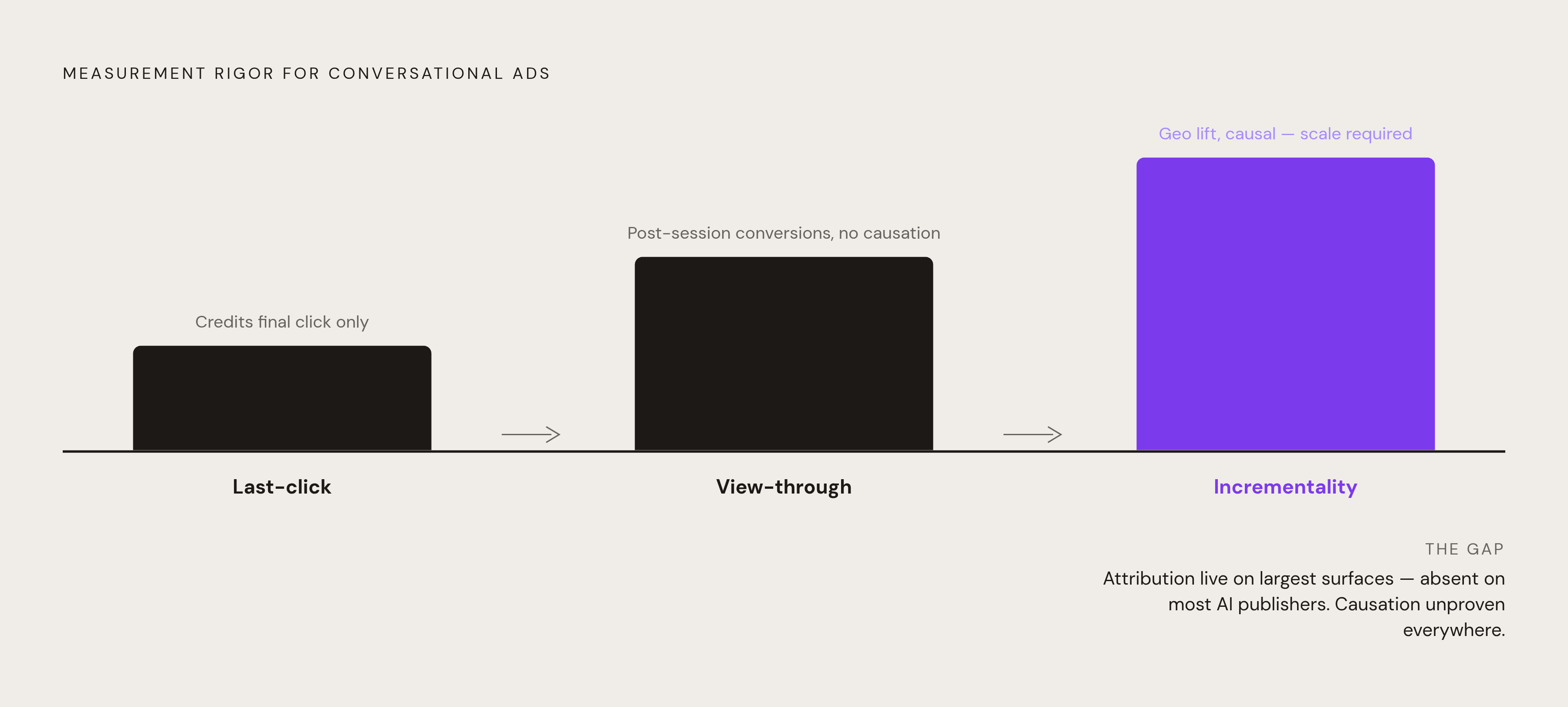
The conversation gap begins when a user defers an ad click while continuing to ask questions. That user may leave the chat and convert later, beyond the interaction that shaped the decision. Last-click models systematically undercount this channel's contribution. They can instead credit the search or other final touch that completed a journey begun in conversation. The unresolved task is to connect conversational influence to outcomes without mistaking correlation for causation.
OpenAI's October 5, 2026 measurement expansion added Pixel and Conversions API, an Event Quality Score, and a one-day view-through window. OpenAI also named attribution partners including AppsFlyer, Triple Whale, Adjust, DV Rockerbox, Northbeam, Branch, Singular, Kochava, Airbridge, and Tenjin. The view-through window attempts to recognize conversions after a session ends within a short period. It does not establish that the ad caused them.
Incrementality testing addresses that separate causal question through control groups and measured lift. OpenAI's work with Haus, Measured, and WorkMagic explores geo-based experiments for that purpose. Such experiments require scale and clean design. Most advertisers have not yet built those foundations, even as conversations offer rich modeling inputs through feelings, motivations, and unbranded category exploration. To use those signals, they need turn-level event capture alongside their click and impression records.
Attribution is solvable, but not solved at scale. Early infrastructure exists on the largest surfaces and is absent on most independent AI app publishers. A one-day window and more integration partners improve what can be observed without closing every session-spanning gap. The channel therefore needs measurement built around session events and incrementality, with confidence matched to what the evidence can actually support.
What a purpose-built AI ad infrastructure stack actually covers, and where the cross-surface problem sits
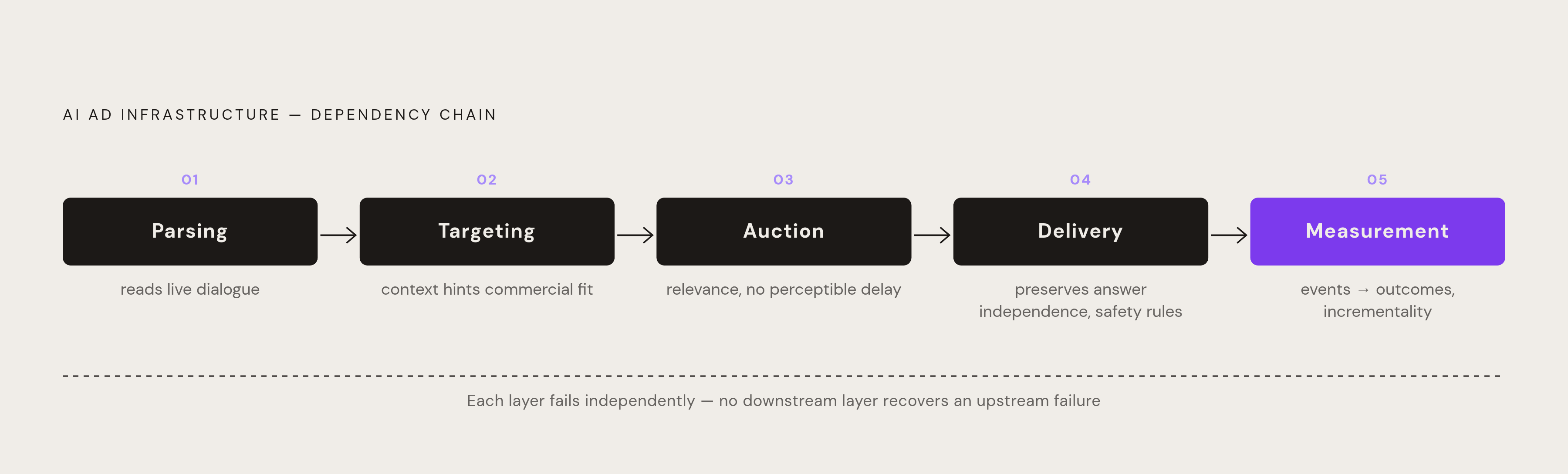
A complete stack starts with parsing that understands the live dialogue and targeting that describes useful commercial contexts. Its auction must assess relevance without perceptible delay, while delivery preserves answer independence and enforces audience and safety rules. Measurement then connects conversational events to outcomes and supports incrementality testing. Each layer depends on the preceding decisions. Capturing events correctly cannot make up for targeting that misses the mark, just as an auction that finds a good match cannot justify a placement that changes the answer.
ChatGPT Ads Manager opened self-serve access on May 5, 2026 with the removal of spend minimums, and now drafts creative from a website, suggests copy and imagery, runs campaigns from a plugin, and connects to Shopify and HubSpot. Those capabilities serve ChatGPT inventory only. Microsoft Advertising's official documentation describes automatic Copilot placements from existing campaign assets, with all eligible campaign types opted in. That route also serves only its own surface.
Advertisers need a brand voice and product truth that stay the same across interfaces, creative angles they have tested, landing pages that fit conversational contexts, and measurement that counts each conversion once. An ad-buying platform built for AI environments can organize that cross-surface program. Independent publishers also need tools on the supply side, including a conversational ad-selling platform and an exchange layer that connects their inventory to buyers who want those signals. The relevant buying criteria are contextual access, auction latency, placement enforcement, and measurement coverage.
What publishers and advertisers need to build or buy now, before the infrastructure gap widens
eMarketer projects US AI search ad spend rising from just over a billion dollars in 2025 to tens of billions by 2029. Along with early access to inventory, teams gain an advantage now from what they learn over time. Teams building repeatable systems can test targeting, creative, and measurement while competition is thin. Those results become more useful as teams use the same process for more campaigns and surfaces.
For advertisers, the first step is an audit of existing delivery. Google and Microsoft are already serving ads inside AI answers from campaigns advertisers run, with no opt-in required. Teams need to establish what is live and whether its creative, landing pages, and measurement fit conversation. Explicit conversational campaigns then require context hint writing as a distinct skill. Their landing pages should continue the buyer's task, while creative should fit the problem-solving mindset of someone reading an answer.
For publishers and AI app builders, the decision is whether to build, join a program, or connect to a purpose-built supply layer. That choice should follow the conversational events the business needs to monetize and the enforcement work its interface requires. Measurement cannot be deferred until revenue grows. Session-level event capture, incrementality test design, and multi-touch attribution frameworks create a record that later analysis can use, even while attribution remains imperfect. Teams that wait cannot reconstruct conversational history that was never captured.
Early infrastructure decisions will define how this channel operates, just as search ad infrastructure shaped paid search for two decades. The durable advantage comes from systems that learn from conversations without disrupting them. That requires treating conversational AI advertising as its own channel, with its own targeting logic, auction mechanics, and standards of evidence.